Are you an Indian citizen looking to visit Thailand? Whether you’re planning to explore the Land of Smiles to work, go on a holiday, or get medical treatment, first you need to learn about the visas available for Indian citizens.
Know all the visa options for Indian citizens, including visa requirements, application processes, and more in this guide.
Join ExpatDen Premium and discover the tips and tricks that long-term expats have used to qualify for a variety of Thai visas. With your membership, you get immediate and unlimited access to our library containing hundreds of exclusive guides that will help you move to and live in Thailand. You’ll discover how to:
- apply for a Thai visa on your own
- effectively prepare your visa documents so you don’t raise any eyebrows at the immigration office
- secure one of the secret education visas
…and so much more!
"*" indicates required fields
Disclaimer: This article may include links to products or services offered by ExpatDen's partners, which give us commissions when you click on them. Although this may influence how they appear in the text, we only recommend solutions that we would use in your situation. Read more in our Advertising Disclosure.
Contents
- What You Need To Know Before Applying For a Thai Visa
- Where to Apply for Thailand Visas
- Required Documents
- Fees
- Visa Options
- Special Visa
- FAQs
- Can I get an extension on my visa exemption or tourist visa?
- Can I extend my tourist visa within Thailand?
- Can I apply for a back-to-back Tourist Visa?
- Can an immigration officer at the airport deny my entry even when I’m holding a legitimate visa or on a visa exemption?
- How Long Does it Take to Process a Visa?
- What is the 90-Day Reporting For?
- What would happen if my visa gets cancelled?
- What happens if I overstay?
- Useful Sources of Thai Visa Info
- Reddit Thailand
- Address of the Royal Thai Embassy and the Royal Thai Consulate in India
- Now, on to You
Most expats throw money away, get lost in red tape, and miss the local hacks that make life easier and cheaper. ExpatDen Premium gives you the secrets seasoned expats use to save, earn, and thrive beyond the basics, saving you thousands and opening doors you didn’t even know existed.
Here’s what’s inside:
- Housing Hacks: Slash your rent by 40% or more - because the locals are laughing at what you’re paying.
- Banking Mastery: Stop wasting on fees and get top exchange rates. Why give your money away?
- Healthcare for Local Prices: Quality treatment without the expat price tag.
- Visa and Legal Shortcuts: No more bureaucratic nightmares. Get the visa and residency secrets that others pay their lawyer dearly for.
- Deep Discounts: Find the savings locals rely on for groceries, dining, and more.
If you’re serious about making Thailand work for you, join ExpatDen Premium and make Thailand work for you.
What You Need To Know Before Applying For a Thai Visa
Thailand has now granted Indian citizens a visa-free policy. If you’re an Indian citizen and your purpose is tourism in Thailand, you can stay without getting a visa beforehand.
You can stay up to 60 days, and you can extend your stay for an additional 30 days at a local immigration office within Thailand.
If your purpose of travel to Thailand isn’t tourism, then you’ll have to apply for a visa. There are various types of Thai visas for different purposes, such as studying, working, doing business, getting medical treatment, retiring, and so on.
You can’t get just any visa. You need to get a visa based on your purpose of visit.
For example, you can’t work in Thailand while holding a tourist visa because that’s illegal.
In addition, each type of visa has specific requirements. For example, if you’re employed by a company in Thailand, you need to have a business visa.
So before applying for any visa, it’s important to understand the requirements for the visa that you’re applying for. Otherwise, your visa application will likely be rejected.
You should know when and where you can apply for the visa when the 60-day visa-free policy doesn’t apply.
Where to Apply for Thailand Visas
You can apply for a Thai visa from either outside or inside Thailand.
Here we name specific places where you can apply for each type of Thai visa.
Outside of Thailand
When applying for a Thai visa from India, instead of going to the Royal Thai Embassy, you should go to a Thailand Visa Application center such as VFS Global or Visa Facilitation Services Global.
With operations around the world, VFS Global works with governments, including the Thai government, to facilitate and handle the administrative tasks involved in visa application and other visa-related processes and activities.
When applying for a Thai visa from India, you can do it online through the Thai e-visa service.
If you are applying outside of India, it’s also possible to apply at any Royal Thai Embassy or Consulate in any country, depending on the type of visa applied for.
Online
Since January 2025, the Thai embassy in India has stated that all visa applications are handled through the e-visa service, which processes them online.
In other words, there is no need to go to a Thai Embassy or Consulate to apply for a visa in person.

The process is straightforward:
- First, visit the e-visa service website.
- Create an account and fill out an application form.
- Upload any required documents for your visa type.
- Pay the visa fee, which varies by visa type. Single-entry non-immigrant visas cost ₹ 5,000, for example.
- Wait for a few days to get a confirmation through email.
Alternatively, you can also use VFS Global to handle the process for you.
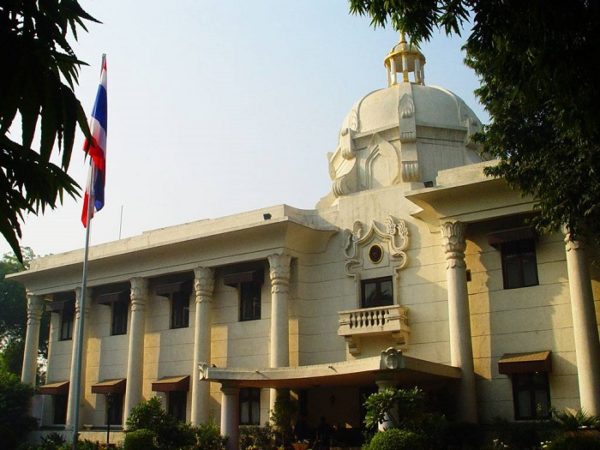
There are Royal Thai Embassies/Consulates in four metro cities in India, including:
- New Delhi – New Delhi, Gurgaon, Chandigarh, and Jaipur
- Chennai – Chennai, Hyderabad, Bangalore, and Cochin
- Mumbai – Mumbai, Pune, Ahmedabad, and Goa
- Kolkata – Kolkata
Inside Thailand
You can apply for certain types of visa, including a marriage visa and a business visa, within Thailand at any of the Immigration Offices all over Thailand.
Please note that applying for a visa within Thailand is usually more complicated compared to doing it outside. This is why many people, especially employers of foreigners, recommend doing it before flying to Thailand.
Required Documents
Here’s a list of the required documents when applying for a Thai visa:
- Passport with at least 6 months validity and two blank pages on both side
- Visa application form
- Confirmed flight ticket to Thailand (round trip)
- Proof of funds; the required amount varies among each type of visa
- Two 2-inch photos with white background, taken within the last 6 months
You may need to provide supporting documents, as may be required by the visa type.
For example, if you are applying for an education visa, you need to provide a confirmation letter issued by an educational institution in Thailand.
If you are applying for a business visa, then you need to present an employment contract from your employer.
Please note that the required documents for Thailand visas are always subject to change.
To get the precise list of all the documents you need, it’s best to contact the immigration center in Thailand, a Thailand visa application center, or the Royal Thai Embassy or Consulate.
Fees
Thai visa fees vary according to the type of visa being applied for.
For example, if you apply for a tourist visa (that is not under the visa-exemption scheme), it could cost you around ₹ 5,000 for a multiple-entry tourist visa and ₹ 2,500 for a single-entry tourist visa. The rates provided here are current rates and may change.
So please check the Royal Thai Embassy websites to know the exact fees.
Visa Options
You have various options when applying for a Thailand visa.
Thai visas are generally categorized into three types: short-term visa, long-term visa, and special visa.
Let’s take a look at the most common Thai visas for Indian citizens.
Short-Term Visa
If you want to stay in Thailand short-term, there are only two options available: the visa exemption and the tourist visa.
Visa exemption
As the name implies, under the visa-exemption scheme, you can enter Thailand without having to apply for a visa beforehand. You can stay up to 60 days under the current policy.
The process is straightforward. Your passport should be valid for at least six months, and you should have proof of a return ticket. An immigration officer will place a visa exemption stamp on your passport when you arrive.
You can pay 1,900 baht to extend your stay for another 30 days before it expires, giving you 90 days in total.
Tourist Visa
If you want to travel in Thailand and don’t want to use the visa-free scheme for whatever reason, then you need to get a tourist visa.
There are two types of tourist visa: single-entry tourist visa and multiple-entry tourist visa.
A single-entry tourist visa gives you 60 days in Thailand and is valid for three months.
It means that after your visa is issued, you should enter Thailand within three months. When you are in Thailand, you can stay for up to 60 days. The visa will be cancelled immediately after you leave the country.
A multiple-entry tourist visa is valid for six months. Within these six months, you can leave Thailand as many times as you want. Each entry gives you 60 days in Thailand.
You need to apply for a tourist visa from India.
You may need to provide a bank statement indicating a certain minimum amount as may be required by the Thai government at the time of application as well as proof of employment, such as a payslip, a letter of employment, or a business license.
Medical Treatment
If you want to get a long-term medical treatment in Thailand, you should apply for a non-immigrant visa category O for medical treatment.
It is a single-entry visa that gives you a 90-day stay in Thailand and is valid for three months.
One of the main documents required for this type of visa is a letter of certification from a hospital in Thailand confirming the admission of the patient for treatment.
You may also need to get a medical prescription or medical history from your doctor in India.
This type of visa is normally obtained in India.
Under certain special circumstances, you can change your current visa to a medical treatment visa in Thailand as deemed necessary by the Thailand hospital and upon the approval of the immigration office in Thailand.
Long-term Visa
Long-term visas are called non-immigrant visas and give you 90 days in Thailand.
After that, they can be extended for 1-3 years within Thailand depending on the type of visa and the discretion of the Thai immigration office.
Non-immigrant visas can also be renewed within Thailand. With it, you can easily open a bank account and/or get a Thai driving license.
A 90-day reporting process is required for all non-immigrant visa holders in Thailand.
There are several types of non-immigrant Thai visas. The popular types of such visas are used for business, education, retirement, getting married, and accompanying a family member.
There is also a special long-term visa known as the Privilege visa, which gives you 5-20 years in Thailand.

Non-Immigrant Visa B (Business and Work)
The non-immigrant visa B, also referred to as a business visa or working visa, is for those who want to work or run a business in Thailand.
This includes everyone who becomes employed by a company, teach in a school, becomes a sports coach, or open a company in Thailand.
Here are the requirements to apply for a non-immigrant visa B:
- Educational certificate
- Letter of employment issued by the employer in Thailand
- Employment contract
- Valid passport
- Curriculum vitae
You can apply for this visa both within and outside of Thailand. However, many employers recommend doing it from abroad because it’s much easier.
The non-immigrant visa B initially gives you a 90-day stay in Thailand. To extend this visa, you need to get a work permit issued by the Thai Ministry of Labour.

If you can’t extend the visa before it expires, you can still extend it for another seven days at the immigration office in Thailand.
To find out more about this visa, please read our complete guide to business and work visas in Thailand.
Non-immigrant Visa F (Official Visit)
Non-immigrant visa F, also known as the official visit visa, is a special agency visa issued to persons visiting Thailand for any official visit connected to any special agencies like the United Nations and other international organizations, or for any other diplomatic missions.
Non-Immigrant Visa M (Media)
The non-immigrant visa M, also known as the media visa, is issued to foreigners who are visiting Thailand to work as a journalist, a reporter, or even as a film producer.
But if you are working as a journalist, a news reporter, or a film producer for a Thai company, then you should apply for a non-immigrant visa B instead.
The non-immigrant visa M is also called a “journalist visa” as it applies to all people working in the media sector, including print, social media, TV, radio, online news service, etc.
To obtain this visa, you need to be working in a media company, including news agencies, newspapers, magazines, or TV networks that are not a Thailand-based company.
Non-Immigrant Visa ED (Education)
The non-immigrant visa category ED, also referred to as the education visa, is for foreigners looking to study in Thailand, whether in international schools, universities, language schools, or other institutes that are approved by Thailand’s Ministry of Education.
Indian students willing to participate in an internship program, education seminar, or research project can also apply for a non-immigrant visa ED.
The non-immigrant visa ED must be applied for from outside of Thailand. The duration of stay mainly depends on the study program.
You need the following documents to apply for this visa:
- Letter of Admission from the Thailand institute recognized by the Ministry of Education of Thailand
- Cover letter
- Educational qualifications and other pertinent records
For a more detailed look at what you can study in Thailand, and the visa requirements and processes, read our in-depth guide to Thai education visas.
Non-Immigrant Visa RS (Research)
The non-immigrant visa category RS is issued to people who enter Thailand to conduct clinical, scientific, and educational research.
People coming to work in a research facility in Thailand can also apply for this visa category. This visa is valid for three months and can be extended as required by the research institute in Thailand that authorized the visit.
Non-Immigrant Visa R (Religion)
All religious persons, including missionaries, priests, and ministers entering Thailand to carry out religious activities, can opt for the non-immigrant visa category R.
The religious work you are conducting needs to be approved and recognized by the Thai government or the relevant ministries.
Non-Immigrant Visa O (Other)
The non-immigrant visa category O can be further categorized into several types of visa, including:
- Non-immigrant visa O based on retirement (retirement visa)
- Non-immigrant visa O based on marriage (marriage visa)
- Non-immigrant visa O based on dependent (dependent visa)
- Non-immigrant visa O based on volunteer (volunteer visa)
You can apply for the non-immigrant visa O from India except for the marriage visa.
Non-Immigrant Visa O Based on Retirement
If you are looking to retire in Thailand, then this visa category is for you. The non-immigrant visa O based on retirement is also called a retirement visa, which comes with an initial duration of one year.
Here are the main requirements to apply for a retirement visa:
- Must be 50 years old and above
- No criminal records in India
- Proof of income and a specified minimum balance in your bank account a few months before applying or renewing your visa
- Health insurance
To find out more information, please read our short and simple guide to Thailand retirement visas.
Non-Immigrant Visa O Based on Marriage
The non-immigrant visa O based on marriage is for anyone who legally marries a Thai citizen. It can be applied for within Thailand, is valid for one year, and can be renewed afterwards.
Family photos and a marriage certificate are required to apply for this type of visa. If you are male, you need to provide proof of income as well.
People holding a marriage visa are permitted to work in Thailand.
Immigration officers might occasionally visit your house to make sure that you and your Thai citizen spouse are really married and live together.
 ?
? - A lesson structure to help you effectively learn Thai
- Thousands of Thai language lessons with lesson notes, podcasts, and quizzes
- Learn Thai on the go through their mobile application
- Personalized program to learn exactly on what you need
- Affordable price starting at only $8 a month
- 60-day moneyback guarantee

Check out our step-by-step guide on Thai marriage visas for more information.
Non-Immigrant Visa O Based or Dependent Visa
The non-immigrant visa O or “dependent visa” is issued to people who are accompanying a family member who’s either studying or working in Thailand.
For example, if your non-Thai spouse is working in Thailand, you can apply for a non-immigrant visa O or dependent visa to live in Thailand. Your duration of stay is going to be similar to your spouse.
Non-Immigrant Visa O or Volunteer Visa
The non-immigrant visa O or “volunteer visa” is for everyone working with a recognized NGO in Thailand.
The length of stay will mainly depend on the credibility of the NGO and the duration of the volunteer program, work description, and the decision of the immigration office.
If you are holding a volunteer visa, you should be acting in a volunteer capacity and certain workarounds may be involved if you are paid a salary by the NGO you are working with. In certain cases where an officially registered NGO in Thailand is paying your salary, you may consider getting a business visa instead.
Special Visa
There are a few types of special visas in Thailand that are even better than the long-term visas because they come with a long duration of stay and less documentation required.
However, the requirements are also much stricter. Let’s take a look.
Privilege Visa
Thailand Privilege Visa is a special privilege visa that gives you 5–20 years in Thailand. For this visa, you need to have a clean criminal record and pay the visa fee.

The visa comes with many perks, including visa assistance, airport services, and discounts to travel-related service providers.
It’s also easy to apply for the Privilege Visa. Because of this, it’s becoming a popular option among entrepreneurs, digital nomads, and retirees.
You can read more in our Thailand Privilege visa review article.
SMART Visa
SMART Visa is a type of visa introduced by Thailand’s Board of Investment in 2018. It aims to attract entrepreneurs, investors, and high-skill workers to come to Thailand by giving them a visa valid for up to four years.
The requirements for the SMART visa are also quite stringent.
If you are an investor, you need to invest 5 million THB or more in Thailand based on specific categories required by the Thailand Board of Investment at the time of application.
If you are a working professional, you need to be making a monthly salary of at least 100,000 THB and work in specific industries such as technology and science.
You can read our Thailand SMART Visa article to find out more information.
FAQs
Have questions about visas in Thailand? Here are a few popular questions people frequently ask about Thai visas:
Can I get an extension on my visa exemption or tourist visa?
Indian citizens can extend a visa once for a maximum of 30 days at any immigration office in Thailand.
Can I extend my tourist visa within Thailand?
No, you cannot ask for an extension other than the additional 30 days when applying for an extension within Thailand.
Once your visa expires, you need to return to India to re-apply for a tourist visa.
Can I apply for a back-to-back Tourist Visa?
Even though it is technically not violating any rules, applying for a tourist visa back-to-back can be complicated, and you stand a better chance of success when you apply from an embassy different from the one you’ve previously applied to. Some embassies may issue a tourist visa back-to-back, while some won’t.
Can an immigration officer at the airport deny my entry even when I’m holding a legitimate visa or on a visa exemption?
Yes. Even if you are holding a legit visa or on a visa exemption, the immigration office at the airport may still deny you entry.
However, this usually only happens to people who make frequent visits or an incorrect type of visa, such as a “back-to-back tourist visa”.
Other than that, you shouldn’t have any issues with immigration officers.
How Long Does it Take to Process a Visa?
Visas are generally processed within five business days. However, for some types of visa such as the Privilege visa, the process might take more than a month.
What is the 90-Day Reporting For?
Everyone who holds a non-immigrant visa is required to report their current residence to the immigration office every 90 days.
The passport holder needs to report to the immigration bureau 15 days before or 7 days after the 90-day period expires.
If you are sending an authorized representative, you need to have written approval from the authorities.
Failure to report your address every 90 days carries a fine of around 2,000 THB. You can send an email asking for an extension if you are applying 15 days prior to your scheduled 90-day reporting.
But if you are applying 7 days after the completion of 90 days, then it is mandatory to visit the immigration bureau in person.
What would happen if my visa gets cancelled?
If you are a foreigner working in Thailand, then change jobs, your current employer should cancel your work permit. In case you lose your job or get terminated from your job, then your work visa (non-immigrant visa B) and work permit will be cancelled.
Once your visa is cancelled, you will be given seven days to sort your things out to get ready to leave Thailand and go back to your home country. According to Thai Labor laws, whenever an employer cancels a work permit, they also need to cancel the work visa, as well.
The same principle applies to other non-immigrant visas. For example, if you just divorced your Thai spouse, your marriage visa will be cancelled.
What happens if I overstay?
Overstaying your visa period is illegal and comes with a lot of consequences, including paying a fine of 500 THB for every day of overstay.
Overstaying for a short period, e.g., one day, won’t likely cause major trouble, especially for reasons such as flight ticket availability. But if you are caught by the police with an overstayed visa, chances are that you will be asked to pay a fine, get arrested, and/or get banned from visiting Thailand again.

Recently, the Thai Police launched a crackdown on people overstaying in Thailand, with several people caught, arrested, and later on, deported to their home countries.
People caught overstaying can be banned for up to 10 years from visiting Thailand.
Useful Sources of Thai Visa Info
Note that the information you will find on Thailand visa-related websites might not be enough.
Thai visa regulations are subject to change all the time, and some of these websites may have outdated information.
Fortunately, there are various online communities that provide up-to-date information.
Facebook Groups
You can check out the Thailand ExpatDen community. Our community has many active members who share useful, updated information and may answer some of your visa-related questions.
There is also a group created especially to discuss Thailand visas called Thai Visa Advice.
In the Bangkok Expats group, some members often post visa-related topics with members actively discussing visa matters. It is a great forum to meet fellow foreigners with similar visa issues.
There’s also a group called the Thai-Indian Community in Thailand where members regularly post news and updates specifically for Indian expats.
Reddit Thailand
The Thailand thread on Reddit is a good place to get firsthand accounts of visa-related matters and encounters with Thai Immigration officers.
Aside from Thai visa info, the comments on the VISA-Mega Reddit Thread can illuminate a few points on the frequently asked Thai visa questions on non-immigrant visa B and getting a work permit with a non-immigrant visa O.
Address of the Royal Thai Embassy and the Royal Thai Consulate in India
The Thai embassy and consulate in India are the Royal Thai Embassy in New Delhi and the Royal Thai Consulate in Chennai, Mumbai, and Kolkata.
Their address and contact information are below:
New Delhi
Royal Thai Embassy
56-N Nyaya Marg,
Chanakyapuri,
New Delhi 110021
Phone: +91 11 2419 7200
Fax: +91 11 2419 7199
Email: [email protected]
Website: http://newdelhi.thaiembassy.org
Mumbai
The Royal Thai Consulate General
12th floor, Express Towers,
Barrister Rajni Patel Marg,
Nariman Point,
Mumbai 400 021
Phone: +91 2282 3535 /2282 2061/2282 1628
Fax: +91 22 2282 1525
Email: [email protected], [email protected]
Chennai
The Royal Thai Consulate General
No.116, Chamiers Road,
Nandanam,
Chennai 600 035
Phone: +91 44 4230 0730, +91 44 4230 0740
Email: [email protected], [email protected]
Kolkata
The Royal Thai Consulate General
Unit 20/2, 19th Floor, Acropolis Business Towers,
1858/1 Rajdanga, Main Road
Kolkata 700 107
Phone: +91 33 2440 7836
Email: [email protected], [email protected]
Now, on to You
We hope this detailed guide gives you a clear idea about all things related to Thailand visas for Indian citizens.
We have included several links in the article that will help you get answers to several questions along with information that will be useful for Indian citizens looking to travel to Thailand.






 Deutsch:
 ไทย:
ไทย: Français:
 Português:
 Português:
 Español:
 Español:
 中文 (中国):
 Русский:
 Nederlands:
 العربية:
 Italiano: