
This article will take approximately 12 minutes to read. Don't have the time right now? No worries. Email the ad-free version of the article to yourself and read it later!
Hans, a German expat in Thailand, shares his real-life experience getting custody of his Thai children as a single non-Thai parent. Learn about the process, documents, and costs involved in applying for custody and citizenship in Thailand.
Not long ago one of our readers, Hans, reached out to me to share his experience with getting custody of his Thai children.
Hans is a German national raising his Thai children as a single parent. His daughter was born in the United States, so he had her German citizenship done there. But when it came to getting his son citizenship, the process was entirely different because his son was born in Thailand.
To complete the process in Thailand, Hans needed to apply for custody as a single, non-Thai parent because his children’s Thai mother lived in the United States. By doing so, he received an official father legitimization certificate to apply for a Thai family visa and get German citizenship for his son.
This document is, of course, just one of many documents you need for both processes above, which are completely separate from each other.
In this guide, Hans shares his experience with getting custody of his Thai children. He talks about the process, documents, and costs involved. By the end of this guide, you’ll know exactly what to do if you need to get custody of your Thai children.
Contents
Key Takeaways
- Getting 50% joint custody as a non-Thai parent is achievable through the Thai family court, though the process is lengthy and document-heavy.
- The first step may be obtaining a police report from the Royal Thai Police in your district; requirements vary by province.
- Update your children’s Thai documents, including the house book and ID cards, before applying for custody at the district office.
- Hiring a Thai-speaking lawyer is optional but strongly recommended; it saves time and reduces frustration with court paperwork.
- The family court will interview your children rather than you; the court expects a witness to confirm your relationship with the children.
- After court approval, expect to wait about one month to receive all official documents, including the father legitimization certificate.
- Hans paid THB10,000 in lawyer fees; costs can vary depending on the lawyer and how much of the process you handle yourself.
- Having custodial rights may be required to get a Thai family visa or to apply for citizenship at your home country’s embassy.
Why Apply for Custody of Your Thai Children?
If you’re a single non-Thai parent raising your Thai children, you might need custodial rights for many reasons. For Hans, he had two.
- Apply for a Thai family visa
- Get his son citizenship at the German embassy in Bangkok
Not all countries outside of Thailand require you to have custodial rights to apply for citizenship for your Thai children, but Germany is one of them.
Keep in mind that as the non-Thai parent, Hans only got 50 percent joint custodial rights of his Thai children. In your case, if the Thai parent is deceased or has waived their parental rights, then you might be able to get sole custody.
The mother of Hans’ children lives in the United States, and she is still present in their lives, that is why he only got 50 percent joint custody.
With that covered, let’s take a closer look at the steps Hans took to apply for custody and get his father legitimization certificate.
Dive deeper: Thai Family Visa: Requirements, Documents, Costs, and More
How to Apply for Custody of Your Thai Children
Below is the step-by-step process that Hans took to get 50 percent joint custody of his Thai children.
Register Legitimation
This step is ONLY for those who were not married to the mother when your child was born.
Under Thai law, an unmarried father has no legal standing over his child simply by being listed on the birth certificate. You must either register legitimation at the local district office with the mother’s agreement, or obtain a court order if she withholds consent.
Without completing this step, you have no right to contest custody, consent to medical treatment, or apply for travel documents on the child’s behalf.
Request a Police Report in Thailand
The first step you might have to take is to get a police report in Thailand. I say might because all family courts in each province work differently. If you need one, go to the Royal Thai Police in your district and explain to them why you need the report. They will ask for your passport, run your record, then give you an official copy.
Update all Your Children’s Thai Documents
The next step is to update your Thai children’s documents, these include:
- the house book (blue book) they are registered under
- their Thai ID cards
Make sure your children’s names have been entered into the house book. Also check that their IDs have not expired.
This will involve multiple visits to various Thai government offices, including the local district office where your children are officially registered. Keep in mind that this may be different from the province or district where you currently live with your children.
Hire a Lawyer
This step is optional, but as Hans said, it saves a lot of time and headaches. He originally went to the family court with his children and Thai in-laws to get the information needed to apply for custody.
Once there, he ran into a lawyer and they started talking. Hans realized it would be much easier to hire her to help with the process. The price was also very reasonable (more on that later).
“I recommend to be patient and trust that the tireless staff at the courts and government offices want to help you and will, despite a wall of bureaucracy, wait times, and numerous required documents to be verified and re-certified.
“It may certainly help to have a trusted Thai-speaking friend or family member along with you and perhaps even, with your friend’s help, hire a local Thai lawyer who intimately knows the process and helps you understand the steps involved and ushering your application along to success.”
– ExpatDen reader, Hans
In Hans’ case, the mother of his children lives in the United States. She had to make multiple trips to the Thai consulate in California to get all her documents notarized before sending them to Thailand.
The lawyer helped Hans gather and fill in all the necessary documents for their court date.
Dive deeper: An In-Depth Guide to Hiring a Lawyer in Thailand

Go to Family Court
Once you’re done gathering together all your documents, you have to make an appointment with the family court in the province in which you live. Your lawyer will probably handle this step for you.
When you arrive at the court, you’ll see the judge(s) who will make a decision about your case. Hans stood in front of three judges to wait for his verdict as they interviewed both of his children. Funnily enough, the judges never asked Hans any questions.
“Going through the father legitimization process and the Thai court system, facing a seemingly endless weave of red tape, was lengthy and complex, and therefore often tiring and frustrating.
“But since the reward was not only obtaining the non-O Thai family visa, for which in my case because I’m a single non-Thai father of Thai children living with me in Thailand, my father legitimization was a requirement, but also achieving German citizenship for my Thai-born son, this process was an acceptable ordeal.”
– ExpatDen reader, Hans
His children and their witness had to swear under oath that Hans was indeed the father, as the court wouldn’t even accept a DNA test as proof.
When all was said and done, Hans was granted custodial rights for his children.
Good to know: In contested cases, the court refers the matter to the Observation and Protection Center (OPC), where a social worker interviews both parents and the child and submits a written recommendation to the judge. Thai courts follow OPC recommendations closely. Bringing documentation of your daily involvement — school pickup records, medical appointment logs, photos, bank transfers for child expenses — significantly strengthens your position at this stage. The OPC interview is not a formality; it is often where contested cases are effectively decided.
Wait for the Documents
After the judge(s) approve your request, the family court will send you multiple official documents. In Hans’ case, he received the following:
- Father legitimization certificate
- Certificate of finality letter
- Child registration at the family court letter
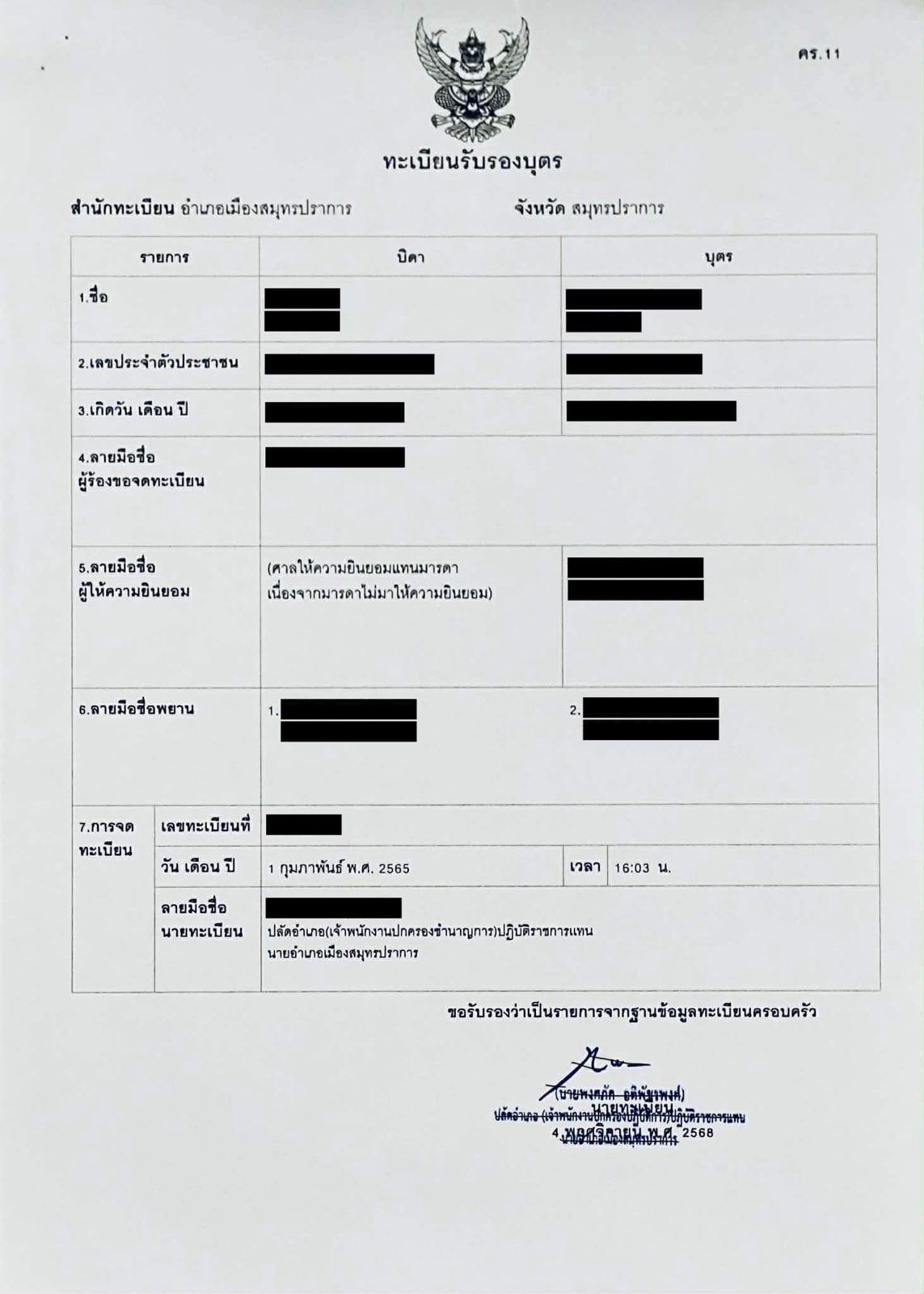
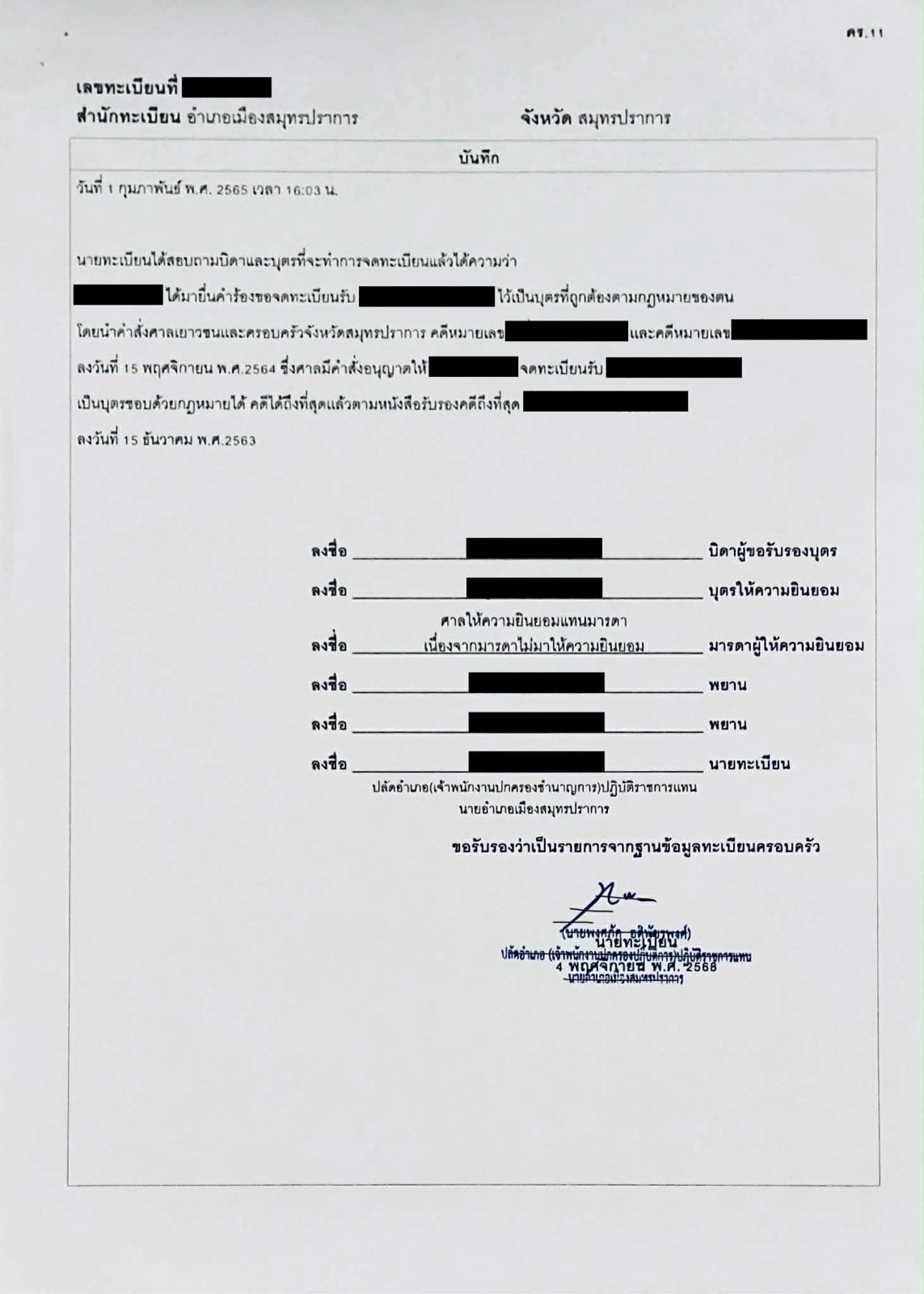
It took Hans about one month to receive these documents.
After achieving father legitimization, the Thai government will digitize your father legitimization certificate and then you can have it printed out at your local district office for a few baht.
That said, you should keep all the original letters that you get from the family court. You may need them when applying for your non-O Thai family visa.
Lessons Learned
Although Hans completed what he set out to do, which was get the father legitimization certificate, he did learn quite a few things that he’d like to pass on to future expats who have to go through the same process.
“If had to go through this process again, I would do an even better job assembling and preparing my documents ahead of the various appointments at the district office, family court, and immigration office so that I won’t be sent back to get or redo some document that turns out to be misinterpreted or missing.
“I would also digitize the entirety of my documents and turn them into convenient PDF files saved on my smartphone that I have access to at my fingertips at any time and that I can quickly print in case it’s needed.
“Make extra sure to coordinate appointments well with a trusted friend or family member so to always have the added benefit of having a Thai-speaking aide on your side.
“And curb your frustrations and always have friendly and respectful exchanges with the government staff you’re dealing with, which directly translates into a smoother and perhaps even faster process.”
– ExpatDen reader, Hans
Costs
Hans paid THB10,000 in lawyer fees to apply for custody of his Thai children. This cost will certainly be lower if you go through the process yourself. And it can also increase depending on the lawyer you hire. That figure reflects an uncontested case with a cooperative other parent.
If the other parent contests custody, costs rise significantly. A full contested court case typically runs THB50,000 to THB200,000 in legal fees, with a custody dispute potentially adding another THB50,000 to THB150,000 on top. Translation and legalization of foreign documents, court filing fees, and any DNA testing ordered by the court are generally on top of those figures.
Now, on to You
Applying for custodial rights for your Thai children can be tricky if you’ve never navigated the Thai legal system, especially when courts are involved.
This is something you want to get done the right way on the first shot.
In this case, it’s better to hire an affordable and ethical lawyer. Just fill out this form and one of our vetted lawyers will get back to you.
Disclaimer
Keep in mind that everyone, including Hans, has a different experience with getting custody of their Thai children in Thailand. This guide isn’t meant to replace legal advice, but rather provide some insight into what the process is actually like. For situations like these, we always recommend that you consult with a Thai lawyer.







 Deutsch:
 Français:
 ไทย:
ไทย: Español: