

This article will take approximately 15 minutes to read. Don't have the time right now? No worries. Email the ad-free version of the article to yourself and read it later!
Since November 2025, China replaced its paper arrival card with a digital one you fill out online before you fly. Here is who needs it, the four ways to file, the 72-hour window, how to avoid fake sites, and what happens at the border.
Since 20 November 2025, the paper arrival card you used to scribble on the plane to China is gone. In its place is the China Digital Arrival Card, an online form you fill in before you travel and carry as a QR code. It applies to almost every foreigner entering the country by air, land, or sea, whether you’re a tourist on visa-free entry, a business traveler, or a relocating expat.
The good news is that it takes about five minutes and it’s free. The catch is a strict timing window, a handful of exemptions worth knowing, and a growing crop of fake copycat sites trying to charge you for something the government gives away.
Disclaimer: This article may include links to products or services offered by ExpatDen's partners, which give us commissions when you click on them. Although this may influence how they appear in the text, we only recommend solutions that we would use in your situation. Read more in our Advertising Disclosure.

Key Takeaways
- Since 20 November 2025, China’s Digital Arrival Card replaced the paper form for foreigners entering by air, land, or sea.
- It’s free and takes about five minutes.
- File it only through official channels: the s.nia.gov.cn website, the “NIA 12367” app, or the WeChat and Alipay mini-programs. Anything charging you a fee is a copycat.
- Submit within 72 hours of arrival. You can’t file earlier than three days out.
- The form has five steps and starts by uploading a photo of your passport data page, which auto-fills your details.
- Screenshot the QR code it gives you so you can show it at immigration without an internet connection.
- A handful of travelers are exempt, including permanent residents and certain transit and group-visa passengers.
Who Needs to Submit China’s Digital Arrival Card
The default is simple: if you’re a foreign national entering China, you need to submit the arrival card. It replaced the old paper form for everyone crossing the border, and it covers entry by air, land, and sea.
A specific set of travelers is exempt. You don’t need to submit the arrival card if you fall into one of these categories:
- You have a valid Foreign Permanent Resident ID Card of the People’s Republic of China
- You have a valid Mainland Travel Permit for Hong Kong and Macao Residents (Non-Chinese)
- You are only transiting directly within 24 hours without leaving the restricted area of the port
- Foreign crew members, drivers, and other employees of transport vehicles
- You enter China by cruise ship and return with the original cruise
- You enter China through the E-channel
- You are a member of a foreign tourist group holding a group visa or entering under the group visa-free policy
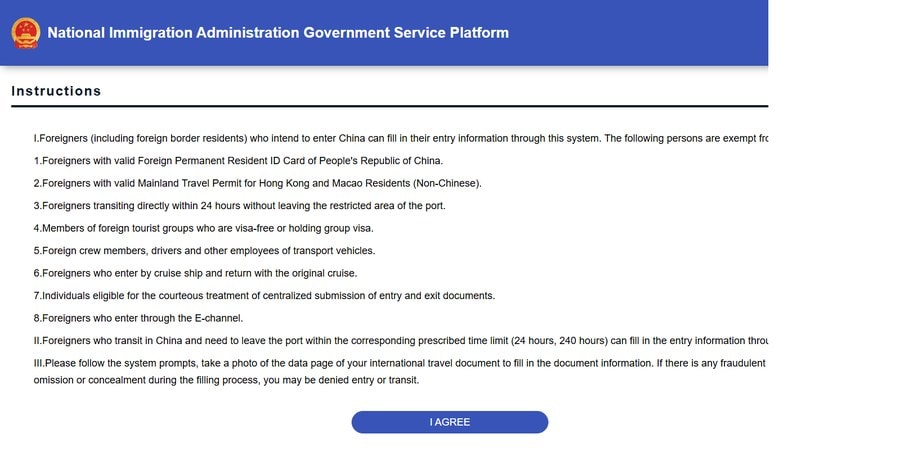
If you’re not on that list, assume you need to file it.
How to Fill Out the Digital Arrival Card
You fill out the arrival card through the National Immigration Administration (NIA), and only through its official channels. There are several ways in, and they all lead to the same form.
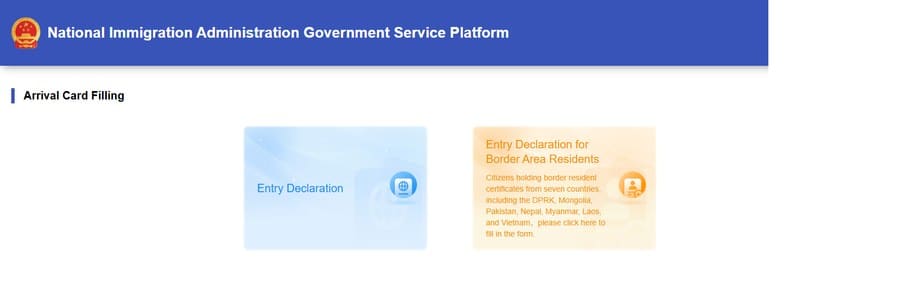
- The NIA website (s.nia.gov.cn): the desktop route. Open it, switch the language to English, and choose “Entry Declaration”. Easiest if you’re filling it out on a laptop before your trip.
- The “NIA 12367” app: the official NIA mobile app, with the arrival card as one of its services. Handy if you’d rather do everything on your phone.
- The WeChat mini-program: an official NIA mini-program inside WeChat. Convenient if you already have the app installed.
- The Alipay mini-program: the same official form inside Alipay.
I filled out my own card in December 2025, a few weeks after the system launched, using the s.nia.gov.cn website on a laptop. It’s genuinely easy and straightforward.
The Five Steps of the Form
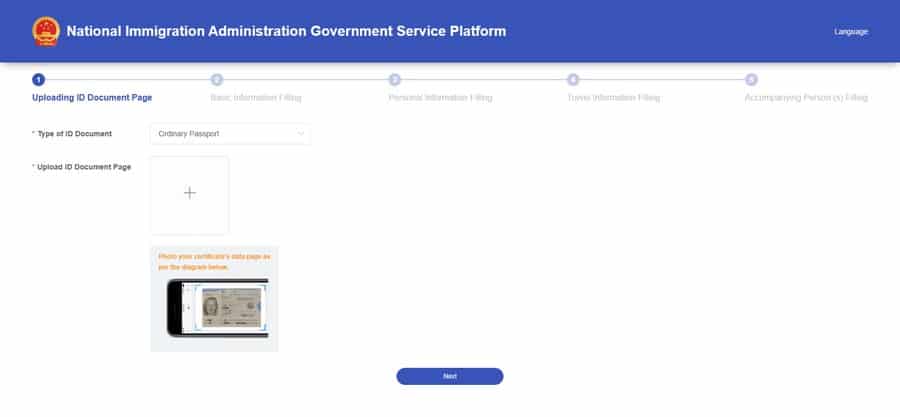
However you access it, the form runs through five steps shown along the top:
- ID document page: select your document type (ordinary passport for most people) and upload a photo of your passport data page. The system reads it automatically and fills in your basic details.
- Basic information: check the details pulled from your passport and correct anything the system misread.
- Personal information: gender, date of birth, nationality, country of birth, a contact phone number, an email address, and optionally your Chinese name.
- Travel information: transport mode, flight or train number, and your city and port of entry.
- Accompanying persons: add any family members traveling with you, so they don’t each have to file separately.
Have your flight details and your accommodation address in China ready before you start.
When to Submit
You must submit within 72 hours (three days) before you arrive in China. You can’t file it earlier than three days out, so there’s no getting it out of the way weeks ahead. Set a reminder for the day or two before your flight.
What the China Arrival Card Form Asks For
The China arrival card asks for your passport details, your travel plans and where you’ll stay. (Verified October 2026.) Have these ready before you start.
- Passport photo: upload a photo of the data page. The form takes JPG or PNG files, and its own rule says uploads can’t top 100 KB, so shrink a big phone photo first.
- Purpose of entry: pick from a list that includes sightseeing, visiting friends or relatives, business, work and study.
- Entry details: your arrival date, the city and port you’re entering through, and your flight, train or vessel number.
- Where you’re going: the Chinese cities you’ll visit, your address there and a phone number in China.
- Visa details: whether you hold a valid visa or other entry permit and, if so, the visa type and number.
- Recent travel: whether you’ve been to other countries or regions in the past two years, and whether your passport has ever been lost or stolen.
At the end you read a declaration and sign on screen. It says China’s immigration authority may store and use your information, and that what you entered is true and accurate.
At the Border: Your QR Code and Automated Gates
Once you submit, the system generates a unique QR code, and you can download it straight to your phone. That code is what immigration officers scan when you land, and it’s the whole point of doing this in advance: it replaces the paper form and speeds you through the checkpoint, including the automated e-gates where eligible.
When I arrived, presenting the downloaded QR code at the gate was quick and straightforward.
Tip: Download or screenshot your QR code as soon as you get it. You’ll often need to show it at immigration with no internet access, and a saved image on your phone means you’re not scrambling for signal in the arrivals hall.
After You Submit: Your Entry Declaration Receipt
The portal gives you an Entry Declaration Receipt as soon as you submit. (Verified October 2026.) You can save it to your device or email it to yourself.
- Download to Local: saves the receipt to your phone or laptop.
- Send to Email: sends a copy to your inbox.
Use both. If your phone dies or goes missing before the flight, the emailed copy is still there.
Avoid Fake Arrival Card Websites
The arrival card is completely free, and you only ever fill it out through the NIA’s official channels: the s.nia.gov.cn website, the “NIA 12367” app, or the WeChat and Alipay mini-programs. The NIA itself has warned travelers about fraudulent websites that imitate the official system.
These copycat sites show up in search results, look official, and charge a “service fee” for something the government provides for free, or worse, harvest your passport details. If a site asks you to pay to submit the arrival card, it’s not the real one. Go directly to the official NIA portal and ignore paid intermediaries.

Common Mistakes to Avoid
Because the form is new, most problems come from small, avoidable errors.
- Wrong passport or travel details: the information must match your passport and your booking exactly. The system warns that fraudulent omission or concealment can get you denied entry or transit, so treat accuracy seriously.
- Submitting too early: file outside the 72-hour window and the system won’t accept it. Wait until you’re inside three days of arrival.
- Arriving with no saved copy: if you can’t pull up your QR code offline, you lose the time you were trying to save. Screenshot it.
- Assuming you’re exempt when you’re not: unless you clearly fall into one of the exemption categories, file the card.
How It Fits With Visa-Free Entry and 240-Hour Transit
The arrival card is separate from your visa status. It doesn’t replace a visa, and it doesn’t grant you entry on its own; it’s simply the entry declaration everyone files. If you’re entering visa-free or using the 240-hour visa-free transit scheme, you still complete the arrival card the same way. For how the underlying visa and transit rules work, see our full guide to the Chinese visa system.
Transit Passengers and the China Arrival Card
You skip the China arrival card only for a direct transit of 24 hours or less that stays inside the port’s restricted area. (Verified October 2026.) If you leave the airport, you file it.
The form has a menu for this. After your passport details, it asks you to pick an entry category. Transit options such as 24-hour and 240-hour visa-free transit sit next to ordinary entry, so choose the one you’re using.
You also enter a departure date. On the 240-hour option, the date picker stops 10 days after your entry date.
| Your trip | Do you file the arrival card? |
|---|---|
| Direct transit of 24 hours or less, staying inside the port’s restricted area | No. You’re exempt. |
| Transit that takes you out of the port under the 24-hour policy | Yes. Choose the 24-hour option on the form. |
| Transit under the 240-hour visa-free policy | Yes. Choose the 240-hour option on the form. |
Tip: Exempt means you stay inside the port’s restricted area the whole time. If you plan to leave the airport for even a few hours, file the card.
Frequently Asked Questions
Can one person submit for the whole family?
The form includes an accompanying-persons step, so a traveler can add family members traveling with them rather than everyone filing separately. Fill in each accompanying person’s details in that section.
Can I update the arrival card after I submit it?
If your details change, the safest approach is to submit a fresh, correct arrival card within the 72-hour window before arrival, so the QR code you present at the border reflects your actual travel information.
Do I still need to fill out a paper arrival card?
No, not if you file online in advance. The digital card replaces the paper form. If you didn’t manage to file before you land, you can still complete it on arrival by scanning the QR code at the port, using the self-service machines, or filling out a paper card there.
What if I forget to submit before arrival?
You’re not stuck. At the port of entry you can complete the arrival card on the spot using the on-site QR code, a self-service device, or a paper form. Doing it in advance simply saves you from queuing to do it after a long flight.
Is the digital arrival card a visa?
No. It’s an entry declaration, not a visa or a travel authorization. You still need whatever visa or visa-free eligibility applies to you; the arrival card is an additional, separate step.
Is the China arrival card free?
Yes. The NIA says online arrival card filling is free of charge. A site that asks for a fee is a copycat, and the NIA has warned travelers about them.
What is the official China arrival card website?
The NIA gives s.nia.gov.cn/ArrivalCardFillingPC as the web address for the form. You can also use the NIA 12367 app, the WeChat or Alipay mini-programs, or the arrival card QR code on the NIA notice.
Do I need WeChat or Alipay to file the arrival card?
No. The NIA website and the NIA 12367 app are official channels too, so you can file without either payment app.
Do tour group members need to file the arrival card?
No. Foreigners with a group visa, or who enter under the group visa-free policy, are exempt. If you travel on your own, file the card.
Who sees the information I enter on the arrival card?
Before you submit, the form asks you to confirm that China’s immigration authority may lawfully store and use what you entered. It also asks you to confirm that it’s true and accurate.
Tips for a Smooth Arrival
- File in the window: submit within the three days before you fly, not before.
- Screenshot your QR code: save it offline so you can show it without internet.
- Match your documents: check every field against your passport and booking before submitting.
- Use only official channels: the NIA website, the NIA 12367 app, or the WeChat and Alipay mini-programs, and never a site that charges a fee.
Done right, the arrival card is a five-minute task the night before your flight that gets you through the border faster. Fill it in, save the code, and walk off the plane ready.
Read more:
Sources Cited
- National Immigration Administration: Beware of Fraudulent Websites for Arrival Card Filling: launch date, official channels, free of charge, paper cards and smart devices at ports.
- Embassy of China in the United States: China Launches Online Arrival Card for International Travelers: effective date and the seven exempt groups.
- Embassy of China in Singapore: Notice on Implementation of Online Filling of Arrival Card: the same exemption list and official filing channels.
- NIA Arrival Card Filling portal: form fields, entry category options, transit instructions, declaration and receipt buttons.