
This article will take approximately 21 minutes to read. Don't have the time right now? No worries. Email the ad-free version of the article to yourself and read it later!
Chengdu is one of China’s best-value big cities: a metro area of more than 20 million people, an 18-line subway, a real expat scene, and rents that run a fraction of Shanghai’s. Here’s what it actually costs to live here, from someone who’s spent time on the ground.
I’ve visited Chengdu, and the first thing that struck me was how cheap the day-to-day living is. Sichuan’s capital is one of China’s “New Tier 1” cities, with a growing international business district and a cost of living that undercuts China’s three biggest cities by a wide margin. A single professional can live comfortably here on a fraction of what the same lifestyle costs in Shanghai, and the savings show up first in rent.
To put it in perspective, I found Chengdu cheaper than Bangkok for many things: getting around, eating out, and renting all cost less than I expected. It’s the kind of city where your money stretches a long way, as long as you know where the traps are.
This guide prices everything in Chinese yuan (RMB) with rough US dollar conversions, at about RMB7 to US$1 for mid-2026. The day-to-day figures come from Numbeo, cross-checked against a 2026 relocation cost report and Chengdu-specific expat guides, and I’ve added my own read where the numbers on paper don’t quite match life on the street.
Disclaimer: This article may include links to products or services offered by ExpatDen's partners, which give us commissions when you click on them. Although this may influence how they appear in the text, we only recommend solutions that we would use in your situation. Read more in our Advertising Disclosure.

Key Takeaways
- Chengdu’s cost index sits at 65 against Shanghai’s 100, so the city runs roughly a third cheaper across the board. I found it cheaper than Bangkok, too.
- A one-bedroom apartment in the city centre averages RMB3,157 a month; the same size outside the centre drops to about RMB1,740.
- Local-integrated single professionals get by on RMB4,500 to 7,000 a month all in; a premium lifestyle runs RMB14,000 to 24,000.
- Metro rides cost around RMB5 and rarely top RMB8, even crossing the whole city, though a Didi is often worth the small extra for convenience.
- A general consultation at a public hospital costs as little as RMB50, but most expats without fluent Mandarin end up at private or international clinics, where the same visit runs RMB800 or more.
- International school tuition, not rent or food, is what pushes a family budget from comfortable into expensive: Chengdu International School charges RMB170,000 to 251,000 a year per child.
Budget Tiers in Chengdu
China Briefing’s 2026 cross-city index scores Shanghai at 100 and ranks Chengdu at 65, meaning the city runs about 35% cheaper than China’s most expensive metro overall. That gap shows up most clearly when you split expat spending into two working lifestyles: a local-integrated budget and a premium one.
A local-integrated single professional, someone renting a modest apartment outside the centre, cooking often, and riding the metro, spends RMB4,500 to 7,000 a month in total. A premium professional, in a modern one-bedroom near the centre, eating out regularly, and paying for a gym membership and the occasional private clinic visit, spends RMB14,000 to 24,000.
| Lifestyle | Monthly Total | Rent | Food |
|---|---|---|---|
| Shoestring (local-integrated) | RMB4,500 to 7,000 | RMB1,200 to 2,500 | RMB500 to 950 |
| Comfortable (premium single) | RMB14,000 to 24,000 | RMB3,000 to 5,000 | RMB2,000 to 3,500 |
| Luxury and family | RMB25,000+ before school fees | RMB5,000 to 8,000+ | RMB3,500+ |
What actually pushes a household budget past RMB25,000 a month is children. Add one child at an international school and the household budget jumps by RMB14,000 to 21,000 a month before anything else changes. More on that in the education section below.
Tip: If you’re negotiating a relocation package, ask for the housing and school allowances as separate line items. A Chengdu-scale housing allowance sized for Shanghai wastes money that could go toward school fees instead.
Accommodation
Rent is where Chengdu’s discount is most obvious. According to Numbeo’s August 2026 data, a one-bedroom apartment in the city centre averages RMB3,157 a month; the same size just outside the centre averages RMB1,740. A three-bedroom runs RMB5,711 in the centre and RMB3,595 outside it. Compare that to Shanghai, where a one-bedroom near the centre commonly costs RMB7,000 to 9,000, and the gap is not subtle.
City Centre Districts
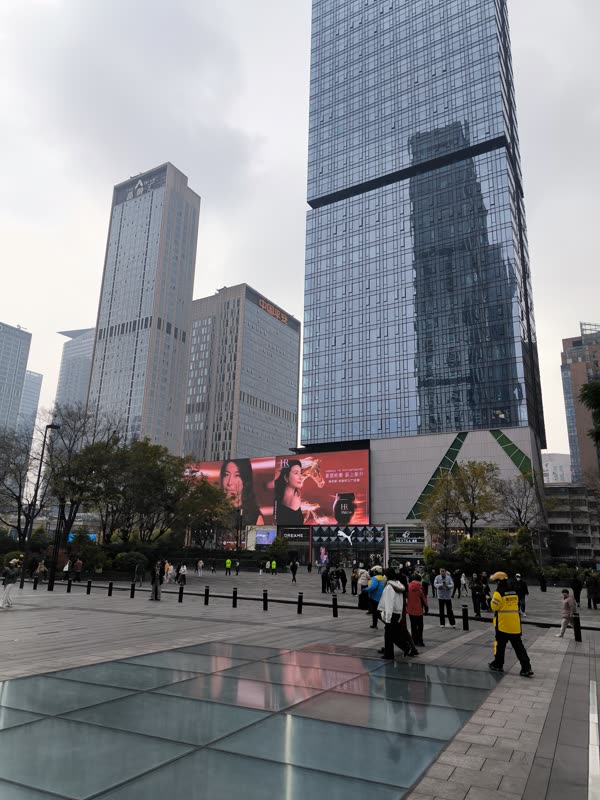
Jinjiang and Qingyang, the two districts that ring Tianfu Square and the historic centre, carry the highest rents but also the shortest commutes and the widest choice of restaurants and bars. Wuhou district, particularly the Tongzilin and Yulin neighbourhoods about 10 kilometres southwest of the centre, has long been the default landing spot for expats living in Chengdu. It’s well connected to the subway, dense with cafes and international grocery stores, and still cheaper than Jinjiang proper.
Outer Districts
Jinniu and Chenghua, north of the centre, offer a wider supply of apartments at lower prices, at the cost of a longer ride to the bars and schools clustered in the south. A studio in these northern districts can run RMB1,000 to 3,000 a month, and a modern two-bedroom in a large residential compound anywhere in the city typically lands around RMB6,500.
Good to know: Landlords and agents typically ask for a deposit worth one to two months’ rent, plus rent paid a quarter or a year in advance. Agencies charge a commission for arranging the lease, and it’s negotiable, so ask before you sign anything.
Transportation
Metro and Bus
Chengdu’s metro is cheap and genuinely good. Fares are distance-based and start at RMB2 for the first few kilometres, and most rides I took came out around RMB5, with a long cross-city trip topping out around RMB6 to 8. The two airport lines cost more given the distance: Line 18 from Chengdu South Station to Tianfu International Airport runs about RMB27, while Line 10 into Shuangliu Airport is a normal distance fare of roughly RMB6 to 8.
You pay with the Tianfu Tong transit card or a linked Alipay or WeChat transit code, and a monthly unlimited pass costs about RMB165.
Two things to know before you rely on the subway.
- Skip it during rush hour if you can: the crowds are intense
- Every station has a security check on the way in, so at peak times you’re queuing to scan your bag before you even reach the platform.
Taxis and Didi
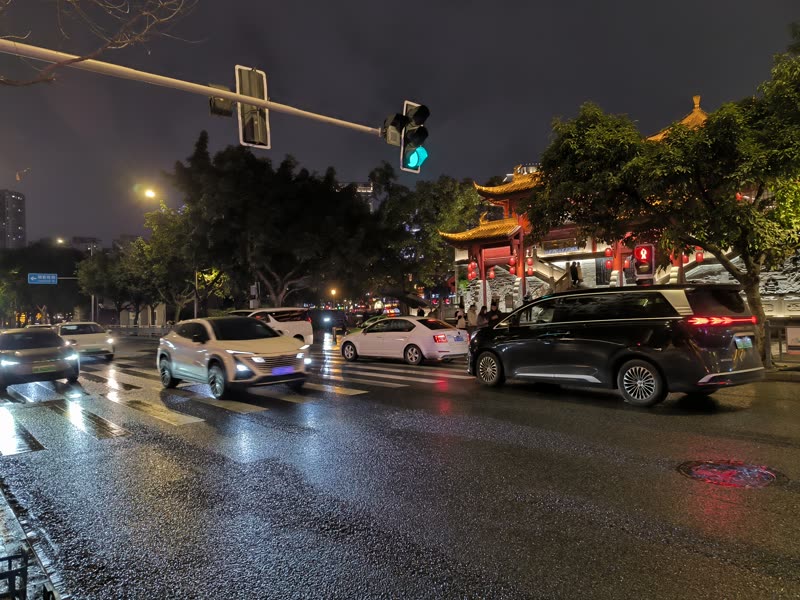
Honestly, I often just took a Didi. It’s China’s dominant ride-hailing app, it covers Chengdu thoroughly, and for a short cross-town hop it’s usually only RMB15 to 25, often cheaper than flagging a taxi on the street. When you weigh a RMB5 metro ride against a RMB20 Didi that skips the security queue and the rush-hour crush, the Didi frequently wins on convenience. Street taxis start at RMB9 and add roughly RMB2 per kilometre.
Compared with Bangkok, both the metro and ride-hailing felt cheaper to me.
Health & Fitness
Healthcare in Chengdu can be very cheap or fairly expensive, depending entirely on whether you can navigate a Chinese-language hospital. Your two main options are cheap public hospitals and pricier private or international clinics.
Public Hospitals
Public hospitals are cheap and, for foreigners without fluent Mandarin, frequently frustrating. The main advantage of going public in Chengdu specifically is West China Hospital’s International Medical Center, a designated treatment site for foreigners run by Sichuan University and the provincial government, with its own outpatient, inpatient, and international department.
Private and International Clinics
International clinics are what most expats without local language skills end up using for anything beyond a routine check-up.
Two names come up repeatedly for Chengdu:
- Global Doctor, a private international clinic in Wuhou district offering family medicine, dentistry, and vaccinations with multilingual staff
- Gleneagles Chengdu Hospital, which absorbed the former Parkway-run Shenton Clinic in 2021 and now operates as the city’s main international-standard private hospital.
| Service | Public Hospital | Private Hospital | International Clinic |
|---|---|---|---|
| General consultation | RMB50 to 300 | RMB800 to 1,500 | RMB1,500 to 3,000 |
| Specialist consultation | RMB200 to 600 | RMB1,500 to 3,500 | RMB2,500 to 5,000 |
| MRI or CT scan | RMB500 to 2,000 | RMB5,000 to 12,000 | RMB10,000 to 20,000 |
| Hospital stay (1 night) | RMB300 to 1,000 | RMB5,000 to 20,000 | RMB10,000 to 30,000 |
Minor surgery starts around RMB50,000 in an international facility, which is exactly why an insurance policy that pays the facility directly, rather than reimbursing you afterward, matters more in Chengdu than the monthly premium does.
Health Insurance
Most expats in Chengdu carry either a China-only local plan or an international health insurance policy through an employer or purchased independently. Insurers that price coverage by city typically give a discount, sometimes up to 10%, for living outside Beijing, Guangzhou, or Shanghai, since claims cost less to settle in a Tier 2 city like Chengdu. Adding a deductible can cut the premium by another 10% to 25%.
Tip: Private hospitals and international clinics in Chengdu expect payment upfront if you don’t have insurance that pays the facility directly. Confirm with your insurer whether Chengdu providers are on their direct-billing network before you need it, not after.
Gym
On the fitness side, a basic gym membership runs about RMB182 a month, or RMB4,000 to 8,000 a year for a mid- or high-end fitness club. A yoga or pilates class costs RMB150 to 200.
Education
If you’re moving with children, school fees will dwarf every other line in your budget. Add one child at Chengdu International School, where fees run RMB170,000 to 251,000 a year depending on grade level, and the household budget jumps by RMB14,000 to 21,000 a month per child before anything else changes.
Chengdu’s international-school options have grown over the years but remain narrower than Shanghai’s or Beijing’s, particularly for secondary-age children. If school choice is a deciding factor for your family, it’s worth confirming places and fees at your shortlisted schools before you commit to the city.
Groceries
A litre of milk costs RMB12.46, a 500g loaf of bread RMB11.29, a kilo of rice RMB6.11, a dozen eggs RMB10.55, and a kilo of chicken fillets RMB24.
Overall, groceries in Chengdu run 17.1% cheaper than in Shanghai. Wet markets undercut supermarkets on produce and meat, and most residential compounds have one within walking distance, which is where the real savings are.
- Local-integrated food budget: RMB500 to 950 a month, cooking at home most nights with the occasional cheap meal out.
- Premium food budget: RMB2,000 to 3,500 a month, eating out regularly and shopping at imported-goods stores for Western staples.
Dining Out
Eating out in Chengdu is cheap, but there’s a catch I ran into fast. A meal at a mom-and-pop shop costs only RMB15 to 20, which is fantastic value, but it’s not something you want to eat every day. In my experience the local hole-in-the-wall food can be oily and heavy on fat, delicious the first few times and then a bit much. So you end up mixing it with meals at a proper restaurant, which run closer to RMB60 a head. Budget for that mix rather than assuming you’ll live on RMB20 lunches.
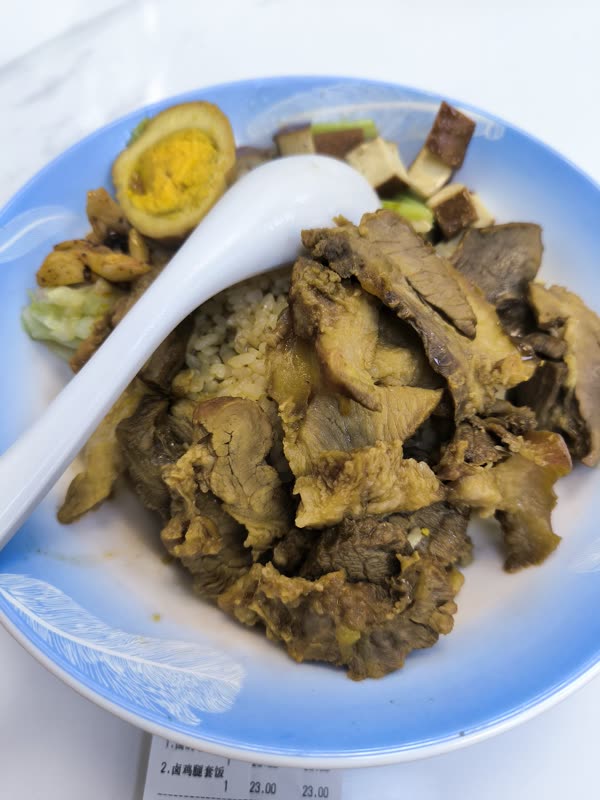
For the numbers: an inexpensive restaurant meal averages about RMB18, a mid-range meal for two at a proper Sichuan restaurant runs around RMB147.50, and a cappuccino at a Western-style cafe costs RMB19.17, about what you’d pay in a mid-sized US city and one of the few things in Chengdu that doesn’t feel cheap. Overall, restaurant prices sit 18.8% below Shanghai’s, and hot pot especially is simply cheaper to produce locally than the imported ingredients that drive up menus in Shanghai and Shenzhen.
Tipping
There’s no 20% rule like in the US, and in small local restaurants a tip isn’t expected and might even get a surprised look. Rounding up is always fine, though: if a Didi comes to RMB26, RMB30 and a thank-you is a nice gesture. Don’t overthink it.
Utilities and Mobile Plans
Combined utilities average RMB276.80 a month for a standard 85m² apartment, covering electricity, water, gas, heating, and garbage collection. A local Chengdu billing guide breaks the same costs down by apartment size:
| Utility | One-Bedroom | Two-Bedroom | Three-Bedroom |
|---|---|---|---|
| Gas | RMB35 | RMB55 | RMB75 |
| Electricity | RMB65 | RMB90 | RMB140 |
| Water | RMB30 | RMB50 | RMB80 |
On top of that, most compounds charge a separate management fee of RMB1.8 to 15 per square metre a month.
Paying Utility Bills
Electricity and gas usually run on prepayment, topped up through a card at a Hongqi convenience store or directly through the utility company’s mini-program inside WeChat Wallet. Water is typically billed through the building’s management office and paid by Alipay or WeChat, cash, or a Chinese bank card.
Internet and Mobile
Home internet at 60Mbps or faster costs about RMB84.86 a month. A resident mobile plan with 10GB or more of data runs RMB64.62 a month through China Mobile, China Unicom, or China Telecom, all of which require a passport for SIM registration. A short-stay prepaid SIM bought at the airport costs roughly the same for a similar data allowance, just packaged as a fixed-term card instead of a monthly plan.
Setting up utility and phone bill autopay is much easier once you open a bank account linked to Alipay or WeChat Pay.
Entertainment and Other Luxuries
Going out in Chengdu costs a fraction of the same night in Shanghai. Here’s a rough menu of what leisure runs:
- Movie ticket: RMB40 to 70 for a regular showing, RMB100 for IMAX or 3D.
- Bar drink: RMB60 to 100.
- Massage: RMB80 to 150 at a local spa, RMB300 to 500 at a high-end wellness centre.
- Museums and exhibitions: RMB20 to 60 for entry.
Put together, a single person spending moderately on eating out, transport, and a few nights out a month, on top of utilities and groceries but excluding rent, lands around RMB3,400 to 6,000. That figure lines up closely with the non-rent portion of the local-integrated budget above, which is a good sign the numbers from different sources actually agree with each other.
Chengdu Compared to Beijing, Shanghai, and Shenzhen
China Briefing’s 2026 index puts Shanghai at 100, Beijing at 95, Shenzhen at 90, and Chengdu at 65. The rent gap drives most of that difference: a one-bedroom in a foreign-popular central district costs RMB7,000 to 9,000 in Shanghai and RMB6,500 to 8,500 in Beijing, against RMB3,000 to 5,000 for the equivalent premium apartment in Chengdu.
| City | Index (Shanghai = 100) | Premium Monthly Budget | Premium Rent |
|---|---|---|---|
| Shanghai | 100 | RMB28,000 to 45,000 | RMB7,000 to 9,000 |
| Beijing | 95 | RMB26,000 to 42,000 | RMB6,500 to 8,500 |
| Shenzhen | 90 | RMB24,000 to 39,000 | RMB6,000 to 8,000 |
| Chengdu | 65 | RMB14,000 to 24,000 | RMB3,000 to 5,000 |
A premium single professional in Shanghai budgets RMB28,000 to 45,000 a month; the same lifestyle in Chengdu costs RMB14,000 to 24,000, a discount of about 47%. What Chengdu gives up for that is depth of infrastructure: Shanghai and Beijing both have a much wider bench of international schools, private hospitals, and multinational offices. But for most people, a net salary in the high teens of thousands of yuan supports a genuinely comfortable single life in Chengdu, a figure that would barely cover rent and transport in central Shanghai.
How Much Do I Need?
As you weigh up a job offer or plan a budget, here are the net monthly figures I’d keep in mind for Chengdu:
- RMB8,000 to 10,000 (US$1,150 to 1,430) is the floor for a single person living local-style: a modest apartment outside the centre, cooking most nights, riding the metro, and keeping bar tabs modest. You can have a genuinely good time in Chengdu on this, but you’ll be watching your spending.
- RMB15,000 to 18,000 (US$2,150 to 2,570) is a comfortable single-professional salary. This covers a modern one-bedroom nearer the centre, eating out whenever you feel like it, a gym membership, and the occasional Didi over the metro without thinking about it.
- RMB20,000 to 24,000 (US$2,860 to 3,430) buys a premium lifestyle with room to save: a nice central apartment, private-clinic visits when you want them, and regular travel out of Chengdu’s two airports.
- RMB30,000+ (US$4,300+) is where a family should be aiming, and even that gets stretched fast once international school fees enter the picture. Try to have tuition covered separately in your package if you can.
Because Chengdu is a Tier 2 city, these numbers are already well below what you’d need in Shanghai or Beijing for the same standard of living, which is the whole reason people choose it.
Money-Saving Tips
- Rent outside Jinjiang and Qingyang. Wuhou’s Tongzilin and Yulin neighbourhoods keep you close to the expat scene and the subway without paying central-district prices.
- Shop at wet markets, not just supermarkets. Produce and meat both run noticeably cheaper than imported-goods stores, and most compounds have a market within walking distance.
- Mix cheap eats with proper restaurants. Living on RMB15 to 20 mom-and-pop meals sounds great until the oil catches up with you; budget for the RMB60 restaurant meals you’ll actually want.
- Use the metro off-peak, and a Didi when it’s worth it. Skip the subway at rush hour, when crowds and security checks make it a slog; a RMB20 Didi is often worth the convenience.
- Ask your insurer about the outside-Tier-1-cities discount. It’s not automatic on every plan, and most people never ask for it.
- Negotiate housing and school allowances separately. A Shanghai-sized housing budget is wasted in Chengdu; that money is better spent on school fees or savings.
FAQ
How much do I need to live comfortably in Chengdu?
A single professional living comfortably, in a modern one-bedroom near the centre, eating out regularly, and covering a gym membership and occasional private healthcare, needs RMB14,000 to 24,000 a month. A more frugal, local-integrated lifestyle works on RMB4,500 to 7,000.
Is Chengdu cheaper than Beijing or Shanghai?
Yes, substantially. Chengdu’s overall cost index is 65 against Shanghai’s 100 and Beijing’s 95, and its rent runs about 59% below Shanghai’s. A premium lifestyle that costs RMB28,000 to 45,000 a month in Shanghai costs RMB14,000 to 24,000 in Chengdu.
What’s the average rent for a one-bedroom apartment in Chengdu?
RMB3,157 a month in the city centre and RMB1,740 outside it, as of mid-2026. Expect to pay toward the higher end in Jinjiang, Qingyang, or the Wuhou district neighbourhoods popular with expats.
Do I need private health insurance in Chengdu?
Not legally, but practically, yes, unless you’re comfortable navigating a Chinese-language public hospital. Private and international clinics require payment upfront without insurance that bills the facility directly, and a single hospital stay can run RMB10,000 to 30,000 a night at an international facility.
How much does public transport cost in Chengdu?
Metro fares start at RMB2 and rarely exceed RMB8, even crossing the city, with most rides around RMB5. A monthly unlimited pass costs about RMB165, and a short Didi ride runs RMB15 to 25, often worth it over the metro at rush hour.
Are international schools in Chengdu expensive?
Yes, and they’re the single biggest line item for a family budget. Chengdu International School charges RMB170,000 to 251,000 a year depending on grade level, which works out to roughly RMB14,000 to 21,000 a month per child.
Now, on to You
Chengdu is one of the best-value big cities I’ve spent time in, and if you’re moving to China on a budget, it’s hard to beat. A comfortable single life here costs a fraction of what it does in Shanghai, and I found it cheaper than Bangkok for the everyday stuff.
A few things are worth remembering. Rent and lease commissions are negotiable, so always ask. Mix your cheap street eats with the occasional proper restaurant so you don’t burn out on oily food. And save the metro for off-peak hours, taking a cheap Didi when the crowds and security checks aren’t worth the hassle. Get those three right and Chengdu is a genuinely easy, affordable place to land.