This article will take approximately 27 minutes to read. Don't have the time right now? No worries. Email the ad-free version of the article to yourself and read it later!
I’ve lived in Singapore for over 15 years and tested different internet providers. Here’s my personal guide to finding the best home broadband in Singapore, comparing speeds, prices, and plans from Singtel, Starhub, M1, and more.
With more companies in Singapore adopting hybrid and fully remote work models, internet connectivity is no longer a nice-to-have; it’s a basic necessity for most people in Singapore.
The question is no longer if we are going to have broadband service at home, but which package best meets all our needs. This question includes deeper questions like:
- How much speed do we actually need?
- Do we need a new router?
- Do we need a Wi-Fi extender to cover the dead zones?
- Should we bundle a TV service with it?
- Or do we want the mobile plan included as well?
It may sound complicated, but as an expat who has lived here for more than 15 years, let me help navigate the options and ultimately find the plan that fits you best.
Contents
- Key Takeaways
- Overview of Home Broadband and Internet Providers in Singapore
- How Reliable Is Home Broadband and Internet Connectivity in Singapore?
- Average Home Broadband Speed in Singapore (2025 Update)
- My Personal Speed Test
- Home Broadband Internet Providers in Singapore
- Sign-Up Requirements for Foreigners
- How to Choose the Best Internet Provider for Your Home in Singapore
- No-Contract and Short-Stay Broadband Options
- Free Wi-Fi in Singapore
- Alternative Options
- How Long Does Installation Take?
- Potential Downsides of Home Broadband
- Now, on to You
- Frequently Asked Questions
- Can I sign up for broadband before I've signed my tenancy agreement?
- Can short-term visitors or tourists get home broadband installed?
- Can I move my broadband contract to a new address if I relocate within Singapore?
- Is 5G mobile data a good enough substitute for home broadband?
- Do broadband providers ask foreigners for a security deposit?
- Which broadband option makes sense if I'm only in Singapore for a few months?
- Sources Cited
Key Takeaways
- Singapore has one of the fastest and most reliable internet networks in the world, with average fixed broadband speeds around 400 Mbps.
- The main providers, Singtel, Starhub, and M1, offer similar speeds, prices, and 24-month contracts.
- Smaller providers like MyRepublic, Whizcomms, ViewQWest, and SIMBA are good alternatives if you want cheaper plans, flexible contracts, or options for gaming and short-term stays.
- If you live in an older building, confirm that your internal wiring and router can handle the current fibre standard before signing up.
- Promotions change often, so the best deal usually depends on what’s currently offered rather than performance differences.
- Free public Wi-Fi through Wireless@SG and private venues is widely available but best used for light browsing, not work.
Overview of Home Broadband and Internet Providers in Singapore
Luckily, in Singapore, choosing a broadband provider isn’t as overwhelming as it might be elsewhere. Most providers offer fairly similar packages, with comparable speeds, services, and pricing.
For example, a 24-month contract instead of a 12-month broadband plan is the standard option you’ll find almost across the board.
The real differences usually come down to ongoing monthly promotions, bundle deals, or other optional add-on services that you can include (or skip) depending on your needs.
And there’s a good reason behind this: Singapore’s broadband market is largely powered by three telco companies that own the core network infrastructure (i.e., Starhub, Singtel, and M1).
The other broadband service providers you see around are essentially buying their network access wholesale from these big three and reselling it under their own labels.
How Reliable Is Home Broadband and Internet Connectivity in Singapore?
I often hear this question, especially from expatriates coming from other developed countries. These are people who are already heavily reliant on internet connectivity in their day-to-day lives.
My short answer to the question is: you have nothing to worry about.
In Singapore, connectivity is exceptionally strong. According to the Infocomm Media Development Authority (IMDA) statistics for 2024, the residential wired-broadband household penetration rate is around 93.3%–93.5%, and wireless broadband subscriptions are about 187.7% of the population.
This means many people in Singapore have multiple wireless broadband subscriptions.
In short, whether you are in the heart of the Central Business District or the farthest neighbourhoods in the northwest, you will have fibre broadband access.
So yes, you’ll stay connected anywhere on the island, including in the MRT underground stations.
In my personal experience over the past 15 years, I have never been anywhere in Singapore where I completely lost connection from my mobile network, and I have never experienced a countrywide or localised broadband outage or incident. I have also lived in many neighbourhoods and have never once had an internet problem.
Average Home Broadband Speed in Singapore (2025 Update)
According to Speedtest, Singapore’s average fixed broadband speed was about 400.68 Mbps in September 2025, making it one of the fastest in the world.
The internet in Singapore is really fast. Starting packages now offer the 1 Gbps plan as a basic plan.
However, the typical speed you experience may vary slightly depending on the broadband provider. For instance, in October 2025, M1’s residential fibre test results (for the period between April–June 2025) showed that the typical download range for a 1 Gbps plan is around 918.5–953.8 Mbps.

Note: Under Infocomm Media Development Authority (IMDA) regulations, all broadband providers are required to publish their typical speeds and not just the theoretical maximum speed to ensure transparency for consumers.
My Personal Speed Test
In the test that I did for my own broadband provider (Singtel) during peak hour (~8 p.m. SGT), here’s the typical download and upload speed performance:
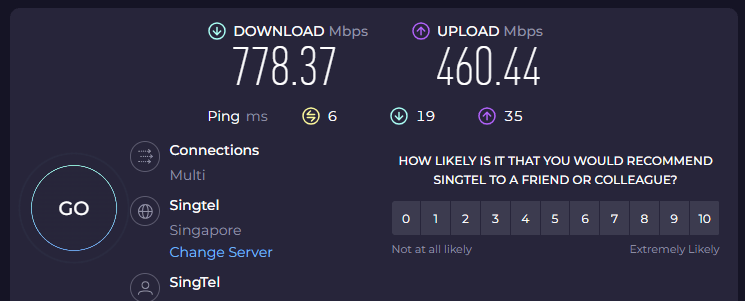
Overall, I would say the reliability is excellent, as downtime for fibre service in Singapore is extremely rare.
Furthermore, the Singapore government has announced a S$100m funding initiative to upgrade the national network infrastructure, with the goal that by 2026/2028, most homes in Singapore will be able to access up to 10 Gbps.
Great news for anyone who relies on fast, stable internet connectivity for work like me, or just for daily life.
Tip: Always check each broadband service provider’s typical speed before making your final decision. If you live in an older building, it’s also worth checking which service tier your unit supports and whether your internal cabling, router, and other installations are optimized for maximum performance.
Home Broadband Internet Providers in Singapore
According to industry research, Singtel continues to hold the largest share of the fixed-broadband market in Singapore (via fibre home broadband), although exact figures are not publicly disclosed.
Currently, Singtel, Starhub, and M1 together serve over 98% of fixed-line subscribers. At the same time, broadband competition remains fierce, with rivals such as MyRepublic and the new player SIMBA steadily working to close the gap.
Here’s a quick summary of companies you can choose from and what I think each is best known for.
Singtel
Singtel is the major incumbent and a full-suite telecom provider with a strong nationwide infrastructure and a wide range of plans to choose from. It’s for that reason many people choose Singtel, including myself for the past four years.
It currently offers five different fibre broadband plans ranging from 3 Gbps, 5 Gbps, up to 10 Gbps, with prices starting from S$39.90/month, making it great for entry-level options.
Singtel also provides Home Priority Services and Fibre Everywhere plans for multi-storey or large homes with more complex layouts, though these come at a higher price point.
Each plan generally comes with a Singtel WiFi 7 router (the number of units depends on your plan and preference), a home line, 12 months of Broadband Protect, and a 24-month contract. If you want to add more services, Singtel offers entertainment bundles that include Singtel TV, giving you access to several TV channel packs and a set-top box.
Some customers, like me, also go for the lifestyle gadget plan, which lets you pick a free gadget. You can choose from an iPad, Dyson appliance, or Samsung tablet to bundle with your broadband package.
Singtel also claims that all its WiFi devices have the highest Level 4 certification under the Singapore Cybersecurity Labelling Scheme, which is good news given the rising number of cybersecurity threats worldwide. Read more about it here.
At the time of writing, Singtel is also offering two years of free 10 Gbps broadband with a Singtel TV bundle, plus one year of Disney+, HBO Max, and Amazon Prime subscriptions.
All new sign-ups can also enjoy free weekday and weekend installation worth up to S$202, which is a great deal.
Starhub
You can choose Starhub if you are looking for an entertainment and broadband bundle. I was their loyal customer for almost 10 years before I was lured by a promotion and switched to Singtel.
Similar to Singtel, Starhub offers 3 Gbps, 5 Gbps, and 10 Gbps plans starting from S$39.91 per month, which include a free WiFi 7 router. They currently offer both WiFi 6 and WiFi 7 for faster speeds and stronger connectivity throughout your home. They also provide hassle-free installation and consultation at no extra cost.

For bundling offers, Starhub provides smart device plans alongside your fibre broadband plan. This is a great option if you have been planning to get devices like a Nintendo Switch, smart TV, Samsung tablet, wireless headphones, and more.
As they are also a leader in entertainment bundling, you can consider their offers that suit your lifestyle. Whether you are a sports lover or a TV enthusiast like me, you will have plenty of options, including HBO, Netflix, Sports, and Premier League access to bundle with your plan.
These bundled plans also come with a free 24-month TV box, matching the length of the required contract (i.e., 24-month contract).
M1
M1 is well-known for being competitive in its pricing while still offering good internet speeds. I almost chose them as my broadband provider because I’m already their mobile network customer.

But I guess it’s always good to have two different sources of internet providers just in case one has an outage or incident. M1’s starter package at 3 Gbps is currently the cheapest among the big three broadband providers, which is consistent with their value proposition.
At the time of writing, they are running a great promotion for their 10 Gbps plan at just S$34.90 per month (instead of their usual price of S$135). Like other providers, these offers come with a 24-month contract and include one free WiFi 7 router.
Their current promotion also includes free home fixed voice (landline) and waived registration fees, which are worth considering.
MyRepublic
For those needing high-speed connectivity, MyRepublic is a strong choice, offering both fast speeds and more flexible contracts. They were voted Best Fibre Broadband Service Provider in the Tech Award 2024 Readers’ Choice by HardwareZone.com (here) and Best Fixed Internet during Q1–Q2 2025 by Speedtest Awards.
MyRepublic offers various plans, including 3 Gbps and 10 Gbps options under a 24-month contract, depending on your needs. At the time of writing, their promotional price for the 3 Gbps plan is as low as S$16.99 per month for the first 12 months before returning to the standard price for the following 12 months.
They also offer “No Router” and “No Contract” plans, perfect for those not planning to stay in Singapore long term.
All the plans come with a WiFi 7 router, free point installations, and a home phone line with unlimited local calls. Note that most MyRepublic plans currently do not include free installation and activation fees, so it’s important to check all the details before choosing a plan.
Tip: Because MyRepublic is still a relatively small player, you should also check their service coverage, support, and installation quality in your specific location before committing.
SIMBA
SIMBA Telecom is a newer but increasingly prominent player in the broadband market. Originally Singapore’s fourth fully licensed mobile network operator with full 4G and 5G spectrum rights, SIMBA has now moved into home fibre broadband. It positions itself as the best-value option, offering only ultra-fast speeds at aggressive pricing.
At the time of writing, SIMBA offers a 10 Gbps plan priced at S$9.99 for the first 30 days and S$29.99 monthly thereafter. The good thing about SIMBA is that you can choose between a 12-month or 24-month contract.
The plans also come with a complimentary home phone line, WiFi 7 router, and free device installation as part of their October 2025 promotion.
While SIMBA’s fibre network infrastructure is available nationwide, its subscriber base is still smaller compared to the long-established incumbents (i.e., Singtel, Starhub, and M1). With that in mind, you should always consider local performance, neighbourhood customer experiences, as well as the promo and contract details before choosing their broadband services.
Tip: In August 2025, SIMBA made a proposal to acquire M1. On 18 May 2026, IMDA suspended its assessment of that consolidation after flagging a possible breach involving SIMBA’s use of radio-frequency spectrum outside its licensed assignment, so the deal’s outcome is now genuinely uncertain rather than simply pending approval. Factor that in when weighing SIMBA as your broadband provider.
Whizcomms
Whizcomms is a broadband service provider that uses the Singtel network. They position their 3 Gbps plan as the lowest-priced option, catering to smaller households.

Whizcomms also offers more flexible plans, including a 12-month plan for those who don’t want the standard 24-month contract commitment.
They also provide a “No Router” option (“No Frills”) for customers who already have their own home setup. Installation and service activation are usually free when you sign up for a 24-month contract with Whizcomms.
Currently, the router plan also comes with 180 days of a free entertainment pack via the Cast.sg application.

ViewQWest
ViewQWest is a smaller broadband service provider specializing in niche cases. If you are an online pro gamer or have specific needs like custom setups or overseas routing, they are the go-to broadband service provider.

ViewQWest currently offers 3 Gbps and 10 Gbps plans with a “No Router” option available for those who already have their own setup at home. If you still need a router, you can choose either the WiFi 6 or WiFi 7 model provided.
At the time of writing, they are also still offering zero installation and activation fees.
Sign-Up Requirements for Foreigners
Whichever provider you pick, the paperwork is pretty much the same. Here’s what I needed to have ready when I signed up, and what I’ve seen other expats asked for.
- Your physical FIN card (Employment Pass, S Pass, Work Permit, Student Pass, Dependant Pass, or Long-Term Visit Pass) with at least 6 months of validity remaining.
- If your pass has less than 6 months left, a renewal or extension letter from your employer, school, or the Ministry of Manpower, on official letterhead.
- Proof of your local billing address dated within the last 3 months (tenancy agreement, utility bill, bank statement, or an employer/school letter all work), unless your ID already shows a local address.
- Citizens and PRs need a physical NRIC, plus either a Singapore driving licence or the same proof-of-address documents above if the NRIC still lists an old or overseas address.
Some providers also run a credit check and may ask first-time applicants or short-validity pass holders for a guarantee deposit. MyRepublic states this explicitly in its sign-up terms, and it’s a reasonable assumption for the other providers too.
Tip: Bring your passport, pass card, and one proof-of-address document (front and back scans work for most online applications) and you can usually apply the same day, even before your official move-in date.
How to Choose the Best Internet Provider for Your Home in Singapore
If you don’t have any special requirements for your internet, you can go with any of the big three internet providers in Singapore (Singtel, Starhub, or M1). Singapore is a small country with great infrastructure, and these three are equally good.
In the end, it just comes down to promotions. For example, when I switched from Starhub to Singtel (purely because of promotions at that time), I didn’t notice any difference in quality. I’m also using M1 for my mobile phone plan, and the mobile internet is good as well. A widely shared tip among long-term Singapore residents: when your contract is near expiry, calling to express intent to cancel often prompts the provider to offer retention incentives such as free months, router upgrades, or bill credits before you sign on for another term.
However, if you need custom options such as higher-speed internet with lower latency, you can check out smaller players.
Anyway, here’s a quick comparison table of internet providers in Singapore with their monthly prices for comparison.
| Providers | Best known for | 3 Gbps | 5 Gbps | 10 Gbps |
| Singtel | Premium brand, SG#1 Network, Wide portfolio | From S$39.90 | From S$49.90 | From S$65.90 |
| Starhub | Strong entertainment/bundled services | From S$39.31 | From S$45.00 | From S$59.34 |
| M1 | Large network, Value for money | From S$32.90 | From S$38.90 (6 Gbps) | From S$34.90 |
| MyRepublic | High speed & contract flexibility, Good for gamers | From S$16.99 (first 12 months) | – | From S$39.99 |
| SIMBA | Ultra-high speed with low price | – | – | From S$9.99 for the first 30 days |
| Whizcomms | “No-frills” budget option | From S$28 (no router) | – | From S$28.99 (no router) |
| ViewQwest | Custom needs | From S$18.98 (no router) | – | From S$30 (no router) |
No-Contract and Short-Stay Broadband Options
Not everyone wants to lock into 24 months, especially if you’re not sure how long you’ll be in Singapore. A few routes work better for shorter stays.
- MyRepublic offers a genuine no-contract fibre plan alongside its standard 24-month option.
- SIMBA and Whizcomms both let you choose a 12-month contract instead of the usual 24 months.
- If you’re here for less than 6 months, skip fixed-line broadband altogether and use a SIM-only 5G plan with your own router, or a mobile hotspot device.
On the mobile side:
- GOMO. SIM-only 5G plan runs about S$38 a month for unlimited local data with no contract.
- M1. No-contract SIM-only plan starts from S$14.95 for 150GB.
- SIMBA. No-contract SIM-only plans range from S$5 to S$39 a month.
Pair any of these with a portable 5G router and you get a workable home connection without signing anything long-term.
Just know the tradeoff: fixed-line fibre is still cheaper per GB and more stable for heavy use, like several people in the household streaming or video calling at once. If you’re staying beyond 6 months, the math usually favors a standard broadband contract.
Free Wi-Fi in Singapore
Another great thing to note here is the free public Wi-Fi in Singapore, which is widely available throughout the country. It works fine if you need the internet urgently, but it’s not something you should always rely on.
There are mainly two types of free Wi-Fi in Singapore: public Wi-Fi known as Wireless@SG and private Wi-Fi.
Wireless@SG (Public Free Wi-Fi)
In 2006, the government launched a wireless broadband program called Wireless@SG, which is available across Singapore. It is free to use for both locals and tourists, with no limits on usage duration.
Wireless@SG provides connectivity in public places such as shopping malls, cafes, MRT train stations, community centers, and libraries.
The networks are managed by different operators, including Singtel, Starhub, M1, and SIMBA. Their connection speeds are around 5 Mbps, with plans to improve them further in the future.
When uncongested, some Wireless@SG hotspots can actually deliver higher speeds of 10–20 Mbps, although this is not guaranteed. This is more than enough for basic web browsing, messaging, and even streaming some videos.
Free Private Wi-Fi
In addition to the free public Wi-Fi, I also want to mention that many businesses and venues across the island provide their own complimentary Wi-Fi.
These places include major shopping malls, Changi Airport, cafés and popular chain restaurants, co-working spaces, and hotels. These can also be a great option for those needing reliable connectivity since they can be faster than free public Wi-Fi.
While these Wi-Fi networks are generally safe in Singapore, it’s still wise to exercise caution when connecting to public networks, especially when performing sensitive transactions. For example, I never access my online bank using free Wi-Fi. Use a VPN if you want a safer option.
Find out more: The Complete Guide to Choosing the Best VPN for Singapore
Alternative Options
If you can’t set up broadband in your home for whatever reason, for example, if you are here for less than 12 months, there are a few ways to stay connected without solely relying on free Wi-Fi, which might not be stable or safe enough.
Unlimited Plans
Similar to broadband, mobile internet speeds in Singapore are also among the fastest in the world.
5G services are now the standard for mobile data. And not just that, prices are low even for unlimited plans. For example, you can expect to pay as low as S$10 for 400GB of data and unlimited local calls. There are also Tourist SIM/eSIM packages that typically provide 100GB of data for 7–10 days, priced between S$12–S$30.
These usually include some local talk time and international SMS, while higher-priced bundles may come with extra perks such as unlimited data usage for selected applications (e.g., WhatsApp, Facebook).
Pocket Wi-Fi
Another way is to get a pocket Wi-Fi, where you can share Wi-Fi internet with multiple devices at once. It generally costs around S$5 to S$8 per day for unlimited data, depending on the provider. You can search for “pocket Wi-Fi,” and many options will pop up. You can get it at Changi Airport, and many also provide hotel delivery options.
However, a more affordable option is to just buy a pocket Wi-Fi yourself. Then, subscribe to an unlimited SIM card plan as mentioned earlier and install it in your pocket Wi-Fi.
How Long Does Installation Take?
This is one of the first things expats ask me, especially if they’re arriving with a fixed move-in date. The answer depends on whether your unit already has a live fibre connection.
Most Singapore homes already have an Optical Network Terminal installed from a previous tenant, thanks to the country’s near-universal fibre rollout. If that’s your case, switching providers or activating a new plan usually takes about 3 to 7 working days, with no technician visit needed.
If you need a fresh installation (new-build unit, older building without fibre wiring, or you’re the first fibre subscriber at that address), budget more lead time:
- M1 typically activates a new fibre connection within about 7 working days of your application.
- StarHub recommends applying at least 14 days before your move-in date to lock in an installation slot.
- Singtel recommends submitting your move-in date around a month ahead, with 7 days as the bare minimum.
Tip: Apply as soon as you sign your tenancy agreement, not on moving day itself. It costs nothing to book early, and you can always push the installation date back.

If you already have broadband and are moving apartments mid-contract, Singtel, StarHub, and M1 all offer a relocation service so you can carry your existing plan to the new address instead of paying an early termination fee. You’ll still need to give the same advance notice, and a relocation fee sometimes applies.
Potential Downsides of Home Broadband
While broadband internet in Singapore is generally good, it’s still not perfect. There are two main downsides.
24-Month Contracts
Many broadband plans are tied to 24-month contracts, which can be restrictive if you move frequently. Early termination fees may apply.
For most providers, the typical early termination fee will be the sum of the monthly subscription fees for the remaining months of the contract period.
Issues for Older Buildings
If you are living in an older building, you may experience slower internet speeds, especially during peak hours.
For example, my former colleague who lives in a three-story landed property needed to engage two different broadband service providers to tackle his house setup, since the existing wiring in the building doesn’t support Singapore’s current internet infrastructure.
Now, on to You
There you have it, my complete guide to choosing a broadband service provider in Singapore.
Choose wisely, because whether you are on a video conference call with your boss or selling your products live on TikTok Shop, a steady internet connection can make or break your entire day.
Frequently Asked Questions
Can I sign up for broadband before I’ve signed my tenancy agreement?
Yes, as long as you can show some proof of your local billing address. A signed tenancy agreement works, but so does a utility bill, bank statement, or a letter from your employer or school, as long as it’s dated within the last 3 months.
Can short-term visitors or tourists get home broadband installed?
Not easily. Most providers require your pass to have at least 6 months of validity left, so a tourist or short social visit pass won’t qualify for a standard 24-month contract. A pocket Wi-Fi rental or a no-contract SIM-only 5G plan is the more practical option for stays under 6 months.
Can I move my broadband contract to a new address if I relocate within Singapore?
Yes. Singtel, StarHub, and M1 all offer a relocation service that lets you carry your existing contract to your new home instead of cancelling and paying an early termination fee. You’ll need to give advance notice (StarHub asks for at least 14 days), and depending on your plan, a relocation fee may apply.
Is 5G mobile data a good enough substitute for home broadband?
For a single person doing light to moderate work, often yes. Unlimited or high-data SIM-only 5G plans paired with a portable router can cover video calls and streaming. For a household with multiple people working or streaming at once, fixed-line fibre is still more reliable and cheaper per GB.
Do broadband providers ask foreigners for a security deposit?
It depends on the provider and your pass validity. Some run a credit check and may ask for a guarantee deposit, particularly if your pass has less than 6 months left or it’s your first time signing up in Singapore. It’s not universal, so ask upfront before you commit to a plan.
Which broadband option makes sense if I’m only in Singapore for a few months?
Look at MyRepublic’s no-contract plan, or a 12-month contract from SIMBA or Whizcomms if you’ll be here 6 to 12 months. For anything shorter, a pocket Wi-Fi rental or a no-contract SIM-only 5G plan avoids a contract altogether.





 Deutsch:
 Français:
 Español: