

This article will take approximately 14 minutes to read. Don't have the time right now? No worries. Email the ad-free version of the article to yourself and read it later!
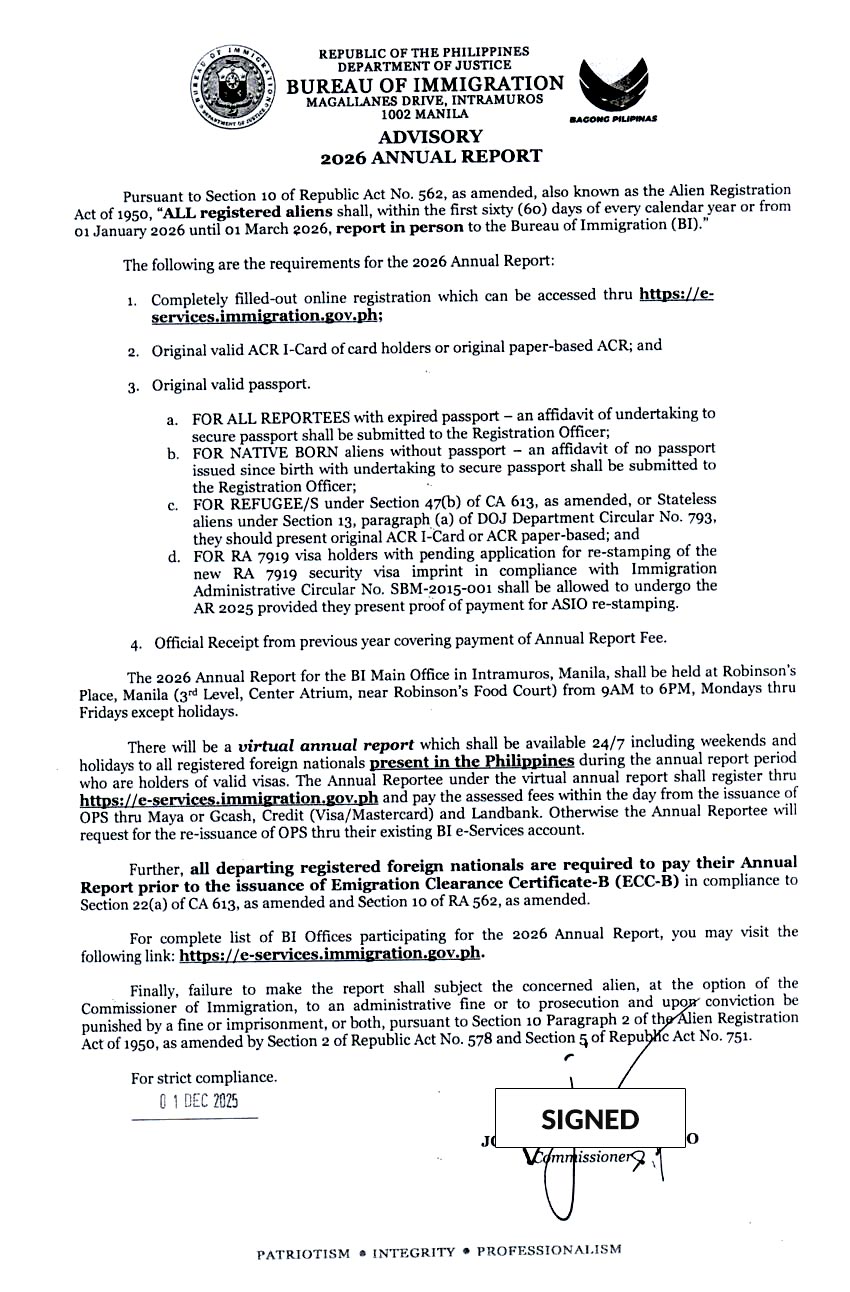
Every foreign resident in the Philippines who holds an ACR I-Card has to file the BI Annual Report between January 1 and March 1 each year. Here is who must file, what it costs, how to do it online, and what happens if you miss the deadline.
Most foreigners in the Philippines find out about the Annual Report the hard way. They learn about it at the airport, when an immigration officer tells them they can’t leave the country until they have settled a filing they never knew existed.
The report itself is almost laughably simple. It takes about twenty minutes and costs ₱310, a little over US$5. The problem is never the filing. It is that nobody tells you it exists, and the Bureau of Immigration treats “I didn’t know” the same way it treats “I couldn’t be bothered.”
Here is exactly who has to file, when, what it costs, and what happens if you forget.
Disclaimer: This article may include links to products or services offered by ExpatDen's partners, which give us commissions when you click on them. Although this may influence how they appear in the text, we only recommend solutions that we would use in your situation. Read more in our Advertising Disclosure.
Key Takeaways
- The Annual Report is a mandatory yearly check-in with the Bureau of Immigration for every foreign national who holds an ACR I-Card.
- The filing window is January 1 to March 1 every year. The late-penalty clock starts on March 2.
- It costs ₱310 in person (a ₱300 report fee plus a ₱10 legal research fee), or ₱310 plus a ₱1,000 express lane fee online.
- You can file online 24/7 through e-services.immigration.gov.ph, or in person at Robinsons Place Manila and other BI offices nationwide.
- Bring your ACR I-Card, your valid passport, and last year’s official receipt.
- Late filing costs ₱200 per month, capped at ₱2,000 a year, plus a possible ₱1,510 motion for reconsideration fee.
- An unfiled Annual Report can block your visa renewal and your exit clearance (ECC-B) when you leave the country.
What the BI Annual Report Is
The Annual Report is a once-a-year check-in with the Bureau of Immigration (BI) that every registered foreign national in the Philippines has to complete. You confirm you’re still in the country, still living at the address on file, and still the same person on your Alien Certificate of Registration Identity Card (ACR I-Card).
It’s not a new tax, not a visa renewal, and not optional. The requirement comes from Republic Act No. 562, the Alien Registration Act of 1950, which obliges every registered alien to report to immigration during the first sixty days of each calendar year.
In addition, the Annual Report is completely separate from your visa. Renewing your 13a, paying your SRRV dues, or extending your work visa doesn’t file your Annual Report for you, and filing your Annual Report does nothing for your visa. They are two different obligations at the same agency, and you have to handle both.
Who Has to File, and Who Doesn’t
The rule is simpler than the immigration jargon makes it sound. If you hold an ACR I-Card, you almost certainly have to file.
That covers the vast majority of long-term foreign residents, including:
- 13a marriage visa holders married to a Filipino citizen
- SRRV retirees on the Special Resident Retiree’s Visa
- 9(g) work visa holders employed by a Philippine company
- Other immigrant and non-immigrant visa holders who were issued an ACR I-Card
The official wording from the Bureau of Immigration is that the report applies to “all registered aliens and ACR I-Card holders except Temporary Visitor’s Visa holders or Tourist Visa holders.“
So who is off the hook?
A standard tourist on a 30-day or 59-day stamp, with no ACR I-Card, doesn’t file. The catch is the word “standard.” If you have been in the Philippines on a long tourist stay and your visa ran past six months, you were required to get an ACR I-Card, and once you hold that card you’re inside the Annual Report net whether you think of yourself as a tourist or not.
This is the single biggest source of confusion in the expat groups: people assume “tourist” means exempt, when what actually matters is whether BI issued you a card.
Good to Know: If you’re unsure whether you hold an ACR I-Card, check your wallet for a green-and-white plastic card roughly the size of a driver’s license. If you have one, you file.
When to File
The reporting window opens on January 1 and closes on March 1 every year. For 2026 that means January 1 through March 1, 2026.
You can file any time inside that window, but don’t leave it to the back end. The BI offices fill up through February as everyone who procrastinated rushes to beat the deadline, and the online system tends to get sluggish under the load. Filing in the first two or three weeks of January means short queues, a responsive website, and one less thing hanging over you for the rest of the year.
There’s no early-filing option. You can’t do your 2026 report in December 2025. The window is the window.
What It Costs
The Annual Report is one of the cheapest pieces of Philippine bureaucracy you will ever deal with. The standard fees are:
- Annual Report fee: ₱300.
- Legal Research Fee: ₱10.
That is ₱310 total to file in person, a touch over US$5. If you use the virtual online system, there’s an additional express lane fee of ₱1,000 (around US$18), which buys you the convenience of never leaving your house. For most people the in-person fee is the cheaper route, but the online option is worth it if you live far from a BI office.
Fees are set by BI operations order and can change without much notice, so treat these as current-year figures rather than permanent ones. They have held steady for years, but always check the receipt against what you were quoted.

Documents You Need
Bring three things, and only three things:
- Your ACR I-Card, or your original paper-based ACR if you were issued the older document
- Your valid passport
- The official receipt from last year’s Annual Report*

*The previous year’s receipt is your proof you filed before, and BI staff will ask for it. If you have lost it, you can usually still file, but expect questions and a slower process while they look up your record.
Get into the habit of keeping the receipt somewhere you will find it eleven months later. Clipped inside your passport cover works.
How to File Your Annual Report
There are two ways to file: online through the BI virtual system, or in person at an immigration office. Both end with the same stamped receipt.
Online (the virtual system)
BI now runs a virtual Annual Report system that’s available 24/7, including weekends and holidays, through its e-services portal. If you live any distance from a BI office, it saves you a morning in a queue.
The process runs roughly like this:
- Register at e-services.immigration.gov.ph and start an Annual Report application
- Enter your ACR I-Card and passport details and upload what the system asks for
- Pay the fees the same day through GCash, Maya, credit card, or Landbank
- Keep the digital receipt and reference number
The honest caveat is that the portal isn’t the slickest piece of software in the world. Expats regularly report timeouts and payment errors during the busy February stretch, which is one more reason to file in January when the servers are quiet. When it works, it’s genuinely a ten-minute job.
Main Complaint: In the Philippines expat forums, the complaints about the online system are specific and consistent: the print function failing at the last step (“you click print and the page just disappears”), confirmations that can’t be downloaded, and required fields that reject a submission without carrying an asterisk to warn you. The workaround people settle on is to screenshot every stage as you go, especially the confirmation, rather than trusting the print button to produce anything. On timing, the consistent advice is to wait out the first-week rush but stay well clear of February.
In person
If you would rather do it face to face, or your case is unusual, you can file at the BI Main Office or any designated immigration office nationwide.
The main filing counter sits in the center atrium of Robinsons Place Manila, open Monday to Friday, 9 a.m. to 5 p.m., excluding holidays. Bring your three documents, take a number, pay at the cashier, and walk out with your receipt.
In January this is a quick errand. In late February it can swallow a couple of hours, so go early in the day and early in the window.
Tip: Whichever method you use, the stamped or digital receipt is the only proof that counts. Photograph it and store it in your phone the moment you get it, so next year’s filing has the prior receipt ready to go.
What Happens If You Miss the Deadline
Missing March 1 doesn’t get you deported, but it does get expensive, and it can quietly block things you care about more than the fine.
File after March 1 and you pay a flat fee plus a monthly fine, reckoned from March 2 of the current year:
- Motion for Reconsideration fee: ₱1,510 (around US$27), charged on every late filing.
- Monthly fine: ₱200 (around US$4) for each month of delay.
- Annual cap: the monthly fine can’t exceed ₱2,000 (around US$36) per year.
The fines themselves are survivable. The real cost is friction. An outstanding Annual Report can hold up a visa renewal or extension, because BI sees the whole picture when you come back to them for anything else. Several years of unfiled reports stacked together turn a forgettable errand into a genuine headache, with back-fines and paperwork to untangle.
If you have missed a year or several, the fix is to go in person, explain the situation, pay the assessed penalties, and get current. BI deals with late filers constantly and there’s no drama in it, but the longer you leave it the more it costs.
The Annual Report and Leaving the Philippines
This is the part that catches people at the airport. If you’re a long-term resident leaving the country, you may need an Emigration Clearance Certificate (ECC-B), and BI won’t issue one while your Annual Report is outstanding.
In practice that means an unfiled report can stop you boarding a flight, or at least force an unpleasant scramble at the immigration counter before departure. Settling your Annual Report is what keeps you free to come and go, which is a bigger deal than the ₱310 fee makes it sound.
If you keep your filing current every January, this never becomes your problem. The ECC-B issue only bites people who let the report lapse.
Frequently Asked Questions
Do I have to file the Annual Report if I am only on a tourist visa?
If you’re on a standard tourist stamp with no ACR I-Card, no. If your long tourist stay pushed past six months and BI issued you an ACR I-Card, then yes, you file like any other cardholder. The card is what matters, not the label on your visa.
Can someone file the Annual Report on my behalf?
You generally have to appear yourself or use the online system tied to your own ACR I-Card, since the point of the report is to confirm you’re physically present. Visa agents can help you prepare, but don’t assume an agent who handled your visa also filed your Annual Report. Confirm it was done and get the receipt.
What if I lost last year’s official receipt?
You can usually still file. BI can look up your record, but it slows things down and may invite extra questions, so it’s worth keeping the receipt. Photograph it the day you file so you always have a copy.
Is the Annual Report the same as renewing my visa?
No. They are two separate obligations at the same agency. Renewing your 13a, SRRV, or work visa doesn’t file your Annual Report, and filing your Annual Report does nothing for your visa status. You have to handle both.
How much does the Annual Report cost in 2026?
₱310 in person (a ₱300 report fee plus a ₱10 legal research fee), around US$5 in total, or ₱310 plus a ₱1,000 (around US$18) express lane fee if you file through the virtual online system. Late filing adds a ₱1,510 motion for reconsideration fee plus ₱200 per month, capped at ₱2,000 a year.
What is the deadline for the 2026 Annual Report?
March 1, 2026. The filing window runs from January 1 through March 1, and the late penalty clock starts on March 2.
Read more: