This article will take approximately 9 minutes to read. Don't have the time right now? No worries. Email the ad-free version of the article to yourself and read it later!
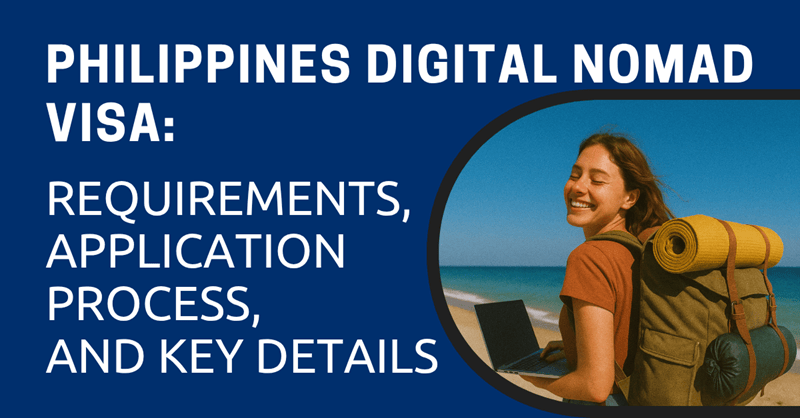
The Philippines Digital Nomad Visa launched in mid-2025, letting remote workers live legally in the country for up to two years. Here is what you need to qualify and how to apply.
Everything You Need to Know to Work Remotely from the Philippines
The Philippines is another country in Southeast Asia, after Thailand, that has released a digital nomad visa.
With this visa, remote workers and digital nomads can live and work legally for up to two years. This means no more doing visa runs with a tourist visa.
In this post, you’ll find everything you need to know about the Philippines digital nomad visa, including the requirements, necessary documents, and step-by-step application process.
The Philippines Digital Nomad Visa has been officially authorized via Executive Order No. 86 (signed April 24, 2025) and applications are now being processed through the official e-Visa portal. We will update the article with any new official details as they are released.
Contents
- Key Takeaways
- What Is the Philippines Digital Nomad Visa?
- The Philippines Digital Nomad Visa Requirements
- Required Documents
- How to Apply
- Launch Timeline
- Restrictions
- Frequently Asked Questions
- When can I apply for the Philippines Digital Nomad Visa?
- Can I work for a Philippine company while on this visa?
- Do I need to pay personal income taxes in the Philippines?
- Can I bring dependents or family members?
- Can I convert this visa to permanent residency?
- Can I travel in and out of the Philippines while on this visa?
- Pros and Cons of Being a Digital Nomad in the Philippines
- Should I Get a Philippines Digital Nomad Visa?
Key Takeaways
- The Philippines Digital Nomad Visa launched in mid-2025, authorized by Executive Order No. 86 signed on April 24, 2025.
- The visa allows you to stay in the Philippines for up to 2 years (1 year initial, renewable for a second year).
- Proof of remote work, foreign-sourced income, and valid health insurance are the three main requirements. The exact minimum income threshold has not been officially confirmed.
- With the Philippines Digital Nomad Visa, you can continue your remote work as long as it is not for a Philippines-based company.
- You cannot work for a company based in the Philippines.
- Applications are submitted online through the official Philippines e-Visa portal (evisa.gov.ph).
What Is the Philippines Digital Nomad Visa?
The Philippines Digital Nomad Visa is a visa program that allows remote workers and digital nomads to live and work legally in the Philippines.
It works the same as digital nomad visas in other countries:
- You can live in the Philippines legally.
- The visa is initially valid for 1 year. Then, you can renew it for another year, giving you a total stay of 2 years. After that, you should be able to reapply, assuming you still fulfill all the requirements.
- You can work for an overseas company or run an online business, as long as it is with international clients.
The Philippines Digital Nomad Visa Requirements
Below are the main requirements for the Philippines Digital Nomad Visa. They are similar to digital nomad visas in other countries.
Note that the exact minimum income threshold has not been officially confirmed by the Philippine government. We will update this section once official figures are published.
- Age requirement: You must be at least 18 years old.
- Proof of work: You must work remotely for an overseas employer or run an online business for international clients.
- Income requirement: You must demonstrate sufficient foreign-sourced income to support yourself during your stay. The exact minimum has not been officially announced, though third-party guides estimate around US$2,000 per month (US$24,000 per year).
- Country eligibility: You must be a citizen of a country that has diplomatic relations with the Philippines and that offers reciprocal digital nomad visa access to Filipino nationals. This covers most countries worldwide.
- Criminal background: You must have a clean criminal record.
- Health insurance: You must have valid health insurance that covers your entire stay in the Philippines.
Requirements may vary slightly depending on your nationality and the specific Philippine embassy or consulate processing your application.
Required Documents
Here are the documents you will need for the Philippines Digital Nomad Visa application:
- Passport: Valid for at least 6 months with blank pages for visa stamps.
- Remote work proof: Documentation showing your remote work arrangement, such as employment contracts, freelancer contracts, or portfolio.
- Income verification: Bank statements (at least 3 months), payslips, tax returns, or other documents proving sufficient foreign-sourced income.
- Health insurance policy: Health insurance coverage that includes medical treatment in the Philippines.
- Criminal background check: Apostilled police clearance from your home country.
- Completed application form: Available through the official Philippines e-Visa portal at evisa.gov.ph.
Each Philippine embassy, consulate, or immigration office may require slightly different documents, so confirm the requirements with them before submitting your application.
How to Apply
Applications are processed through the Philippines’ official e-Visa portal. Here is what to expect:
- Online applications: Submit your application through the Philippines eVisa website.
- Embassy applications: You may also be able to apply in person at Philippine embassies or consulates in your home country.
- Processing location: Applications are handled through the Philippine Department of Foreign Affairs, Bureau of Immigration, and relevant foreign service posts.
- Fees: Application fees have not been officially published. Third-party sources estimate US$200-US$300 depending on nationality. We will update this once official figures are confirmed.
- Processing time: Expect 2-6 weeks for standard processing, though some embassy appointments for document verification may be required.
Launch Timeline
The Philippines Digital Nomad Visa was officially authorized by Executive Order No. 86, signed by President Ferdinand R. Marcos Jr. on April 24, 2025. Applications opened through the e-Visa portal in mid-2025 and the program is now fully operational. The visa is jointly administered by the Department of Foreign Affairs, Bureau of Immigration, Department of Justice, Department of Tourism, and Bureau of Internal Revenue.
Based on community reports, many applicants found that preparing apostilled documents in advance significantly reduced delays, since the apostille process alone can take 2-4 weeks depending on your home country.
Restrictions
The primary restriction is an employment restriction: you cannot work for a company based in the Philippines while holding this visa. Your income must come exclusively from overseas clients or employers. This is a common restriction for digital nomad visas around the world.
Foreign-sourced income is exempt from Philippine income tax, though you remain responsible for meeting your tax obligations in your home country.
Frequently Asked Questions
When can I apply for the Philippines Digital Nomad Visa?
Applications are now open. The program launched in mid-2025 and is being processed through the official e-Visa portal at evisa.gov.ph.
Can I work for a Philippine company while on this visa?
No. Your remote work must be exclusively for overseas clients or employers. Working for Philippine-based companies is not permitted.

Do I need to pay personal income taxes in the Philippines?
Foreign-sourced income is exempt from Philippine income tax under the visa program. You will still owe taxes in your home country on that income.
Can I bring dependents or family members?
This has not been officially confirmed yet. We will update this section once official guidance is published.
Can I convert this visa to permanent residency?
It is unlikely that you can convert it to permanent residency or other long-term immigration statuses.
Can I travel in and out of the Philippines while on this visa?
Yes. The Philippines Digital Nomad Visa grants multiple-entry privileges, so you can travel in and out of the country freely during the visa period.
Pros and Cons of Being a Digital Nomad in the Philippines
If you are still deciding whether you want to be a digital nomad in the Philippines, here is a quick list of pros and cons:
Pros:
- Hassle-free visa: No more visa runs. You can now live in the Philippines for up to 2 years.
- English-speaking environment: Almost everyone speaks English well, making communication straightforward.
- Low cost of living: Your money goes further here. You can live comfortably for less than US$1,000/month. The cost of living in the Philippines is among the lowest in the region.
- Growing digital nomad community: Major cities like Manila, Cebu, and Siargao have established co-working spaces and nomad communities. The community in these hubs tends to be tight-knit, with co-working spaces doubling as social venues.
- Tropical lifestyle: Access to beautiful beaches, islands, and outdoor activities year-round.
Cons:
- Infrastructure challenges: Outside of major cities, internet speed and stability can be unreliable. Regular power outages, known locally as “brownouts,” are also common.
- Unclear income threshold: The minimum income requirement has not been officially confirmed, which makes it harder to plan your application.
- Weather concerns: Typhoon season and high humidity may not suit everyone.
- Bureaucratic processes: Philippine government processes can be slow or require multiple visits. The apostille requirement for police clearance adds time to the document preparation stage.
- Safety concerns: Overall safety is not as strong as in nearby countries like Thailand or Malaysia.
Should I Get a Philippines Digital Nomad Visa?
If you are planning to live and work in the Philippines long-term, this visa is the most straightforward legal path available. The affordable cost of living, English-speaking environment, and growing nomad communities make the Philippines a practical base. The main unknown is still the official income threshold. Once that is confirmed, you will have a clear picture of whether you qualify.
Related article: Thailand Destination Thailand Visa (DTV): Requirements and Application in 2026




 Deutsch:
 Français:
 Español: