This article will take approximately 11 minutes to read. Don't have the time right now? No worries. Email the ad-free version of the article to yourself and read it later!
Immunization is crucial to keep your baby healthy. Private hospitals in China offer immunization packages for children. Once you pick the hospital, your child will receive a vaccination book, and a pediatrician will make a schedule for the vaccine appointments.
China is one of the biggest manufacturers of vaccines in the world, and the Chinese vaccine regulations meet the World Health Organization standards. They divide vaccines into two categories. Category 1 is under the national Expanded Program on Immunization (EPI), and category 2 comes from the private sector.
They do not include these vaccines in the EPI.
Disclaimer: This article may include links to products or services offered by ExpatDen's partners, which give us commissions when you click on them. Although this may influence how they appear in the text, we only recommend solutions that we would use in your situation. Read more in our Advertising Disclosure.
Contents

Is It a Good Idea to Get a Vaccine for Your Kids in China?
You do not need to worry about vaccinating your children in China. According to the WHO, China has established a well-functioning and integrated regulatory system that ensures the quality, effectiveness, and safety of vaccines manufactured in the country or imported.
Most vaccines are available in China’s public healthcare system. But if you can’t speak Chinese, it can be a challenge to navigate the system. On the other hand, you can also get them from the private sector at your own cost or get comprehensive insurance that covers vaccinations.
Also, after your relocation, your children can easily continue their vaccination schedules. Just keep tracking them and take a photo of the vaccine boxes for your records.
By vaccinating your children, you can protect them from serious diseases. To clarify any doubts, read more from the Centers for Disease Control and Prevention provides on immunization.
Find out more: Cigna Global Review – Is It Good International Medical Insurance for Expats?
Types of Vaccines and Vaccination Routes
The vaccination world might confuse a new parent. First, you need to learn about the types of vaccines and the ways your baby can get them.
These are the types of vaccines available on the market
- Attenuated (weakened) live germs. For instance, the vaccines are against measles, mumps, rubella (MMR), and chickenpox.
- Inactivated (killed) germs. For example, the flu shot is an inactivated germ.
- Toxoid vaccines. They use this type of vaccine against diphtheria and tetanus diseases.
- Conjugate vaccines (examples are vaccines against hepatitis B, HPV, whooping cough, and meningitis).
- mRNA (messenger RNA) vaccines (some covid vaccines are examples).
Your baby can get vaccines via
- oral methods
- intramuscular injection (IM)
- subcutaneous injection (SubQ)
- intradermal injection (ID)
These are Category 1 vaccines that are generally recommended and included in the Expanded Immunization Program in China. Your local hospital should also give you a local timeline for when you receive each vaccination.
HepB – Hepatitis B
Timeline: first dose on the day of birth, second dose at 1 or 2 months, third dose at 6 months.
The infant will receive the first dose of the Hepatitis B vaccine within 24 hours of life. Children adequately respond to this vaccine. It comes via intramuscular injection. According to the WHO, the hep B vaccine can prevent infection 95% of the time. In 1992 the Chinese government started a National Hepatitis B Immunization Plan, and cases have dropped since then.
BCG – Tuberculosis
Timeline: only one dose on the day of birth.
Bovis Calmette-Guérin vaccine prevents tuberculosis. It gives protection for about 20 years. Some studies showed that this vaccine might also decrease the development of some diseases, such as asthma.
China implemented the BCG immunization plan in 1957.
It comes via intradermal injection. Your baby will receive it directly after birth.
Pertussis, Diphtheria, Tetanus
Timeline: a first dose of DTaP: 3 months, and then at 4, 5, and 18 months, a final dose of DT: 6 years.
These vaccines prevent diphtheria, tetanus, and pertussis diseases (whooping cough).

DTaP and DT vaccines come via intramuscular injection.
Poliomyelitis
Timeline: First dose of IPV: two months, second dose of IPV: three months, and then bivalent oral vaccine at four months and four years.
Poliovirus vaccines (Inactivated and bivalent). It is given in a four-dose series via an intramuscular injection.
Men – Meningococcal
Timeline: first two doses: 6 and 9 months (MPSV-A), and then two final doses: 3 and 6 years (MPSV-AC).
Meningococcal polysaccharide vaccine (MPSV-A and MPSV-AC) is used to prevent Neisseria meningitides, which can cause meningitis and some other diseases. The vaccine became available in China in 1980.
It is given in four doses via subcutaneous injection. The manufacturers of this vaccine are domestic.
JE – Japanese Encephalitis
Timeline JE-L (live): first dose: 8 months, second dose: 2 years.
Timeline JE-I (inactivated): first two doses at 8 months with an interval of 7 to 10 days, the second dose at 2 years, and then the third dose at 6 years.
Japanese encephalitis (JE) vaccines can prevent Japanese encephalitis. This disease occurs mainly in Asia and the Western Pacific. Half of the cases occur in China. It spreads through the bite of a mosquito. It is a dangerous disease that can progress to a brain infection. No treatment exists, so the most effective prevention method is a vaccine.
Two vaccines are available: JE-L (live) and JE-I (inactivated). Your baby will receive JE-L in two doses, via subcutaneous injection. JE-I comes in a four-dose series.
MMR – Measles, Mumps, Rubella
Timeline: first dose: eight months, second dose: eighteen months.
MMR vaccine protects against measles, mumps, and rubella. Children get two doses of MMR vaccine via subcutaneous injection.
HepA – Hepatitis A
Timeline: the first dose: 18 months, the second dose: 24 months.
Two types of HepA vaccine are available in China: A live attenuated and An inactivated vaccine. A live attenuated comes with one dose of HepA and has been since 1992. They give it to children after 18 months. An inactivated, two-dose HepA vaccine has been available since 2002. The first dose is The manufacturers of both vaccines are domestic.
Other Recommended Vaccines by WHO
Although some important vaccines are not in the Chinese Expanded Immunization Program, the WHO recommends them for your children’s immunization. These vaccines are coming from the private sector in China.
Hib – Haemophilus Influenzae Type B
Timeline: first dose: 2 months, then 2 or 3 more before 15 months of age.
They use this vaccine against meningitis, pneumonia, and other severe infections. The WHO recommends this vaccination for countries in all countries. China introduced the Hib vaccine in 1997.
Varicella
Timeline: first dose: 12 through 15 months, a second dose between 4 and 6 years old.
Currently, many types of vaccines are available in the Chinese market to prevent chickenpox. Check with your healthcare provider to find out which one works best for your case.
Rotavirus
Timeline: first dose: 15 weeks of age, final dose: no later than 8 months of age.
This virus causes fever, diarrhea, vomiting, and abdominal pain. In China, many vaccines are available such as the Lanzhou lamb rotavirus vaccine (LLR) by a domestic manufacturer, Lanzhou Institute of Biological Products, and RotaTeq.
PCV – Pneumococcal
Timeline: a first dose of PCV13: 2 months, a second dose: 4 months, a third dose: 6 months, final dose: between 12 and 18 months.
This vaccine is also known as the pneumonia vaccine. 13-valent pneumococcal conjugate vaccine (PCV13) has been available in China since 2017.
The Centers for Disease Control and Prevention recommends pneumococcal vaccination for all infants and children younger than two years and all adults 65 years or older.
Seasonal Influenza – Flu
Timeline: yearly
Children spread the flu in schools and kindergarten. Therefore, the WHO recommends that all children above six months old take vaccine shots.
In China, the influenza vaccine has been available in the market but is still not included in the national immunization program, and the coverage for children is shallow. However, many cities in China now provide influenza vaccines to children free of charge.
HPV – Human papillomavirus
Timeline: first dose: 9 years, second dose: 6-12 months after the first dose.
HPV vaccination is the most effective way to prevent cervical cancer. Since 2016, China has approved multiple HPV vaccines, including imported products such as Cervarix®, Gardasil®, and Gardasil® 9, as well as domestic vaccines including Cecolin® and newer Chinese‑made bivalent and multivalent vaccines.
Two-dose schedule is recommended for children who started vaccination before their fiftteen’s birthday, and a three-dose schedule for children who started vaccination after their fifteen’s birthday.
Vaccine Side Effects
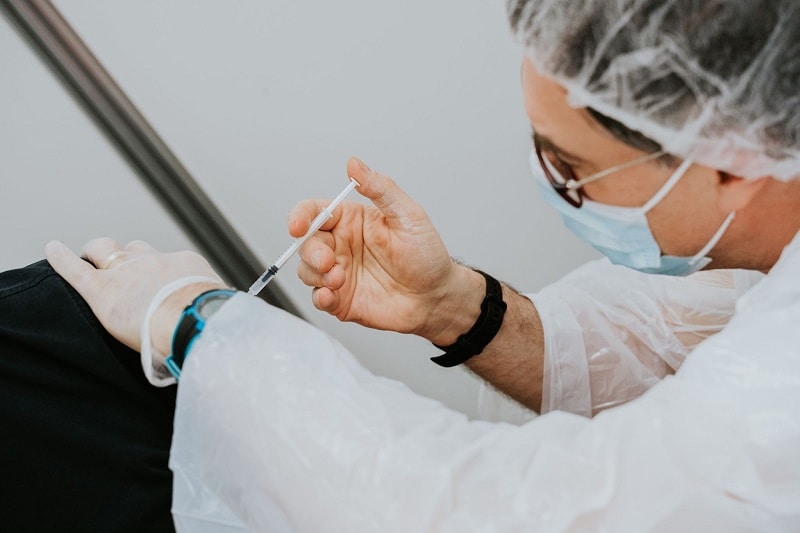
Vaccines, as medicines, can have some side effects, but they are very mild.
After some particular vaccines, your baby can get fever, tiredness, redness, swelling, and body aches. However, it is unnecessary to worry. It will go away within a few days. If you notice your baby has a strange reaction, contact your pediatrician.
Costs
Private hospitals in China offer pediatric immunization packages that bundle vaccines, injections, and routine pediatric check-ups. Prices can be high, so having a good health insurance plan is important.
Typical vaccination package prices in Shanghai are generally around:
- 1 to 24 months: 18,600 RMB
- 1 to 12 months: 13,800 RMB
- 1 to 6 months: 9,800 RMB
- 7 to 24 months: 8,800 RMB
These packages usually include scheduled pediatric consultations, standard childhood vaccines, and administration fees.
Learn more:
- Health Insurance for Expats in China: What You Need to Know
- The Essential Guide to Hospitals in Shanghai
Things to Consider
1. You can check with your hospital if they offer different vaccines when appropriate. For instance, combination vaccines as an alternative to single vaccines, imported vaccine brands of your choosing, locally produced alternatives to expensive brands etc. Be sure to ask your doctor lots of questions.
2. Check what vaccines they recommend in your home country, and then ask the Chinese hospital if they have them, so when you are back in your home country, your child will not have issues attending kindergarten or school.
3. When vaccinating your children, consider diseases that can occur in China. For instance, Japanese encephalitis. It might not be present in your country but might appear in China, especially in rural areas. Vaccination against this disease might be very beneficial for your baby.
Timetable
The schedule for vaccinations of children will vary slightly around the world according to each country’s own government regulations. In China, hospitals will generally follow the China CDC Recommendations which you can find at this link. But the most important thing is that you communicate clearly with your child’s doctors, keep all medical records, and make the best choices for your child.

Now, on to You
Check the vaccination program in your home country, and once you visit a pediatrician, ask what vaccines you can get in China. Take a photo of the vaccine box. It might be helpful if you need to come back to your home country and continue vaccination there. And last but not least, check that the nurse updates information in the vaccination book.
Vaccination is one of the best ways to take care of the health of our children and keep them safe.






 Deutsch:
 ไทย:
ไทย: Français:
 Português:
 Português:
 Español:
 Español:
 中文 (中国):
 Русский:
 Nederlands:
 العربية:
 Italiano: