This article will take approximately 26 minutes to read. Don't have the time right now? No worries. Email the ad-free version of the article to yourself and read it later!
Sending money to Vietnam may have been a challenge 10 to 15 years ago, but with the rise of online money transfer services, transferring money into the country has become quite easy.
With all the choices currently available, the only challenge now is picking a service that gets you the best exchange rates and lowest transfer fees.
Luckily for you, services like Monito do all the legwork and list out the money transfer services that fit the criteria above, saving you both time and money.
If you want to do all the legwork yourself, then continue reading.
In this guide, we’ll show you the fastest, cheapest, and most reliable way to send money to Vietnam while getting the best exchange rates and transfer fees while avoiding hidden charges.
Contents
- Key Takeaways
- What to Watch Out For
- Transfer Options
- What Happens to the Money Once It Lands in Vietnam
- Foreign Currency Checks
- Forex Companies
- Examples of Forex Companies
- Cash Pickup Without a Bank Account
- Cryptocurrencies
- Country-Specific Recommendations
- Now, on to You
- Frequently Asked Questions
- Do I have to pay tax on money my family sends me in Vietnam?
- Is there a limit on how much money I can receive in Vietnam?
- Do I need a Vietnamese bank account to receive an international transfer?
- Can I receive an international transfer directly into MoMo?
- How much cash can I carry into Vietnam without declaring it?
- Why did the bank ask my recipient for extra paperwork on an incoming transfer?
- Sources Cited
Key Takeaways
- Online transfer services like Wise almost always beat banks on cost for sending money to Vietnam.
- Banks hide most of their margin in the exchange rate and can cost up to 5 percent more.
- Always compare a service against the mid-market rate (check XE.com) before you send.
- Wise charges low, transparent fees and uses the real mid-market exchange rate.
- For cash pickup, Western Union and Remitly are fast but pricier on instant transfers.
- Ask the receiving Vietnamese bank, not the sending bank, to convert your money into dong.
- Since January 2026, crypto is legal to own in Vietnam but still cannot be used for payment.
- Use a comparison tool like Monito to find the cheapest option for your route.
What to Watch Out For
The cheapest way to transfer money to Vietnam is usually an online service like Wise, paid for from your bank account. The fee and the exchange rate together decide how much dong lands, so check both before you pick a provider.
If you’re looking to send money to Vietnam, the first thing that you need to take notice of is the exchange rates, transfer fees, transfer speed, and security.
Transfer Fees
When transferring money into the country, you have to pay one of these three types of transfer fees:
- Fixed Fees
- Percentage Fees
- Combination of both
Fixed Fees
Mostly, you will be paying a fixed fee along with what the service provider charges. The fixed fee varies based on the currency you choose.
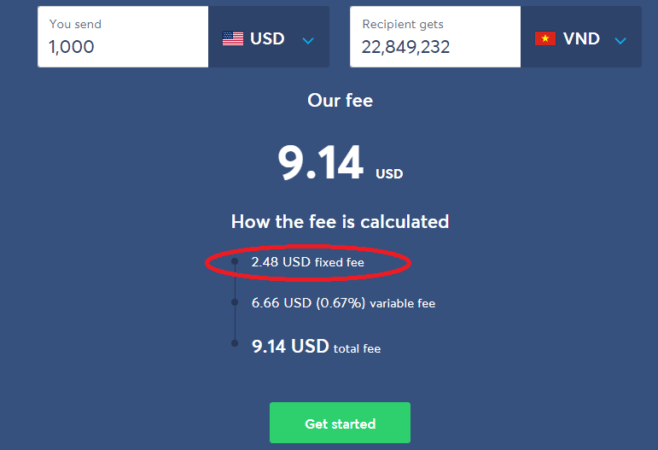
For example, if you send US$1,000 to Vietnam by wire transfer, Wise charges a fixed fee of US$7.92 plus a variable fee of US$5.34, so US$13.26 in total. Pay from a US bank account by ACH instead and the total drops to US$8.84. (Verified October 2026.)
Similarly, if you send AUD1,000 from an Australian bank account, Wise charges a fixed fee of AUD2.12 plus a variable fee of AUD5.56.
Percentage Fees
Percentage fees are calculated based on a percentage of the total transfer amount. Hence, if you plan to send a large sum of money, the fee will also be on the higher side.
While sending money overseas, receiving banks normally charge you around 0.125 percent, while Wise’s variable fee on a transfer to Vietnam is about 0.5 to 0.7 percent when you pay from a bank account.
Paying by credit card costs far more. Wise’s variable fee on a USD credit card transfer is over 7 percent, so fund it from your bank account if you can. (Verified October 2026.)
Combination of Fixed and Percentage Fees
There are various money transfer services and banks that use a combination of both the fixed fee and the percentage fee.
As shown in the picture above, you can see that Wise charges both a fixed and a percentage fee for an online money transfer to Vietnam.

Remember, lower transfer fees don’t guarantee a cheaper transfer, because you still have to check the exchange rates as well, which we’ll get into in the next section.
Exchange Rates
Before you send money to Vietnam, you need to take note of the exchange rates on offer on the various transfer options.
Online transfer agencies won’t openly declare the exchange rates. Like the surcharge fees you pay for your airline ticket, the exchange rate is an additional fee you pay for sending money across a border, apart from your transfer fees.
Wise, however, is one of the few online money transfer services that doesn’t charge an exchange rate fee.
Banks in Vietnam, like HSBC, on the other hand, can charge an exchange rate fee of roughly 0.2 percent.
Watch out for online transfer agencies that claim they don’t charge any additional fees, as they normally add them into their exchange rates.
Before you send money to Vietnam, check the mid-market rates at XE.com and select a service accordingly that suits your requirements.
Transfer Speeds
If you’re in a hurry, then you need to choose a service that comes with better transfer speeds.
Speeds vary based on the transfer option you choose.
Generally, sending money through banks may take one to three business days, while online transfer services like Wise can get your money delivered in less than 24 hours.
Fund Security
Apart from the best exchange rates and transfer speeds, you also need to consider the safety of your money.
Hence, it’s always recommended to choose a service that complies with local and international money transfer standards and provides ample security.
Transfer Options
Online money transfer services are the cheapest way to send money to Vietnam for most people. Banks and PayPal usually cost more once you add up the fee and the exchange rate.
There are various options available to send money to Vietnam, including:
- Online money transfers
- Bank transfers
- PayPal
- Western Union
- Foreign currency checks
- Forex companies
- Crypto transfers
Generally, the transfer speed, exchange rates, and convenience vary between these transfer options.
Online Money Transfer Services
People looking for the fastest method to send money to Vietnam usually choose online money transfer services.
Listed below are two of the most popular online money transfer services available.
Wise
Wise’s primary goal is to offer you excellent service at affordable rates when sending money overseas.

Highlights
- Excellent customer service
- Exchange rate locking
- Over 40 currencies supported
- Free business account and debit card
- Transparent rates
- No hidden charges
- Over 10 million customers
- FCA regulated
Exchange Rates
One of the major advantages of Wise over other transfer services is that they offer transparent exchange rates.
You can get a clear idea about the exchange rates and transfer fees on your transaction before following through with it.
Wise only charges mid-market rates as exchange rates. Hence, you can be guaranteed that no additional fees are charged in the name of exchange rates.
Transfer Fees
The transfer fees charged by Wise are very nominal when compared to other transfer services like forex agencies and banks.
Sending US$1,000 to a Vietnamese bank account from a US bank account (ACH) costs US$8.84 in total with Wise, which is under 1 percent. (Verified October 2026.)
Small transfers cost more in percentage terms. Sending US$100 the same way costs US$2.51, or about 2.5 percent.
You can reduce transfer fees even more by opening a borderless account to send money to Vietnam.
To find out more about borderless accounts, read our in-depth review of opening a Wise borderless account.
Transfer Speeds
Wise is reputed for its transfer speeds, as it is far quicker than most of the other online transfer agencies.
If you send US$1,000 to Vietnam, for instance, it will get delivered in just one to two days. If you opt for bank transfers, it will take more than two to three days.
Debit and credit card transfers will happen in less than an hour, whereas wire transfers will happen within 24 hours.
To find out more about the rates and speed, check out Wise’s online calculator.
Ease of Use
Wise also comes packed with a lot of features and an easy-to-use interface.
It also supports around 13 different languages, including English, French, Spanish, Polish, Dutch, Turkish, and more.
The help center provides all the answers to your questions, like how to send money, how to activate your Wise card, how to cancel transfers, and how to send batch payments.
Others
Apart from Wise, there are other money transfer options available, like:
International Bank Transfers
Generally, some people prefer an international bank transfer for sending money to Vietnam.

Banks are preferred because they have been in existence for many years and have earned the trust of the people.
Moreover, people also got used to the method, and many still think it’s the safest option.
But the reality is that international bank transfer rates are very high when compared with other transfer options available.
You will end up paying up to 5 percent more in the name of exchange rate fees and transfer fees.
Moreover, banks won’t disclose the total charges to be deducted from your transaction.
Hence, unless you’re sending a huge sum of money or you want credit advice for accounting purposes, bank transfers are not recommended.
Sending Banks
If you do send money to Vietnam, remember that the fee structure varies from bank to bank.
While banks tell you about the transfer fees during your transaction, they won’t disclose the exchange rates.
Transfer fees for sending money will range from 4 percent to 5 percent, whereas exchange rate fees will come to 2 percent to 3 percent of the total amount to be sent.
Banks say that since the exchange rates may vary, they cannot disclose the exact rate. But this is not a fact, because the online transfer agencies can easily provide you with a complete breakdown of all the charges.
Check the mid-market rates with the exchange rates provided by banks and select the bank that offers a rate that is closest to the mid-market rates.
This will save you a considerable amount if you send a large sum of money to Vietnam.
Usually, banks charge you some additional fees as conversion charges. For example, when you send money in foreign currency and ask the sending bank to convert it to VND.
Hence, it’s always a better option to ask the receiving bank to do the conversion rather than the sending bank, as the rates will be much lower with the receiving bank.
Receiving Banks
Similar to sending banks, receiving banks also have their own fee structures. In Vietnam, the fee structure varies from bank to bank.
Getting quotes about the exchange rates from both the sending and receiving banks is quite tough, because they operate using the prevailing rates.
Based on our analysis of Vietnamese banks, VietComBank offers the lowest fees at 0.05 percent on incoming transfers, along with decent exchange rates when receiving international transfers of foreign currency.
One thing to check before sending: as of 1 April 2026, all Vietnamese bank payment accounts must be registered under the account holder’s real name matching their official ID, under Circular 30/2025/TT-NHNN. Make sure the name on the recipient’s bank account matches their passport or national ID exactly, or the transfer may be rejected.
Biometric verification is a separate requirement, and it trips people up. A personal payment account in Vietnam can only be used for electronic payments and cash withdrawals once the holder has matched their biometrics against their chip ID card, under Circular 17/2024/TT-NHNN. For personal accounts, this rule has applied since 1 January 2025. (Verified October 2026.)
So if your recipient never completed that step, the money can land in their account but their internet banking, mobile banking, and ATM withdrawals stay blocked. They can fix it in their bank’s app with an NFC phone, or at any branch with their chip ID card.
What Happens to the Money Once It Lands in Vietnam
Money that family or friends send you in Vietnam isn’t taxed, but it only clears smoothly if the account name matches the recipient’s ID and their biometrics are verified. The same applies if you’re moving your own pension over to retire in Vietnam.
Getting a good rate is only half the job. The other half is making sure the transfer actually clears without your recipient getting a call from their bank asking for paperwork.
The good news first: personal remittances, money sent by a relative or friend abroad to someone in Vietnam, are exempt from personal income tax under Circular 111/2013/TT-BTC, and there’s no cap on the amount. The recipient just needs to be able to show where the money came from if a bank ever asks, so tell them to keep the transfer receipt or confirmation email.
That documentation habit matters more for larger transfers. Under the State Bank of Vietnam’s reporting rules, incoming international electronic transfers above a set threshold get reported to the SBV, and large cash transactions at a Vietnamese bank in a single day are reported too. None of this blocks a normal remittance. It’s routine anti-money-laundering paperwork that happens in the background, but it’s why a bank teller sometimes asks extra questions on a bigger transfer.
The other thing to get right before you send: the recipient’s name on the receiving bank account has to match their official ID exactly, and the account itself has to be biometrically verified. Skip either step and the money can still arrive, but the account can be frozen for online banking, mobile banking, and ATM withdrawals until your recipient fixes it in person or through their bank’s app.
Foreign Currency Checks
While international bank transfers are considered a safe and trusted option, the exchange rates are much higher than those of other transfer options.
Moreover, forex agency rates are lower than banks’, but still high compared to online money transfer services.
Hence, people looking for lower rates sometimes go for foreign currency checks.
Compared to other transfer options, sending money in the form of a foreign currency check could be beneficial because the conversion will be done at the receiver’s bank only.
Before sending foreign currency checks, however, ensure that the check is valid in that particular country, as some local checks are not.

Also, when compared with other transfer options, foreign currency check transfers are the slowest.
Forex Companies
Forex money transfers are another method you can use to send money to Vietnam.
While some forex agencies claim to charge lower exchange rates for money transfers, the transfer fees are much higher to compensate.
Hence, if you’re opting for a forex transfer, ask about both the exchange rate fees and the transfer fees before sending money.
What is a Forex Company?
A forex company is a non-banking firm that provides foreign exchange services and international money transfers.
People can easily buy and sell foreign currencies using forex companies.
Moreover, people mainly opt for forex companies when they need to transfer large sums of money.
Why Should You Use Forex Companies to Send Money Overseas?
Forex companies may not be the cheapest way to send money to Vietnam, but they can come in handy in emergencies.
What Are the Disadvantages of Using Forex Companies?
One of the main drawbacks with forex companies is that their process is not as transparent as that of online money transfer service providers.
Examples of Forex Companies
Western Union is the fastest of the big names, with cash or MoMo pickup in minutes, but it’s rarely the cheapest way to send money to Vietnam.
Listed below are a few examples of forex companies.
Western Union
If you’re looking for a quick way to send money to Vietnam, then Western Union is a good choice.

With Western Union, your money gets delivered in just a couple of minutes.
However, when compared with other money transfer services, Western Union’s exchange rates are much higher. But these rates are only higher when you opt for instant money transfers.
If you choose regular transfers, on the other hand, the rates may come down to 3 percent or 4 percent as opposed to 7 percent with instant transfers.
Western Union has thousands of agent locations across Vietnam; use its official location finder for the nearest one. You can send money through:
- Their mobile application
- The nearest Western Union branch
- Their website
Sending Straight to a MoMo Wallet
If your recipient doesn’t have a Vietnamese bank account, or just prefers not to deal with one, an e-wallet is often the easiest landing spot. MoMo is Vietnam’s biggest mobile wallet, and it’s used for everything from splitting a restaurant bill to paying utility bills.
Western Union and MoMo have a direct partnership: your recipient searches for Western Union inside the MoMo app, enters the tracking number from your transfer, and the money shows up in their wallet. No trip to an agent location required.
Remitly offers the same option. Alongside cash pickup and bank deposit, Remitly lists MoMo mobile wallet as a delivery method for transfers to Vietnam, so you can pick whichever suits your recipient at checkout.
One thing to check first: MoMo accounts have their own identity verification requirements in Vietnam, so make sure your recipient’s wallet is already verified before you send. An unverified wallet can delay or cap how much it can receive.
PayPal
PayPal is another option for sending money overseas.

It’s one of the best online money transfer methods if you’re looking to send small amounts of money.
For an international personal transfer from a US PayPal account, PayPal charges 5 percent of the amount, with a minimum of US$0.99 and a maximum of US$4.99. That doesn’t include the exchange rate. (Verified October 2026.)
As long as you send USD to a PayPal account, there’s not much of a problem. However, if your recipient gets a different currency from the one you pay in, PayPal adds a 4 percent currency conversion fee.
One disadvantage to PayPal is that you can only send money to people who also have a PayPal account.
Cash Pickup Without a Bank Account
Not every recipient in Vietnam has a bank account or an e-wallet, especially in smaller towns. Cash pickup solves that: the money is available to collect in person, usually within minutes for a digital transfer.
The main networks with pickup coverage in Vietnam are:
- Western Union, through its own agent locations and partner banks
- Remitly, which lists cash pickup alongside bank deposit and MoMo wallet for Vietnam
- MoneyGram, through its own partner network
Your recipient will need valid photo ID to collect the cash, and the name on the transfer has to match that ID. Use each provider’s own location finder before you send, since coverage varies by city and changes over time.
Cash pickup is convenient, but it’s rarely the cheapest option. If your recipient can receive into a bank account or MoMo wallet instead, that route usually beats pickup on both fees and exchange rate.
Cryptocurrencies
For years, the State Bank of Vietnam treated cryptocurrency as illegal to use for payment, and people could be fined for paying with it.
That shifted on January 1, 2026, when Vietnam’s Law on Digital Technology Industry took effect. The law recognizes crypto as a form of property you can legally own, trade, and invest in.
It still is not legal tender, so you cannot use it to pay for goods and services in Vietnam. From January 20, 2026, the Ministry of Finance also started licensing approved crypto exchanges under a pilot program.
For simply sending money to Vietnam, though, crypto is rarely the easiest or cheapest route. Unless you and the recipient already use it, a service like Wise is faster and simpler to cash out into Vietnamese dong.
Country-Specific Recommendations
Wise beat OFX on every route we checked in October 2026, landing about VND1,000,000 more in Vietnam on a US$1,000 transfer.
If you’re looking for information on rates and fees for sending money from a particular country, we’ve got you covered in the sections below.
Please note that money transfer service providers may change their exchange rates and transfer fees over time.
Use Monito to get the best rates.
The Wise and OFX figures below are each provider’s own quote for a bank-funded transfer, checked in October 2026. The Remitly and WorldRemit figures come from an earlier snapshot. Rates move daily, so confirm the number on each provider’s live calculator before you send.
Sending Money from the USA to Vietnam
Looking for the best method to transfer money from the U.S. to Vietnam?
Check the comparison table below to compare the transfer fees, exchange rates, and transfer speeds for transfers of US$1,000 to Vietnam using Wise, OFX, Remitly, and WorldRemit.
| Provider | Transfer Fee | Exchange Rate | Amount Received (VND) | Speed |
| Wise | US$8.84 | 25,849.00 | ₫25,620,495 | 1-2 days |
| OFX | US$5.00 | 24,611.73 | ₫24,611,732 | 1-3 days |
| Remitly | – | 25,575.25 | ₫25,575,250.64 | 0-2 days |
| WorldRemit | US$4.99 | 25,023.98 | ₫24,899,111.01 | 1-2 days |
Sending Money from the UK to Vietnam
Looking for the best method to transfer money from the UK to Vietnam?
Check the comparison table below to compare the transfer fees, exchange rates, and transfer speeds for transfers of GBP1,000 to Vietnam using Wise, OFX, Remitly, and WorldRemit.
| Provider | Transfer Fee | Exchange Rate | Amount Received (VND) | Speed |
| Wise | GBP7.03 | 34,525.20 | ₫34,282,488 | 1-2 days |
| OFX | GBP7.00 | 32,922.71 | ₫32,922,715 | 1-3 days |
| Remitly | – | 35,065.23 | ₫35,065,228.10 | 0-2 days |
| WorldRemit | GBP6.99 | 34,089.59 | ₫33,851,300.59 | 1-2 days |
Sending Money from Singapore to Vietnam
Looking for the best method to transfer money from Singapore to Vietnam?
Check the comparison table below to compare the transfer fees, exchange rates, and transfer speeds for transfers of SGD1,000 to Vietnam using Wise, OFX, Remitly, and WorldRemit.
| Provider | Transfer Fee | Exchange Rate | Amount Received (VND) | Speed |
| Wise | SGD6.30 | 20,205.60 | ₫20,078,305 | 1-2 days |
| WorldRemit | SGD3.00 | 20,135.47 | ₫20,075,063.70 | 1-2 days |
| OFX | SGD15.00 | 19,233.17 | ₫19,233,175 | 1-3 days |
| Remitly | – | 20,369.02 | ₫20,369,015.32 | 0-2 days |
Sending Money from Australia to Vietnam
Looking for the best method to transfer money from Australia to Vietnam?
Check the comparison table below to compare the transfer fees, exchange rates, and transfer speeds for transfers of AUD1,000 to Vietnam using Wise, OFX, Remitly, and WorldRemit.
| Provider | Transfer Fee | Exchange Rate | Amount Received (VND) | Speed |
| Remitly | – | 18,733.75 | ₫18,733,753.17 | 0-2 days |
| Wise | AUD7.68 | 18,164.10 | ₫18,024,600 | 1-2 days |
| OFX | AUD15.00 | 17,318.12 | ₫17,318,118 | 1-3 days |
| WorldRemit | AUD9.99 | 18,164.39 | ₫17,982,926.92 | 1-2 days |
Now, on to You
Most people are of the opinion that bank transfers are the best option when it comes to sending money to Vietnam.
But if you start comparing the exchange rates between banks and other online money transfer services, you’ll discover that that’s not always the case.
Online money transfer services can save you a lot of money, as they offer favorable exchange rates. When it comes to online money transfers, you cannot rule out Wise.
That lines up with what regular senders report. Most expats settle on Wise for the rate and reach for Remitly when the recipient wants a cash pickup. One Vietnam-specific tip: let the receiving bank handle the conversion into dong, and keep your transfers documented, since larger incoming foreign-currency transfers can trigger extra paperwork at the Vietnamese bank. If you are still planning your budget, our cost of living in Vietnam guide breaks down what your money goes on once it lands.
But again, always be sure to check Monito for the best rates possible.
Frequently Asked Questions
Do I have to pay tax on money my family sends me in Vietnam?
No. Personal remittances from relatives or friends abroad are exempt from personal income tax in Vietnam under Circular 111/2013/TT-BTC, with no cap on the amount. Keep the transfer receipt in case your bank asks where the money came from.
Is there a limit on how much money I can receive in Vietnam?
There’s no cap on the tax-exempt amount, but larger transfers and large single-day cash transactions get reported to the State Bank of Vietnam as routine anti-money-laundering compliance. That’s a paperwork step, not a block on the transfer.
Do I need a Vietnamese bank account to receive an international transfer?
No. You can also receive into a MoMo mobile wallet through Western Union or Remitly, or collect the money as cash through a pickup network like Western Union, Remitly, or MoneyGram.
Can I receive an international transfer directly into MoMo?
Yes. Western Union’s MoMo partnership lets your recipient collect a transfer inside the MoMo app using the tracking number, and Remitly lists MoMo wallet as a delivery option for Vietnam as well. The wallet needs to be verified first.
How much cash can I carry into Vietnam without declaring it?
Under Circular 15/2011/TT-NHNN, you have to declare foreign currency cash above US$5,000 (or the equivalent) or Vietnamese dong cash above 15,000,000 VND when entering or leaving through an international border gate.
Why did the bank ask my recipient for extra paperwork on an incoming transfer?
Usually it’s one of two things: the transfer crossed the reporting threshold that Vietnamese banks pass on to the State Bank of Vietnam, or the recipient’s account name or biometric verification doesn’t fully match their ID yet. Either is normal to resolve, not a sign anything is wrong.
Sources Cited
- State Bank of Vietnam, Circular 17/2024/TT-NHNN: biometric verification needed before a personal payment account can make electronic payments or withdrawals, from 1 January 2025.
- Information Security Magazine, Circular 30/2025/TT-NHNN: real-name matching on Vietnamese bank accounts from 1 April 2026.
- State Bank of Vietnam, Circular 15/2011/TT-NHNN: cash declaration limits at the border.
- Ministry of Finance, Circular 111/2013/TT-BTC: personal income tax exemption for remittances.
- Wise, send money pricing: Wise fees and mid-market rates for USD, GBP, SGD and AUD transfers to Vietnam (October 2026).
- OFX: OFX fees and customer rates for transfers to Vietnam (October 2026).
- PayPal, consumer fees (US): international personal transfer fee and currency conversion fee.
- Western Union Vietnam: Western Union services in Vietnam.
- Remitly, Vietnam page: delivery methods to Vietnam, including mobile wallets.







 Deutsch:
 Français:
 Español: