If you’re thinking about buying an electric car in Thailand, you probably have a few key questions in mind.
- How much do EVs cost?
- Which models are actually worth it?
- And is charging really convenient here?
EVs are becoming more common across Thailand. You’ll see them on the streets more often than before.
This shift is also reflected in real sales data. At the Bangkok International Motor Show, the country’s largest automotive exhibition, recent figures show that over 50% of car bookings are now EVs. In other words, a growing number of people in Thailand are moving away from petrol cars and switching to electric.
That said, buying an EV isn’t always straightforward. With so many new brands, models, and technologies entering the market, it can feel overwhelming, especially since EVs are still relatively new here.
In this guide, I’ll walk you through everything you need to know before buying an electric car in Thailand, including prices, the best EV models, real ownership costs, charging options, and where to buy one.
"*" indicates required fields
Disclaimer: This article may include links to products or services offered by ExpatDen's partners, which give us commissions when you click on them. Although this may influence how they appear in the text, we only recommend solutions that we would use in your situation. Read more in our Advertising Disclosure.
Contents
- Key Takeaways
- What are EVs
- Benefits of Owning an EV in Thailand
- EV Prices in Thailand (2026)
- Popular EV Brands in Thailand
- Cost of Owning an EV in Thailand
- Where to Buy an Electric Car in Thailand
- How to Choose the Right EV
- How to Charge Your EV
- How Long Does it Take to Charge an EV?
- How Do You Find a Charging Station in Thailand?
- Are EVs Safe?
- Downsides to Owning an EV
- Should You Buy an EV in Thailand?
- EV vs Petrol Cars in Thailand (Quick Comparison)
- Alternatives to EVs
- Now, on to You
(And How It’s Costing Them)
Most expats throw money away, get lost in red tape, and miss the local hacks that make life easier and cheaper. ExpatDen Premium gives you the secrets seasoned expats use to save, earn, and thrive beyond the basics, saving you thousands and opening doors you didn’t even know existed.
Here’s what’s inside:
- Housing Hacks: Slash your rent by 40% or more - because the locals are laughing at what you’re paying.
- Banking Mastery: Stop wasting on fees and get top exchange rates. Why give your money away?
- Healthcare for Local Prices: Quality treatment without the expat price tag.
- Visa and Legal Shortcuts: No more bureaucratic nightmares. Get the visa and residency secrets that others pay their lawyer dearly for.
- Deep Discounts: Find the savings locals rely on for groceries, dining, and more.
If you’re serious about making Thailand work for you, join ExpatDen Premium and make Thailand work for you.
Key Takeaways
- EVs are less expensive to own than gas-powered vehicles over the long run
- Do your due diligence when picking an EV, considering your driving habits, budget, and power needs
- Charging an EV in Thailand is becoming more convenient as stations pop up all around the country
- Despite Internet rumors, EVs are safer than gas-powered vehicles
- If you’re not 100 percent sold on EVs or need more horsepower requirements, you can buy a hybrid vehicle
What are EVs
EVs run solely on rechargeable batteries instead of gas or hybrid gas-electric combination systems. As opposed to being measured in horsepower, they are measured in kilowatts. The higher the kilowatt rating, the more power. EVs come in a range of sizes, from tiny two-seaters to massive SUVs.
Benefits of Owning an EV in Thailand
Although everyone buys an EV for different reasons, owning one does come with some universal benefits when compared to traditional gas-powered internal combustion engines (ICE).
- Save money over time: It’s cheaper to own and run an EV than an ICE over a seven-year period according to research from Natural Resources Defense Council. And as far as fuel costs, EV costs between THB0.5 and THB1.25 per kilometer. While gas costs THB2.5 to THB3 per kilometer. Considering that, you can save over THB3,500 a month if you drive 2,000 kilometers, on average.
- Lower your maintenance costs: Because EVs have fewer mechanical parts than traditional vehicles, it’s cheaper to maintain them. You won’t have to pay to replace spark plugs or for routine oil changes. In fact, Consumer Reports estimates that you’ll pay half the maintenance fees for EVs than you would for gas-powered vehicles over their lifetime.
- Improve Thailand’s environment: It’s no surprise that Thailand has an air quality issue. And although crop burning is the biggest contributor, vehicle emissions do play a role in Thailand’s toxic PM 2.5 levels. Because EVs have zero emissions, you’ll be helping everyone breathe a little easier in Thailand — and you won’t suck in exhaust smoke every time you roll down your window to pay for a toll or scan your security card to leave your moo baan or condo complex.
- Charge while you rest: Instead of waiting in line to fill up on gas during morning rush hour, you can charge your EV overnight if your condo or house has an EV charging station.
- Drive more comfortably: We’ve all had the experience of nearly getting hit by an EV pulling out of a parking spot at Central Mall or Mega Bangna. EVs are so quiet, you don’t even know they’re moving. This is because at lower speeds, EVs are quieter than ICEs by as much as 20 decibels. So, if you drive locally to work, you’ll have a more comfortable ride. But keep in mind that at higher speeds, EVs produce almost the same amount of road noise as ICEs.
EV Prices in Thailand (2026)
The cost of EVs are similar to petrol cars. You can spend anywhere from THB450,000 to over 5 million baht for an EV in Thailand. That said, below are some of the average prices for the more popular EVs in the country.
| Brand | Model | Starting Price (THB) | Type of EV | Style | Range | Max Power |
| BYD | Dolphin Standard Range | 569,900 | BEV | Hatchback | 410 km | 70 kW |
| MG | MG4 D Standard | 579,900 | BEV | Hatchback | 423 km | 120 kW |
| Geely | EX5 Pro | 699,000 | BEV | Compact SUV | 495 km | 160 kW |
| Aion | Y Plus 410 Premium | 769,900 | BEV | MPV / Crossover | 410 km | 150 kW |
| BYD | Atto 3 Standard | 899,900 | BEV | SUV | 410 km | 150 kW |
| Tesla | Model 3 RWD | 1,599,000 | BEV | Sedan | 513 km | 208 kW |
| Tesla | Model Y RWD | 1,719,000 | BEV | SUV | ~455–488 km | 220 kW |
| BMW | i4 eDrive35 M Sport | 3,899,000 | BEV | Sedan | ~490–590 km | 210 kW |
But keep in mind that some of these prices are base costs. Add-ons, long-range models, and fast-charging cables will all increase the total price.
Cheapest Electric Cars in Thailand
If you want to try buying an EV, there are a few popular entry-level models in Thailand right now. They are relatively affordable but still practical for daily use, including:
- Geely EX2 (around THB500,000 to THB600,000)
- Aion UT (around THB519,900 to THB669,900)
- BYD Dolphin (around THB499,900 to THB639,900)
Even though these are considered entry-level EVs, they are more than good enough for everyday use. Most of them can drive around 400 to 500 kilometers per charge, depending on the model and battery size.
For example, the BYD Dolphin can go up to around 490 km on a full charge.
From what I’ve seen, they’re not just city cars anymore. One of my friends uses a BYD Dolphin as his main car. He doesn’t only drive it around Bangkok but also takes it on trips to nearby provinces without any issues.
Mid-Range EVs (Best Value)
If you want to buy an electric car for everyday use, including driving to other provinces without much trouble, I’d suggest setting a budget of around THB600,000 to THB1,000,000.
Within this range, you already have many solid options in Thailand, such as:
- BYD Atto 3 (around THB629,900 to THB849,900)
- Aion V (around THB799,900 to THB1,000,000)
- MG ZS EV (around THB599,900 to THB799,000)
- Geely EX5 (around THB799,000 to THB929,000)
- Jaecoo 5 EV (around THB549,000 to THB699,000)
These models are a step up from entry-level EVs. Most of them offer a real-world driving range of around 400 to 500+ km per charge, which is enough for intercity travel in Thailand, such as Bangkok to Hua Hin or even longer trips with a charging stop.
From what I’ve seen, people are starting to use these cars beyond just daily commuting. Some even turn them into mini camp cars.
Premium EVs
For a budget of over THB1,000,000, you start getting into premium EVs that come with significantly better performance, build quality, and features than mid-range models.
Popular options in Thailand include:
- BYD Seal (around THB1,199,000 to THB1,599,000)
- Tesla Model 3 (around THB1,599,000 to THB1,799,000)
- Tesla Model Y (around THB1,749,000 to THB2,199,000)
- BMW EVs such as iX1 or i4 (starting from around THB2,499,000+)
- Mercedes-Benz EVs such as EQA or EQB (starting from around THB2,390,000+)
At this level, the difference is quite noticeable. You get:

- Better acceleration and driving performance
- Longer real-world range (often 500 to 600+ km per charge)
- Higher-quality interiors and quieter rides
And yes, Tesla is considered a premium EV brand in Thailand. Prices in Thailand here are still relatively high due to taxes.
Popular EV Brands in Thailand
There are many EV brands in Thailand right now. The majority of them are Chinese brands, along with a few others like Mercedes-Benz.
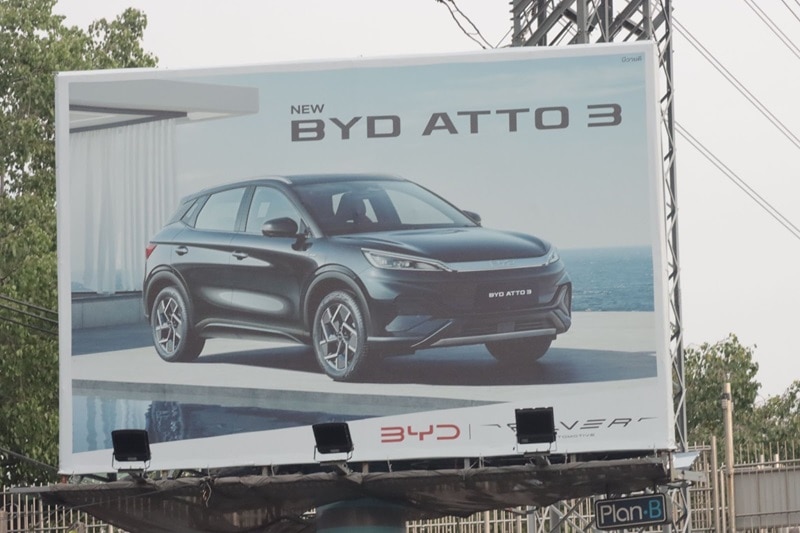
Popular brands include:
- BYD: Chinese company that sells electric cars, sedans, and SUVs. BYD has the strongest market share of all EVs in Thailand.
- MG: MG is one of the first brands to import EVs to Thailand. MG vehicles are manufactured in China, Thailand, and India.
- Tesla: Tesla is an American company best known for its Model 3 and Model Y EVs. In Thailand, Tesla is positioned as a premium option, with higher prices due to import costs.
- GAC (Aion): A sub-brand of GAC from China. Aion has become popular in Thailand for offering good range and features at competitive prices, especially in the mid-range segment. The brand is often referred as “Chinese Toyota”
- Geely: Another major Chinese automaker expanding into Thailand. Known for affordable EVs with modern design and tech features.
- Great Wall Motor (GWM): A Chinese brand that sells EVs and hybrids in Thailand, including models under the Ora lineup, which focus on compact city driving.
- BMW: A German brand offering premium EVs in Thailand, such as the i4 and iX.
- Mercedes-Benz: Another German premium brand with EV models like the EQ series.
- Volvo: A Swedish brand that has been pushing strongly into EVs. Known for safety and minimalist design, with models like the XC40 Recharge.
Also, in 2026, Japanese brands have started entering the EV market in Thailand. For example, in early 2026, Mazda released its first EV model, the Mazda6E, at a price point of around THB1,100,000, making it more accessible than many expected.
Later in the year, Suzuki is also planning to launch its first EV, the Suzuki Vitara EV, targeting the compact SUV segment.
It’s expected that there will be more EV options from Japanese brands available in the future.
The table below shows EV car sales at the Motor Expo from November 29, 2025 to December 12, 2025. Almost 60% of all car sales at the event were EVs. This gives you a clear picture of how popular EVs are in Thailand right now.
| Brand | Units Sold | % of Total Cars |
|---|---|---|
| BYD | 6,212 | 8.25% |
| Omoda Jaecoo | 5,217 | 6.93% |
| GAC (Aion) | 5,019 | 6.67% |
| Geely | 4,831 | 6.42% |
| MG | 4,827 | 6.41% |
| GWM (ORA) | 4,609 | 6.13% |
| Deepal | 4,586 | 6.09% |
| Chery | 2,009 | 2.67% |
| ZEEKR | 1,129 | 1.50% |
| AVATR | 1,103 | 1.47% |
| XPENG | 1,089 | 1.45% |
| Tesla | 527 | 0.70% |
| Wuling | 525 | 0.70% |
| Denza | 469 | 0.62% |
| Leapmotor | 389 | 0.52% |
| Farizon | 300 | 0.40% |
| Total EV | 44,832 | 59.6% |
Cost of Owning an EV in Thailand
Now, let’s move on to another big consideration of EVs: what’s the real cost of owning one in Thailand? The calculation isn’t as straightforward as with a petrol car, since many factors come into play, especially when it comes to charging.
For example:
- Charging at home can be almost 2 times cheaper than using public charging stations
- If your home has solar panels, your charging cost will be even lower
- If you use a TOU meter, electricity is cheaper at night but more expensive during the day
In addition, EVs can be more expensive than petrol cars in certain areas:
- Tires tend to wear out faster due to the heavier weight of EVs
- Insurance is usually more expensive
To give you a more realistic idea of EV ownership costs, a Thai influencer shared a detailed breakdown after driving a BYD Atto 3 for 201,097 km in 2 years and 5 months.
Here’s a simplified summary of his actual expenses:
Here’s a simpler, easier-to-read version:
| Category | Cost | Notes |
| Charging | THB177,401 | ~THB0.88/km~THB4,000 to 7,000/month (Costs increased after switching from off-peak home charging to normal rates and using more public chargers) |
| Tires | THB26,800 | 10 tires, 201,097 km |
| Maintenance | THB2,300 | Most service free up to 160,000 km |
| Insurance | ~THB56,000 | 2 years total, ~THB27,000 to 28,000/year after free first year |
| Repairs | ~THB2,173 | Small battery and cooling system parts |
| Total | THB264,674 | 201,097 km |
| Cost per km | ~THB1.32/km |
As you can see, the overall cost per km, even after including insurance, is still cheaper than the fuel cost of a petrol car alone. For example, based on our other guide on the cost of owning a petrol car in Thailand, fuel alone costs around THB2 per km.
Of course, your actual costs will vary depending on how and where you charge, how much you drive, and the model you choose. But this example gives you a solid real-world benchmark of what to expect when owning an EV in Thailand.
How Much Does it Cost Per K.M. to Charge an EV?
When you top up your EV battery, you pay per kilowatt-hour (kWh). The cost varies depending on where you charge, your car model, and your driving habits.
- Charging stations: MEA, one of the more popular EV charging stations in Thailand, charges THB7.5 per KWh. This works out to roughly THB1.1 to THB1.3 per km.
- At home: On average, provincial electric companies in Thailand charge THB4.5 per KWh, bringing the cost down to about THB0.6 to 0.8 per km.
- At home with solar cells: The cost can drop even further, often to around THB0.3 to 0.5 per km depending on your setup.
Maintenance Costs
The cost of maintaining an EV is generally cheaper than a petrol car for two main reasons.
- First, there are fewer parts to replace. For example, you don’t need regular oil changes every few months.
- Second, maintenance intervals are longer, usually once a year instead of every 6 months.
The maintenance schedule for the BYD Atto 3 gives a good benchmark. Over the first 8 years, the total maintenance cost averages around THB3,666 per year, which is quite low compared to petrol cars.
Add picture here
That said, one area where EVs can be more expensive is tyres. EVs are heavier due to the battery, and they also produce more instant torque. Both factors cause tyres to wear out faster.
In terms of cost, EV tyres are typically about 20% to 30% more expensive than regular petrol car tyres. On top of that, they may need to be replaced more often.
For example, while petrol car tyres might last 40,000 to 50,000 km, EV tyres may wear out closer to 30,000 to 40,000 km depending on driving style.
Thailand pushing EV adoption at a national level.
The Thai government aims to make EVs around 30% of total vehicle production by 2030, based on policy direction and research from Thammasat University. Because of this, you can expect more EV models, better infrastructure, and more competitive pricing in the coming years.
Insurance Costs
The cost of insurance for an EV is generally higher than for a petrol car. For example, based on the data above, a Thai influencer paid around THB27,000 per year for EV insurance.
For a petrol car in the same price range, insurance is usually around THB20,000 per year with similar coverage.
If you own a Tesla Model 3, the cost can be significantly higher, at around THB55,000 per year.
According to Khun Jaruwitt, a managing director of the car insurance brokerage, CheckDi.com, EV insurance is more expensive because many parts are replaced rather than repaired. On top of that, the battery itself is still very costly, which increases the overall risk for insurers.
Find out more: Car Insurance in Thailand: A Complete Buying Guide
Car Charger Installation
If you want to install a home charger, you should expect to pay around THB15,000 to THB20,000 for installation. This typically includes:
- Wall charger (often free with the car)
- Electrical cabinet: ~THB13,000
- Wiring (around 20 meters)
- Upgrading the electric meter: ~THB4,800
- Rewiring your home to meet safety standards: ~THB6,500
The exact cost depends on your home setup, especially the distance from your main electrical panel and whether upgrades are needed.
If you want to install a home charger, you should expect to pay around THB15,000 to THB20,000 for installation. This typically includes:
- Wall charger (often free with the car)
- Electrical cabinet: ~THB13,000
- Wiring (around 20 meters)
- Upgrading the electric meter: ~THB4,800
- Rewiring your home to meet safety standards: ~THB6,500
The exact cost depends on your home setup, especially the distance from your main electrical panel and whether upgrades are needed.
Tip: Alternatively, you can use an emergency charger that usually comes with the car to charge your EV. However, you need to make sure it doesn’t overheat, as it’s not always designed for long-term, daily use. When it comes to electricity, it’s always better to be safe than sorry.
Where to Buy an Electric Car in Thailand
Buying an electric car is similar to buying a regular car. There are several places you can look:
- Dealership: EV dealerships are now popping up all over Thailand, especially in big cities like Bangkok, Chiang Mai, Phuket, and Rayong. In some areas, you may even see more EV showrooms than petrol car dealers.
- Online: Most car marketplace websites, including Facebook Marketplace, now list EVs, both new and used.
- Events: Car events are held regularly at shopping malls across Thailand, where you can check out different EV models in one place. You can also find a wide selection at major events like the Bangkok Motor Show.
In addition to that, the buying and registration process is the same as buying a regular car.
How to Choose the Right EV
Knowing all that you now know about the EV market in Thailand, how do you pick the right vehicle for your needs? Here are a few things to consider.
- Your budget: Your budget will help you decide which EV you can afford to buy. You obviously don’t want to splurge on a Tesla and pay for all the import fees if it’s going to put you in a financial hole. If you’re on a budget, you can always buy a BYD, which would most likely be built in Rayong, cutting back on import fees.
- Brand reputation: This is very important. While EVs are still relatively new in Thailand, they’ve been around in China for a long time. Since most EVs here are from Chinese brands, it’s a good idea to research their reputation in their home market first. Some brands may grow quickly but don’t last long. For example, Neta was once popular in Thailand but later ran into financial issues.
- Range standards (NEDC / WLTP / CLTC / EPA): These are different testing standards used to estimate how far an EV can drive on a full charge. However, they don’t all reflect real-world driving equally. In general, it’s better to rely on WLTP figures when comparing EVs in Thailand.
- NEDC and CLTC tend to give higher numbers that are less realistic, often around 15% to 30% higher than what you’ll get in real-world driving (*Many Chinese brands prefer to use NEDC or CLTC figures because the numbers look higher and more attractive.)
- WLTP is more balanced and closer to real-world usage
- EPA (used in the US) is the most conservative and realistic
- Driving distance: If you live in Bangkok and commute from Bang Na to Nonthaburi for work, you won’t need a long-range EV. Instead, you can save tens of thousands of baht and buy a short-range EV model. But if you live in Bangkok and sometimes commute to Chon Buri and even Rayong for occasional work or meetings, you’ll need a long-range EV.
- Charging time: Most EVs nowadays are fast-charging as long as you have the right connector and charging station. But if you don’t, then charging time can become an issue. If you don’t need to charge your EV in under an hour, you can opt for less expensive charging equipment and save some money.
- Battery warranty: The battery is the most expensive part of an EV. Most brands now offer a warranty of around 8 years or 160,000 km, which is considered the minimum standard. If possible, choose a brand that offers a longer or lifetime battery warranty for better peace of mind.
- Dealership network: You’ll still need to visit a dealership for maintenance, software updates, and parts replacement. Make sure there’s at least one service center from that brand near where you live.
Buying New vs Used EV
Since EVs are still quite new in Thailand, there aren’t many options in the used market. From what I’ve seen, many people selling EVs are still under a mortgage, so the sale is often done by transferring the financing contract to the new buyer, which is complicated for expats.
On top of that, EV technology is improving quickly. Older models still work fine, but they usually have shorter range, slower charging, and fewer features compared to newer ones.
Because of this, buying a new EV makes more sense at the moment, at least in my opinion.
How to Charge Your EV
Charging your EV depends on where you are. Below is a list of the places in Thailand that you’ll most likely top-up when owning an electric vehicle.
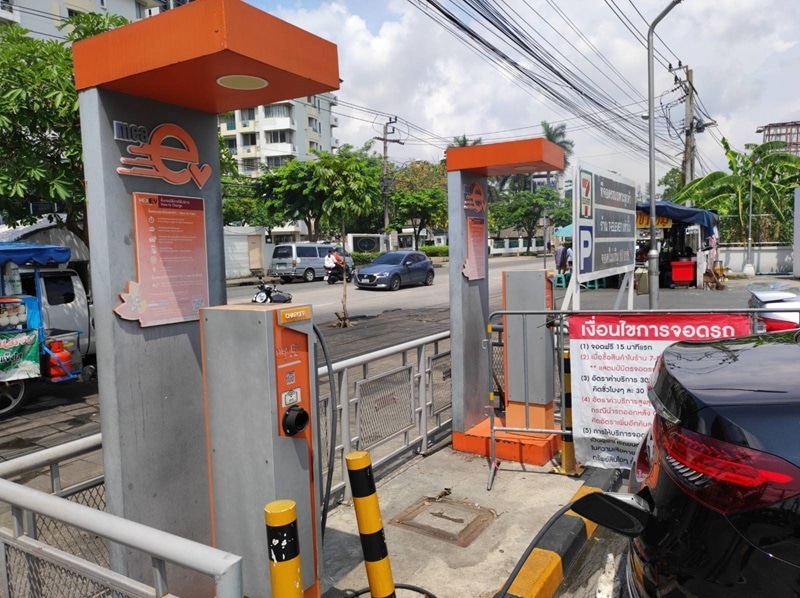
- Home: When you buy an EV, it comes with a standard charger that you can use at home. Keep in mind though that many of these chargers do not have fast-charging capabilities. So it will take at least eight hours to fully charge the batteries in your EV. But you have to make sure the outlet you connect to can handle the charging load. For safety reasons, it’s better to hire a company to install a dedicated charging station for you.
- EV charging stations: The number of charging stations available throughout Thailand is increasing every month. As EVs become more popular in Thailand, more EV stations are being added to gas stations, convenience stores, and residences. EV stations are usually unmanned, so you’ll need to know how to charge your own car. It usually includes plugging the connector into your car, paying for the charge, then waiting for the charge to finish – usually 20 to 30 minutes.
- Convenience stores: You can charge your EV while grabbing a cold drink from a 7-ELEVEN in Thailand. Most of the newer 7-ELEVENs have fast-charging stations that you can use for a quick top-up. Index Living Mall is now starting to install EV charging stations well.
- Shopping malls: Shopping malls are now adding fast-charging stations to their parking lots, so you can top-up while getting some shopping done at the mall. Most of these stations are fast-charging, so you won’t need to wait long.
- Condos: Many condos in Bangkok and other provinces are adding EV charging stations to their parking lots. This way, you can park your EV in one of these spots and charge up while at home. But because there are usually a limited number of parking spots available to begin with, you may come home to find an ICE vehicle parked in the spot.
Numbers of charging station in Thailand
Charging infrastructure in Thailand is growing quickly. There are already over 11,000 charging points nationwide, according to Roland Berger. The number of charging stations has also more than doubled in recent years, based on data from Krungsri Research.
How Long Does it Take to Charge an EV?
The time it takes to charge an EV depends on a few factors. Below are some of the more important ones.
- Battery sizes: It goes without saying that the larger the battery in your EV, the longer it’s going to take to fully charge it.
- Charger types: Because Thailand runs on 220 volts, most EVs will come with Type 2 chargers. So, depending on the type of EV you have, it could take anywhere from 2 to 8 hours to charge the batteries. If you have access to a DC fast-charging station, it’ll take anywhere from 20 minutes to an hour to top up your battery.
- Charging stations: The quality of charging stations also determines how long it takes to charge the battery. Most public EV charging stations in Thailand will provide DC fast-charging stations, so this means you won’t have to wait more than an hour for a full charge. If you have a Type 2 charging station at home, it takes 2 to 8 hours.
- Ambient temperatures: If the ambient temperature is too high or too low, that affects charging times. You won’t have to worry about it getting too cold in Thailand, but it does get hot. So, it’s best to avoid charging your EV midday, when temperatures tend to be at their highest.
- Charging queues: Charging times also depend on how many cars are in front of you at the EV station. If there are two or three cars ahead of you, you might have to wait a while. Luckily, EV charging stations in Thailand are making it more convenient to top up your EV. You can book a time slot in advance, usually for a THB20 fee.
How Do You Find a Charging Station in Thailand?
Charging stations in Thailand aren’t hard to find. The challenge is planning ahead, especially for longer trips. Luckily, there are two ways to do this: apps and maps.

- Saifah – EV Charging Planner App: Saifah is an app that not only specializes in locating EV charging stations in Thailand, but it also lets you plan your entire road trip. You can select your destination, vehicle type, which station and charging method you prefer, and even how much you want to spend on topping up your battery. You can also use the app right from your car’s web browser.
- Google Maps: Google Maps lists all of the charging stations available in Thailand. Although it’s not as customizable as Saifah, it’ll work in a pinch when you need to find the nearest EV charging station. Just open Google Maps on your phone and search for “EV charging stations.”
Are EVs Safe?
When it comes to EVs, every first-time buyer is concerned about safety. After all, you’re dealing with a new technology, mostly made up of electrical parts, and videos of EVs bursting into flames or exploding run rampant online.
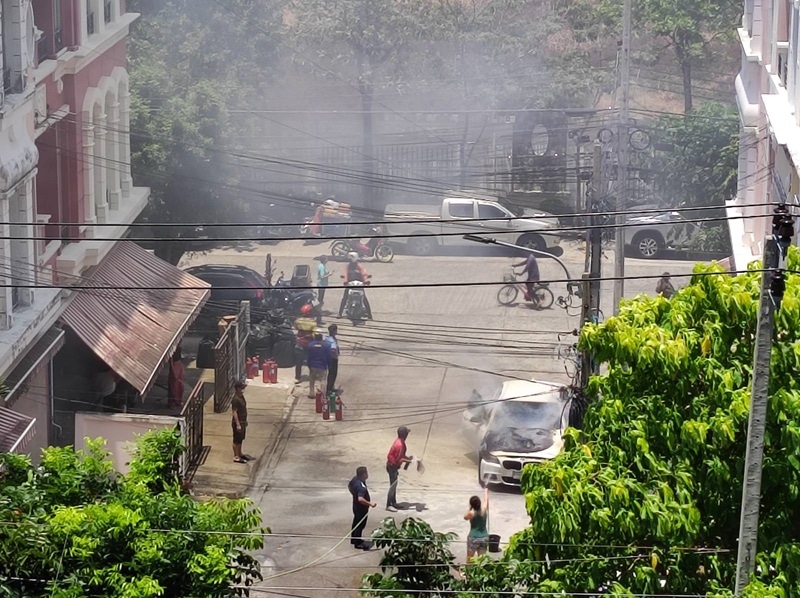
- Fires: Although viral Internet videos will lead you to believe otherwise, EVs do not spontaneously combust. In fact, the chance that an EV will catch fire is 0.9 out of 10,000. For every ICE vehicle, that number is 2 out of every 10,000. EV FireSafe goes further to say that there’s a 0.1 percent chance that your EV will catch fire.
- Floods: Perhaps more important to know is whether you can drive your EV through floods. After all, Bangkok, Pattaya, and other areas are prone to severe flooding during Thailand’s rainy season. EVs, like most vehicles, shouldn’t be driven through floods even if the electrical parts are waterproof. You can still do damage to the waterproof parts, and some of them can become contaminated with debris floating in floodwaters.
- Charging in the rain: No doubt you’ll find yourself in need of a top-up during the rainy season in Thailand, so you’ll have to charge your EV when it’s wet out. In most cases, charging in the rain is safe at EV charging stations. At home, you want to be sure you have safety features installed on your house charger so that if the water comes in contact with the electricity, the line will disconnect. That said, never charge your EV in standing water (if your neighborhood floods and the EV is sitting in the flood). And never use an extension cord to charge your EV if the cord is prone to getting wet in the rain.
Downsides to Owning an EV
As with any big purchase you make, you have to weigh the pros versus the cons – and the same goes with buying an EV. That said, here are some of the downsides to owning an EV in Thailand.
- Long charging times: If you don’t have access to a fast-charging EV station, it can take dozens of hours to fully charge the batteries with a standard charger.
- Lack of EV charging stations in Thailand: EV charging stations are being incorporated into gas stations and in parking lots of most new 7-ELEVENs and residences. But they’re still not as easy to find as gas stations. So, if you make a long trip, you have to plan in advance where you’re going to top up your EV. And because there are usually only one or two top-up stations at any given EV station, you might have to wait for others who got there first.
- Initial cost: Although some of the EVs listed in this article are less expensive than ICE vehicles, you still have to pay to have a fast-charging station installed at your house (optional).
- Car insurance: Car insurance for EVs is more expensive than ICE vehicles in Thailand, mostly because of battery prices. So, be sure to contact a few insurance companies and get quotes before buying an EV.
- Tires: Since EVs have high-torque motors, tires tend to wear out much quicker. So you can expect to replace tires more often than you would with tires on an ICE vehicle. You also have to use specific tires that are made for EVs, which, of course, are more expensive.
- Efficiency: EVs aren’t convenient for long trips across Thailand because they only get a certain amount of kilometers per charge. You’ll have to top up more often than when driving an ICE vehicle.
- Off-road ability: Most EVs aren’t built for off-road use because of the battery location. So, if you’re an outdoor enthusiast who drives on unpaved roads in Thailand’s countryside, you’ll have to be extra careful. You can buy an EV made for off-road use, but it’s going to be triple the cost of a standard EV and harder to find in Thailand.
Read more: Car Insurance in Thailand: A Complete Buying Guide
Should You Buy an EV in Thailand?
To help you decide whether you should buy an EV in Thailand, here’s a quick guide.
It makes sense to buy an EV if you:
- Drive more than 2,000 km per month, where you can start saving on running costs
- Can charge at home, which is much cheaper and more convenient
- Need to pick up your kids regularly, so you can wait comfortably in an air-conditioned car without engine idling
- Have a predictable route with access to charging stations
- Plan to live in Thailand long-term, since reselling an EV is still not as easy as a petrol car
On the other hand, an EV may not be ideal if you:
- Live in a rural area with limited charging infrastructure
- Live in a condo or apartment where you can’t install a charger
- Don’t drive much each month and already have a car
Good to know: According to a survey by Ipsos Thailand, only a small percentage of drivers currently own an EV, but around one-third say their next car could be electric. So right now, we’re in that transition phase. EVs are no longer niche, but they’re not fully mainstream yet either.
EV vs Petrol Cars in Thailand (Quick Comparison)
Let’s take a quick comparison between EVs and petrol cars in Thailand at the moment.
- EV cars are cheaper than petrol cars, especially when you drive more than 20,000 km a year. The more you drive, the more you save.
- Driving long distance isn’t really a problem for EVs anymore. Many models can go over 400 km per charge, which is enough for most trips in Thailand.
- EVs are more convenient for daily use since you can charge at home and don’t need to stop at gas stations. But for long-distance driving, petrol cars are still more convenient because refueling is faster and stations are everywhere.
- Petrol cars are still more proven when it comes to long-term use. EVs are newer, and battery replacement can be expensive if something goes wrong.
Here’s some more details:
Cost
Winner: EVs
The initial cost of EVs and petrol cars is quite similar at the moment. However, EVs are cheaper when it comes to fuel and maintenance. On the other hand, petrol cars still have lower costs for insurance and tyres.
To give you a clearer picture, here’s a simple comparison based on two driving scenarios:
Assumptions:
- EV cost: ~THB1/km
- Petrol cost: ~THB2/km
- Insurance: EV ~THB27,000/year, Petrol ~THB20,000/year
- Tyres: EV slightly higher than petrol
- Maintenance: EV lower than petrol
Quick takeaway:
- The more you drive, the more you save with an EV
- At around 20,000 km per year, you already start seeing clear savings
- At 40,000 km per year, the difference becomes significant
Driving 20,000 km per year
| Cost Category | EV (THB/year) | Petrol (THB/year) | Difference |
| Fuel / Charging | THB20,000 | THB40,000 | -THB20,000 |
| Maintenance | THB3,500 | THB8,000 | -THB4,500 |
| Tyres | THB6,000 | THB5,000 | +THB1,000 |
| Insurance | THB27,000 | THB20,000 | +THB7,000 |
| Total | THB56,500 | THB73,000 | -THB16,500 |
Driving 40,000 km per year
| Cost Category | EV (THB/year) | Petrol (THB/year) | Difference |
| Fuel / Charging | THB40,000 | THB80,000 | -THB40,000 |
| Maintenance | THB4,500 | THB12,000 | -THB7,500 |
| Tyres | THB10,000 | THB8,000 | +THB2,000 |
| Insurance | THB27,000 | THB20,000 | +THB7,000 |
| Total | THB81,500 | THB120,000 | -THB38,500 |
Driving Distance
Winner: Tie
A few years ago, people said that if you regularly drive long distances, you shouldn’t buy an EV. That’s no longer true. Many EVs today can drive over 400 km per charge, which is enough for most trips in Thailand.
Charging is also getting faster, and there are more charging stations available than before.
Convenience
Winner: Tie
This depends on your lifestyle. EVs are more convenient for daily, short-distance driving since you can charge at home and avoid queues at gas stations. You can also sit in the car with the air conditioning on without worrying about engine idling.
On the other hand, petrol cars are still more convenient for long-distance travel. There are far more gas stations across the country, and refueling only takes a few minutes.
Long-lasting
Winner: Petrol cars
Petrol cars have been around for decades and are proven to last a very long time, often reaching hundreds of thousands or even over a million kilometers. EVs are still relatively new, so it will take more time to fully prove their long-term durability.
Also, battery degradation is a key concern. While batteries are designed to last many years, replacing one can be expensive, and in some cases, it may not be worth it compared to buying a new car.
Alternatives to EVs
EVs aren’t your only option when it comes to buying more fuel-efficient or environment-friendly vehicles. Hybrid vehicles and EV bikes are also popular in Thailand.
- Hybrid vehicles: Honda and Mercedes-Benz produce a number of hybrid vehicles that are popular in Thailand. These hybrids run on both electric and gas. Usually, for city driving, the electrical system takes over, while for highway driving, the gas system kicks in. This will save you a little bit of money if you’re a local commuter.
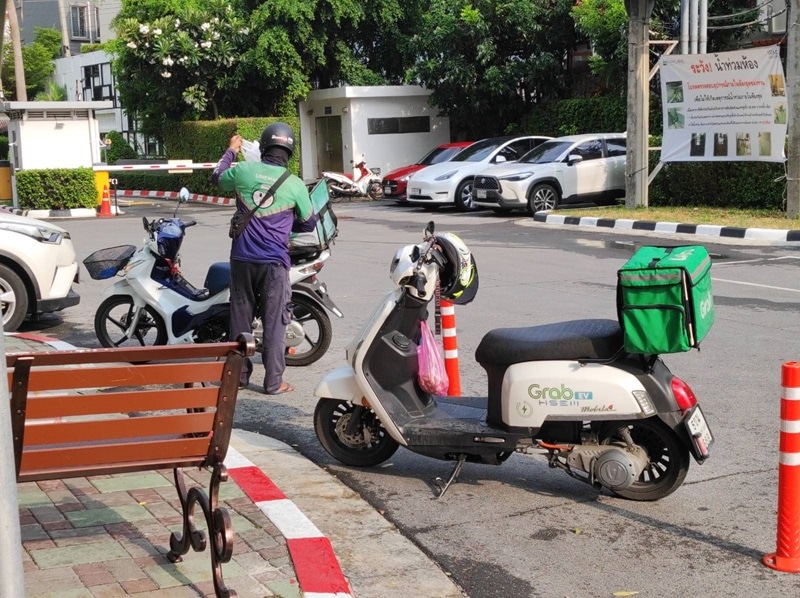
- EV scooters/motorbikes: EV scooters and motorbikes work just the same as the EVs mentioned throughout this guide and are becoming more popular in Thailand. EV scooters and motorbikes, however, are much more expensive than gas-powered ones. Expect to pay at least THB50,000 for a good-quality scooter or motorbike.
Now, on to You
The EV market in Thailand is growing exponentially, which means you have a lot of options when it comes to buying an electric vehicle.
Just be sure you know what you need as far as power consumption and how much you can afford to spend upfront, because you’ll need to install a charging station at your residence if one is not provided.
But in the long run, EVs are less expensive to own and maintain than gas-powered vehicles and, oftentimes, safer and more environmentally friendly to own.




 Deutsch:
  ไทย:
ไทย:  Français:
  Português:
  Português:
  Español:
  Español:
  中文 (中国):
  Русский:
  Nederlands:
  العربية:
  Italiano: