This article will take approximately 13 minutes to read. Don't have the time right now? No worries. Email the ad-free version of the article to yourself and read it later!
Sending money to Cambodia could be very difficult, especially when it’s your first time transferring funds into the country.
You may have read online that it’s damn-near impossible to get money into Cambodia, but that’s not always true.
In fact, just because most online service providers don’t offer exchanges from abroad into Cambodian Riel (KHR) doesn’t mean there aren’t workarounds.
You can easily send US Dollars (USD) into a Cambodian bank account in days, hours, or even minutes.
If you want to skip the lengthy breakdown, we’ve found that it’s always a good idea to check the latest rates on Monito, as you may be able to find better deals on international money transfers on its website.
With that said, this guide on sending money to Cambodia will show you what to watch out for, which services are available to you, and which providers we recommend based on your home country bank.
Disclaimer: This article may include links to products or services offered by ExpatDen's partners, which give us commissions when you click on them. Although this may influence how they appear in the text, we only recommend solutions that we would use in your situation. Read more in our Advertising Disclosure.
Contents
What to Watch Out for When Sending Money to Cambodia
When transferring money into Cambodia, there are some things to consider, which we’ll cover below.
Lack of Cambodian Riel Transfer Options
Unlike when sending money online to other countries around Southeast Asia, when you transfer money online to Cambodia, it’s challenging to get KHR since a majority of money transfer services like Wise don’t have KHR listed as an option.
But all hope is not lost.
There are some services like WorldRemit that allow KHR. But the rate can be expensive. An alternative option is to use USD instead.
Because the USD is widely used throughout Cambodia, you can set that as your receiving currency and then have it deposited into a Cambodian bank account.
However, you can only receive USD if you send from other currencies that’s not USD.
With that said, you can still withdraw and use USD in most places throughout Cambodia, but keep in mind you will probably get KHR back as change for larger notes.
You’ll also need a bank account in one of these countries, which means if you’re from the U.S., it could be more challenging to transfer money into Cambodia.
More about all this later on in the Transfer Options section.
Accessibility
You also need to how your money transfer will reach Cambodia and if you’re in an area that you can access the money. There are banks and ATM’s in a vast majority of cities and villages in Cambodia.
However, not all banks in the country support online transfers – and you could also be limited by the amount of money you can receive.
Exchange Rates
Many banks and online money transfer service providers won’t disclose their exchange rate fees, but mostly all of them charge this kind of fee.
To disclose how much they’re charging, look at the exchange rate they’re offering you on the transfer and then go to XE.com and check the mid-market rates there.
If they’re different, the bank or online service provider is charging you a fee.

As far as I know, Wise is the only company that doesn’t take a cut of the exchange rate. But with that said, they may not be the cheapest option when sending money to Cambodia.
Transfer Fees
The cost of sending money into Cambodia depends on which of the three transfer fees you pay:
- fixed fee
- percentage fee
- combination of the two
Most off- and online transfer services charge fixed fees, but only some of them will disclose these fees upfront.
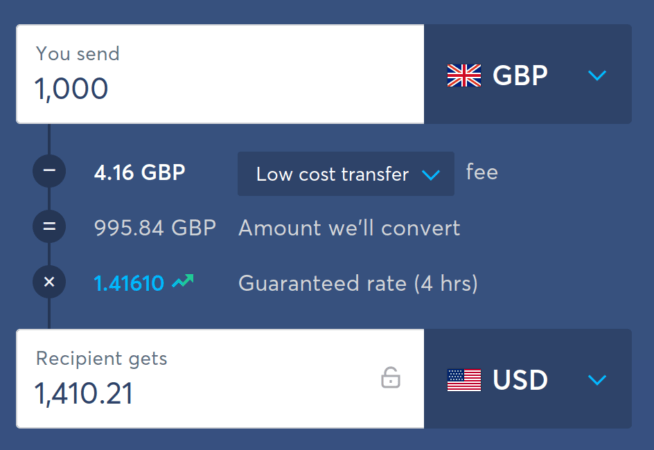
Wise, for example, shows its fixed fees before you go through with your transfer. However, you will only pay a fixed fee with Wise if you transfer money using your bank account. When using debit or credit cards, you’ll pay a percentage fee.
Brick and mortar banks vary in the fixed fees they charge, but to give you a general idea of how much you could pay in percentage fees, let’s look at Cambodia’s Canadia Bank.
Canadia Bank, for example, charges a fee of anywhere between USD15 to USD100 depending on your transfer amount and the type of currency your transferring.
Percentage Fees
Percentage fees work a little differently. This fee is calculated based on your entire transfer amount.
On all incoming money transfers, Canadia Bank will charge you a fixed fee of 0.10 percent (USD10 minimum).
Wise, on the other hand, doesn’t charge percentage fees when transferring money into Cambodia, but they do charge fees that expats in other parts of Southeast Asia don’t have to worry about – more or these fees in section on Wise.
Combination Fees
Lastly, some banks and online transfer services charge both fixed and percentage fees.
As you’ve seen in the example above, Canadia Bank is one of them. In fact, most banks in Cambodia may charge a combination of fees.
We’ll cover this in more detail in the sections below, but for now let’s look at another important factor – transfer speeds.
Transfer Speeds
When you transfer money into Cambodia using brick and mortar banks, online service providers, Western Union, or Dee Money, it could take anywhere from minutes to hours to days to receive the money.
In general, Wise and Western Union are some of the faster services. Bricks tend to be slower, but they also tend to be cheaper.
This is because quicker transfer times equate to higher fees.
Transfer Options
When it comes to sending money to Cambodia, you have quite a few options.
Assuming you already have a bank account to transfer money into in Cambodia, here are your choices:
- WorldRemit
- Wise
- International bank transfers
- Western Union
- PayPal
- Cryptocurrency
With that said, let’s dive a bit deeper into each one.
WorldRemit
We’re starting off with WorldRemit because it’s the cheapest way to send money to Cambodia when using an online money transfer service.

Moreover, you can receive USD or KHR in the country, which you can’t do with Wise.
Depending on if you transfer using your bank, credit or debit card, in-person pick up, or mobile money, you’ll pay anywhere from USD22 to USD26 on transfers of USD999.
WorldRemit does have limits. For example, if you choose a cash pickup in Cambodia, you can usually send up to around USD1,000 per transaction. However, the exact limit may vary depending on the country you’re sending from, the payment method you use, and the payout option selected.
So if you need more than that each month to cover your general monthly living expenses, your best bet is to go with a bank transfer.
Also, WorldRemit will charge you an exchange rate fee of around 1 percent to 1.5 percent. This fluctuates, so your best bet is to compare the exchange rate with XE.com’s mid-market rate.
Lastly, transfer speeds are quick with WorldRemit. Your money can hit Cambodia in a matter of minutes when using the mobile money option.
And if you choose to pick up your money in-person, you can do so at any Wing branch – assuming you have an account open with them.
Keep in mind, though, that Wing may charge an additional fee of USD0.25 to USD2.50 for this service.
With all that said, you can expect to pay around 2 percent to 3 percent in fees of your total transfer amount using WorldRemit. But you can also get KHR, which is more convenient than using USD day-to-day as an expat.
The only limitation to be aware of is the USD999 transfer limit on each transaction.
Wise
Wise prides themselves on the fact that they offer real-time exchange rates, which, according to XE, is correct.

That is, instead of offering slightly-lower exchange rates, they charge a transfer fee, which they do disclose upfront during the transfer process.
But unfortunately, this doesn’t make Wise your best choice when sending money to Cambodia. Unlike other countries, Wise can be more expensive than other online money transfer service providers.
In addition to the disclosed transfer fees that Wise charges – which varies according to how much you transfer into Cambodia – intermediary banks will charge an additional USD10 to USD30 just to move your money from outside of Cambodia to inside the country.
This is the exact reason why many expats in Cambodia use WorldRemit to transfer money into the country.
ATMs
With all the fees banks and online money transfer providers charge, you may think it’s cheaper to withdraw cash from your home country’s bank account through an ATM in Cambodia.
But be aware, you’ll still incur all the fees mentioned above.
Withdraw rates from ATM’s in Cambodia vary from USD4 to USD6 depending on the bank you use, but here are a few examples below:
- Canadia Bank: USD5 per withdrawal
- Mekong Bank: USD5 per withdrawal
- Maybank: Free withdrawals for US and European Visa/PLUS cards (~USD4 to USD6 per transaction for the rest of us)
- ABA: USD4 per withdrawal
- ACLEDA: USD4 per withdrawal
- Vattanak: USD4 per withdrawal
- Cathay United: USD6 per withdrawal
With that in mind, if you have a bank account through TD Bank or Charles Schwab, you’ll be refunded on the ATM withdrawal fees you pay each month.

However, you’ll still pay hidden exchange rate fees of about 2 percent to 6 percent when using an ATM machine. But it’s best to check with your bank for exact fee amounts.
International Bank Transfers
You’ll probably use an online money transfer service to transfer small amounts into Cambodia, but if you’re sending thousands of dollars into the country, then it makes sense to use an international bank transfer.
We already mentioned the 0.10 percent transfer fee Canadia bank charges when you send money into the country.
This means you’ll only pay USD1.00 for every USD1,000 you transfer into the country. Moreover, Canadia bank’s exchange rates aren’t too far off from mid-market rates on XE.
Keep in mind, the bank’s website says the exchange rate can be decided at the time of your transaction – so pay close attention when getting to this stage of the process.
ABA is also another top choice among expats in Cambodia. And according to research and posts from other expats in the country, ABA only charges USD10 on all incoming money transfers.
This makes ABA another great option if you’re looking to send large amounts of money into Cambodia.
Here’s a few other banks that come highly recommended:
- ACLEDA Bank
- Foreign Trade Bank of Cambodia
- Union Commercial Bank
- ANZ Royal
Western Union
Let’s look at how much you could pay in fees when sending GBP1,000 (to be converted into USD) to Cambodia through Western Union.

Having a close look at the final sum, the receiver only gets USD1,328.83, not the USD1,393 you’d get at the mid-market exchange rate on XE.
This means Western Union charges USD65 in hidden exchange rate fees.
If you’re in a bind and need money in Cambodia ASAP, then it might makes sense to use Western Union for their quick transfer times.
However, if you’re in no rush to receive the money, Western Union is best avoided because of the hidden fees.
What is the Best Method to Send Money to Cambodia?
Considering everything we’ve uncovered, for one-off or recurring transfers under USD1,000, WorldRemit is your best choice, as they charge the least amount of fees.
For anything larger than USD10,000, your best bet is to use a bank transfer, as you’ll pay a smaller percentage of fees.
For expats with bank accounts outside of the U.S., Wise would also be a good choice for larger amounts.
Lastly, unless you’re in a financial bind, avoid Western Union or Wise, as one doesn’t disclose exchange rates fees and the other deals with intermediary banks who charge anywhere from USD 10 to USD30 for online transfers.
With that said, the “best” method to transfer money to Cambodia honestly depends on your situation.
But to help you ever further, we’ll explore some country-specific recommendations in the next section.
Now, on to You
Transferring money into Cambodia can be difficult for first-timers, but once you find out which service provider is best for your case, the next time you have to transfer money into the country it’ll be a lot easier.
With that said, we hope this article helps you determine which service is best for you, so that you can avoid paying the highest fees, and instead focus on getting the most bang, or KHR, for your buck.






 Deutsch:
  ไทย:
ไทย:  Français:
  Português:
  Português:
  Español:
  Español:
  中文 (中国):
  Русский:
  Nederlands:
  العربية:
  Italiano: