Street dogs, often called soi dogs, are part of everyday life in Thailand. Here’s what expats should know about safety, rabies risk, and how to interact with them.
If you spend any amout of time in Thailand, you’ll encounter street dogs. After over five years living here, I’ve come to see them as part of daily life. They sleep under shopfronts, wander temple grounds, nap on beaches, and stretch out across residential streets as if they own them.
In Thailand, street dogs, often called soi dogs, aren’t hidden or rounded up. They’re just there. You get used to it.
Over time, I learned that experiences with street dogs vary. Some are friendly. Some are completely indifferent. Others can be territorial, especially at night or near places where they’re regularly fed. I’ve walked the same street that felt calm during the day, then taken the same route after dark and felt more alert.
Understanding street dogs here isn’t about fear. It’s about knowing what’s normal. Once you understand why they’re around and how they tend to behave, most situations become manageable.
This isn’t a theory. It’s just what living here looks like after a while.
Contents
- Why There Are So Many Street Dogs in Thailand
- Are Street Dogs Dangerous?
- What to Do If You Encounter Aggressive Street Dogs
- What to Do If You Are Bitten or Scratched
- Street Dogs Around Condos, Houses, and Gated Communities
- Helping Street Dogs Responsibly
- Living With Street Dogs
- Now, on to You
- Special Thanks
Why There Are So Many Street Dogs in Thailand
After a few years in Thailand, it becomes clear the street dog population exists for a mix of cultural, practical, and systemic reasons.
Feeding
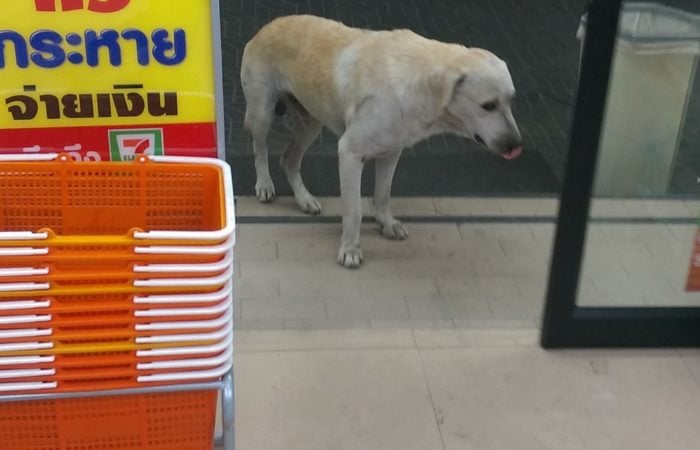
Feeding is common. Outside condos, shops, temples, and construction sites, someone is usually leaving food out. Security guards, shop owners, cleaners, monks — many feel responsible for the dogs in their area.
There are many Thais that love dogs and feeding them is seen as kindness. Some people also think of it as a way of making merit.
While the intention is compassionate, it also encourages dogs to stay and reproduce.
But feeding alone doesn’t solve the bigger issue.
As Sohani Shahid, Community Engagement Director at Soi Dog Foundation, explains:

“The biggest challenge is overpopulation. This is largely due to a lack of sufficient CNVR (Catch, Neuter, Vaccinate, Return) programs across Thailand, combined with ongoing pet abandonment. Without widespread sterilization efforts and responsible pet ownership, the number of dogs on the streets continues to grow.”
Sohani Shahid, Community Engagement Director at Soi Dog Foundation
“Without widespread sterilisation efforts and responsible pet ownership, the number of dogs on the streets continues to grow.”
— Sohani Shahid, Soi Dog Foundation
Abandonment
Abandonment plays a role too. Dogs are sometimes left behind when owners move or can’t care for them anymore. Puppies occasionally appear near temples or quiet streets, where people assume someone will look after them. Once dogs settle into an area, they tend to remain.
Theresa Chi from Dog Rescue MaePhim Foundation says this happens frequently.
“For us, the biggest challenge is getting people to stop dumping dogs outside and to sterilize their dogs. We keep doing sterilization in our area, but people dump dogs and puppies almost every day. This creates a bad circle.”
Inconsistent Sterilization
Sterilization is inconsistent, especially outside major cities. A small number of unsterilized dogs can turn into a larger group fairly quickly. Thailand does have animal welfare laws, but there isn’t a large government system that routinely collects and rehomes street dogs.
Most shelters are run by NGOs and rely heavily on donations. Capacity is limited. Authorities usually step in only after something serious happens.
Melanie from Saved Souls Foundation explains:

“Without consistent sterilization programs and greater awareness among locals to sterilize their dogs, the population continues to grow very quickly. This makes it difficult for communities and rescue organizations to keep up.”
Many people assume the government manages the issue more actively than it actually does.
Verity Cattanach Poole, co-owner of Headrock Dogs Rescue Association, says most programs are still run by rescues.
“The majority of CNVR (Catch, Neuter, Vaccinate, Return) programs are carried out by independent rescues with funding from overseas donors.”
Shelters also face capacity limits.
“Most rescues rely entirely on private donations and international sponsorships, and many struggle to keep their rescues out of debt.”
Climate
The climate makes street life easier too. There’s no winter, food is usually available, and communities are generally tolerant. Put it all together, and you get what most long-term expats eventually realize: street dogs aren’t temporary. They’re part of the landscape.

Are Street Dogs Dangerous?
In my experience, most aren’t dangerous. But ignoring them completely isn’t realistic either.
Most of the time, they’re asleep. They lie in the shade and barely react as people pass. Dogs that see you regularly often lose interest in you.
Still, I’ve had moments that changed how aware I am:
- A dog barking aggressively behind me at night.
- A group stepped into the road as I rode past on a motorbike.
- A sudden charge that stopped short. More warning than attack.
- A dog suddenly comes out of nowhere on the street
Aggression usually comes down to territory. Dogs guard where they sleep and eat. During the day, especially in busy areas, they’re usually calmer. At night, when things quiet down, they tend to be more alert.
Melanie from Saved Souls Foundation explains:
“People often assume street dogs are aggressive or dangerous and are therefore afraid of them. In reality, many street dogs in Thailand have learned to live alongside people and are generally accustomed to human presence.”
Melanie from Saved Souls Foundation
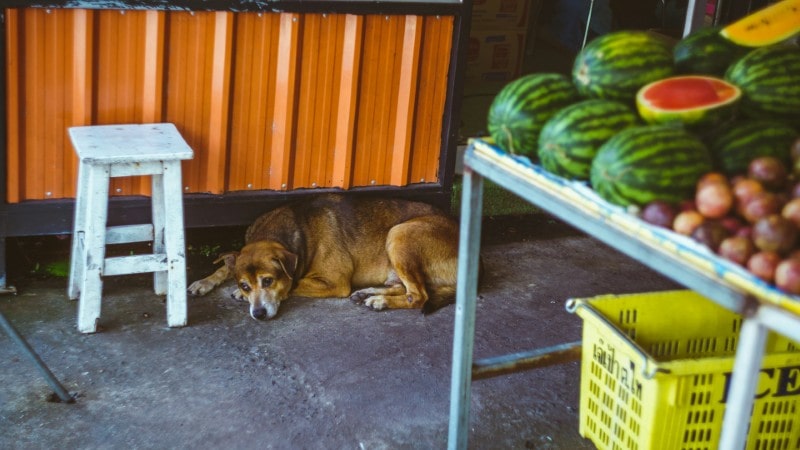
Location matters. In cities, dogs are used to people but may protect specific areas like parking lots or condo entrances. In beach towns, they’re relaxed during the day and less predictable after dark. In rural areas, they may be less socialized.
Pack behavior changes things. One dog is usually manageable. A group can escalate if one starts barking and the others follow.
Serious attacks are uncommon, but bites and scratches do happen, especially with runners, cyclists, and motorbike riders.
Learning to notice warning signs. Stiff posture, raised fur, prolonged staring has helped me avoid problems more than anything else.
Case Study: Motorcycle Crash from Street Dogs

In my opinion, street dogs can be especially dangerous for motorcycle riders at night. They can easily cause accidents. One of my friends recently crashed his motorcycle while riding home in Rayong after a group of street dogs suddenly ran out into the road. As a result, he had to call an ambulance and was taken to a nearby hospital immediately. When I arrived at the hospital, the nurses told me that they see many similar cases of motorcycle accidents caused by street dogs in that area.
Saran Lhawpongsawad, Project Manager at ExpatDen
What to Do If You Encounter Aggressive Street Dogs
How you react matters more than what you’re carrying.
- Don’t Run. If a dog starts barking or approaching, stop. Running almost always escalates things. Keep your movements slow. Avoid direct eye contact, which can be read as a challenge.
- Don’t shout, kick, or wave your arms. Those reactions tend to make it worse. Stand slightly sideways to appear less confrontational, and create distance gradually when you can.
- Make adjustments. Practical adjustments help. Avoid certain routes. Be cautious on quiet streets at night. When riding a bicycle or motorbike, slow down early instead of trying to pass quickly.
- Bring an umbrella. An umbrella can help. Opening it creates space without touching the dog. More than anything, staying calm usually shortens the encounter.
Avoidance isn’t a weakness. It’s just part of adapting here.
What to Do If You Are Bitten or Scratched
If you’re bitten or scratched, don’t brush it off — even if it looks minor.
First, wash the area thoroughly with soap and running water for at least 10–15 minutes. That step matters more than people think.
Then go to a hospital or clinic as soon as possible. Thai hospitals handle dog bites regularly, and the process is straightforward.
Rabies still exists in Thailand, though confirmed cases are relatively rare. Because you usually won’t know a street dog’s vaccination status, doctors often recommend post-exposure rabies shots as a precaution. This is routine here. It doesn’t mean you have rabies. It just means they’re careful.
Treatment may include a series of rabies vaccinations, a tetanus booster, antibiotics, and in some cases rabies immunoglobulin. Care is generally efficient, and costs are reasonable.
Some long-term expats choose pre-exposure rabies vaccination for peace of mind, since it simplifies treatment if something ever happens.
Thailand’s medical system is reliable. Use it if you need to.

Street Dogs Around Condos, Houses, and Gated Communities
This is where many expats struggle.
In places I’ve lived, dogs were regularly fed by security guards or residents. Over time, they treated the area as their territory, barking at unfamiliar faces, chasing bikes, and sleeping near entrances.
When concerns are raised with management or the juristic office, expectations don’t always match reality. In most cases, management can’t simply remove the dogs. Even when relocation happens, it rarely solves the issue long term. Dogs return. Or new ones move in.
Sohani Shahid, Community Engagement Director at Soi Dog Foundation gave us some good insights:
“Many expats and tourists don’t fully understand the culture of free-roaming animals in Thailand. It is common for owned animals to spend time on the street while still having a home.”
Theresa Chi adds:
“There is a difference between stray dogs and street dogs. Stray dogs do not have an owner while street dogs may have an owner but spend time on the streets.”
What tends to help are practical adjustments: designated feeding areas away from entrances, coordinated sterilization, better lighting, and working with security staff to discourage dogs from sleeping in high-traffic spots.
What usually doesn’t help is demanding total removal. That’s generally not how things operate here.
Over time, many expats factor dog presence into housing decisions. Newer developments and proactive management can make a noticeable difference.
Helping Street Dogs Responsibly
Compassion is understandable. But how you act matters.
Uncoordinated feeding can unintentionally create territorial behavior. When food appears in the same spot consistently, dogs start defending it. In residential areas, this can create tension between neighbors.
Feeding without sterilization also contributes to population growth. A few unsterilized dogs can expand a local population quickly.

A consistent feeder is often the first to notice mange, tumors, or injuries from road accidents. Without a feeder, these conditions often go untreated until they are terminal. Also, feeding street dogs without the goal of getting them sterilized only leads to more litters of puppies being born.
Verity Cattanach Poole, Co-Owner at Headrock Dogs Rescue Association
Sterilization is widely recognized as the most effective long-term approach. Spay-and-neuter programs reduce reproduction and help stabilize populations over time.
Local rescue groups usually know which dogs are sterilized and which areas are monitored. Supporting structured programs tends to have more impact than acting independently.

Sometimes responsible help means recognizing limits. Not every situation can be solved personally.
Compassion without coordination can create problems.
Living With Street Dogs
At some point, most expats adapt. I did.
Routes change. Schedules shift. Awareness becomes instinctive. Dogs that once caused unease don’t stand out the same way. Not because the risk disappeared, but because you learn how to read it.
Patterns become clearer. Which streets stay calm. Which ones require more caution after dark. Many dogs recognize familiar faces, and a kind of neutral coexistence develops.
Eventually, street dogs stop feeling unusual. They’re just another part of daily life, like traffic or seasonal rain.
They don’t disappear. You adjust.
How Expats Can Help
If you are passionate in helping street dogs, there are many ways that you can help such as
- supporting sterilization programs
- volunteering with rescue groups
- adopting rather than buying pets
- sponsoring rescue dogs

Expats can volunteer in shelters, support sterilization programs, adopt or sponsor dogs, and help educate people about responsible pet ownership.
Theresa Chi, Founder at Dog Rescue MaePhim Foundation
Another thing to keep in mind is that removing dogs from the streets isn’t always helpful, as explained by Sohani Shahid.
“One important thing to avoid is picking up street dogs and bringing them to shelters unless they are sick or injured. Many animals have community carers.”
Now, on to You
Street dogs in Thailand aren’t villains or mascots. They’re part of a system shaped by culture, habit, economics, and imperfect infrastructure.
For newcomers, their presence can feel chaotic. Over time, patterns emerge. You learn where to be cautious, how dogs respond to familiarity, and how communities quietly manage them.
Living here doesn’t require fear. It requires awareness.
Like a lot of things in Thailand, it’s less about changing the system and more about adjusting to it.
Special Thanks
This article includes insights from people and organizations working directly with street dogs across Thailand. Their experience helps provide a clearer understanding of the challenges and solutions around soi dog populations.
Special thanks to:
- Sohani Shahid, Community Engagement Director at Soi Dog Foundation, for sharing insights on street dog populations, community animals, and CNVR programs in Thailand.
- Theresa Chi, Dog Rescue MaePhim Foundation, for explaining the realities of rescue work and the difference between stray and street dogs.
- Verity Cattanach Poole, Co-Owner at Headrock Dogs Rescue Association, for highlighting the challenges rescues face and the importance of sterilization programs.
- Melanie, Saved Souls Foundation, for sharing perspectives on sterilization, vaccination, and common misconceptions about street dogs.
These organizations and volunteers work every day to improve the lives of street animals through rescue, sterilization, vaccination, and community education.