This article will take approximately 18 minutes to read. Don't have the time right now? No worries. Email the ad-free version of the article to yourself and read it later!
If you’re going to visit or move to Seattle, safety is something you shouldn’t overlook or take for granted, especially given the city’s high property crime rate, visible drug use, and homelessness issues. However, there are things you can do to keep yourself safe.
If you’re going to visit or move to Seattle, safety isn’t something you’re going to overlook or take for granted.
Seattle is generally unsafe. If you look at the statistics and the local news reports, you can see why people feel this way. That said, you can still keep yourself safe if you’re careful and pay attention to your surroundings.
In this short article, I’m going to talk about the safety of living in Seattle and provide you with some tips along the way. I’ll also share a few experiences where I encountered crimes firsthand.
Disclaimer: This article may include links to products or services offered by ExpatDen's partners, which give us commissions when you click on them. Although this may influence how they appear in the text, we only recommend solutions that we would use in your situation. Read more in our Advertising Disclosure.
Contents
- Key Takeaways
- Seattle Crime Rate
- Theft and Burglary
- Package Theft
- Violent Crime
- Drug Problem and SODA
- Driving in Seattle
- Public Transportation Safety
- Homelessness
- Protests and Riots
- The Weather and Natural Disasters
- Emergency Contacts
- My Overall Thought on Seattle’s Safety
- Frequently Asked Questions about Safety in Seattle
- Is Seattle safe to visit as a tourist?
- Is Downtown Seattle safe at night?
- Which Seattle neighborhoods should I be careful in after dark?
- How bad is package theft in Seattle?
- Is public transportation in Seattle safe?
- Are the homeless people in Seattle dangerous?
- What should I do if there are protests or riots near where I live?
Key Takeaways
- Seattle’s overall crime rate is significantly higher than the US average, with most incidents involving property crime such as theft, burglary, and car prowls.
- Violent crime does happen, especially at night in neighborhoods like Downtown, Capitol Hill, the CID, and the U-District, so it’s better to avoid walking alone at night and stick to well-lit, busy areas.
- Package theft is still an issue, so using lockers, package rooms, and video doorbells, and being careful about who you buzz into your building, can really help.
- The city has a drug and homelessness problem, particularly in SODA zones and areas with large encampments, so be cautious around people acting erratically.
- Public transport and driving are generally manageable if you stay alert, know which areas to avoid at night, and adjust to narrow streets, steep hills, rain, and occasional snow.
Seattle Crime Rate
According to Security.org, Seattle’s crime rate is 172.9% above the national average, making the city the fourth most crime-ridden city in the US. Most of these crimes are property-related, like theft, burglary, and shoplifting.
The average property crime rate is 5,007.6 per 100,000 people, placing the city third for property crime rate, below Memphis, TN, and Portland, OR.
In my opinion, after living in Seattle for many years:
- I think it’s not a good idea to walk alone at night, but if you have to, avoid sketchy places and stay alert at all times.
- You’ll definitely need to keep an eye on your belongings and always lock your doors. At least that’s what I always did when I lived in Seattle.
Seattle fares worse in terms of crime compared to the rest of the US and globally. Most of the crimes you’re likely to encounter (if you ever do) are property crimes.
Theft and Burglary
Thefts and burglaries are the most common crimes in Seattle. They’re the primary crimes you need to worry about the most. And honestly, if you’re a foreign expat, you’re more likely to be targeted than locals.
Burglaries are known to be widespread in Capitol Hill, especially at night. The majority of targets are shops. Avoid walking through the business area at night in that area.
Pickpocketing, though less common, is still an issue in tourist areas, like Pike Place Market and Seattle Center. You can follow these tips to prevent pickpocketing:
- Keep stuff in your front pants pockets or zippered pockets.
- Keep your keys on a chain attached to you.
- Keep bags in front of you.
- Never leave your bag or your coat unattended.
- Dress down (seriously, thieves usually target expats and international students who dress fancy).
Car prowls are common in Downtown and the surrounding areas. Criminals often steal phones, wallets, credit/debit cards, and the like by smashing windows. So, if you own a car, make sure to:
- Lock the doors and park it somewhere safe (nowhere is “completely” safe here, but a private parking spot can increase its safety).
- Also, don’t leave valuable items in your car.
Package Theft
Another prominent issue to look out for is package theft. When you shop online, delivery companies usually leave packages in front of your house or in front of an apartment building. This makes it easy for someone to steal and walk away, and Seattle is pretty notorious for this.
In one experience, a resident in the apartment I lived in had her package stolen because the DoorDash driver who delivered my food took it after seeing it sitting outside the building while on his way out. I don’t remember what happened after, but she may have gotten a replacement, or the police might have caught the driver, since I gave her his info.
Here are some tips to prevent package theft in Seattle:
- You can have your packages delivered to lockers or counters around the city and pick them up later. The website LockerMap can help you find a nearby locker or counter. I had a UPS locker at a UPS store on Broadway, and the monthly cost was included in my apartment rent. Normally, lockers cost around US$10 and up per month, depending on the locker size.
- Most apartments have package locker rooms, and a locker is usually assigned to you. In the case of my apartment in the U-District, the lockers were small and could fit only small packages and mail, so couriers either left larger packages directly in front of my room or on top of the lockers.
- Ask delivery drivers to leave your package in a hidden spot, out of view from the sidewalk.
- If you use food delivery, ask drivers to hand the food to you directly or pick it up as soon as it’s delivered outside.
- If you live in a house, install video doorbells.
- This is very important since I learned it the hard way. Most apartments have intercoms and automatic locks, so when letting anyone in remotely, don’t let strangers in, including food delivery drivers. They could take your or other people’s packages.
Violent Crime
Violent crime, though less widespread compared to theft, is still high and nearly double the national average, with a rate of 775.1 per 100,000 people, according to MyNorthWest. Most of them are murder, rape, assault, and robbery (like using force to steal something from you directly). The experiences of violent crime that happened close to me were few. There was a shooter on campus, who was quickly arrested by the university police.
Here are some tips to mitigate these crimes:
- Avoid walking alone at night in these neighborhoods: Downtown, Capitol Hill (especially around E Pine St), South Lake Union, Ballard, the Chinatown-International District (CID), and the U-District. Read my Seattle neighborhoods guide to find out more.
- Walk with a friend or in a big group. I used to go grocery shopping with my friend who also lived at the same apartment (not a roommate).
- Avoid rundown alleyways and barely lit sidewalks.
- If you must be out at night for whatever reason, stay close to well-lit, busy areas with many people around. This is what I usually did the most when I had to be outside at night, though it doesn’t completely guarantee your safety.
Drug Problem and SODA
Seattle has a major drug crisis, and it’s so widespread in some areas that the city government has designated them as “Stay Out of Drug Areas” (SODA), which includes certain streets in Downtown, Belltown, the CID, Capitol Hill, and the U-District.
The original intent of SODA was to keep people charged with drug offenses, theft, and other crimes out of these areas, but I think it can be used as a useful indicator of what really goes on in those areas.
You can view the SODA map provided by the city government at this link.

In my own personal experiment of walking at night in Capitol Hill, it can be eerily quiet, and you can often see homeless people on the sidewalks or acting up, but there are still lots of people around, and the streets are fairly well-lit.
In the U-District, most residents (mostly university students) between 7th Ave NE and 20th Ave NE usually lock their doors by 9 pm because of prevalent drug activity. Also, the neighborhood is dead silent at night, except for the area around University Way NE.
Driving in Seattle
People usually use public transport here, but if driving is your thing, getting around Seattle can be a bit of a challenge, though you’ll get used to it.
Here is some info about driving in Seattle from what I’ve observed and what people say on Reddit:
- The streets and lanes are very narrow, so driving and parking a car aren’t easy for newcomers.
- Traffic is pretty bad, especially Downtown.
- That said, people tend to drive very slowly because they expect the traffic to be bad and try to avoid bumping into someone.
- Since the city was built on top of hills, some streets are very steep. The most prominent “hills” are in the neighborhoods of First Hill and Capitol Hill, east of Downtown.
- Slippery roads occur a lot because of the rain, so you need to be extra careful when it rains, especially since it happens pretty much all year round.
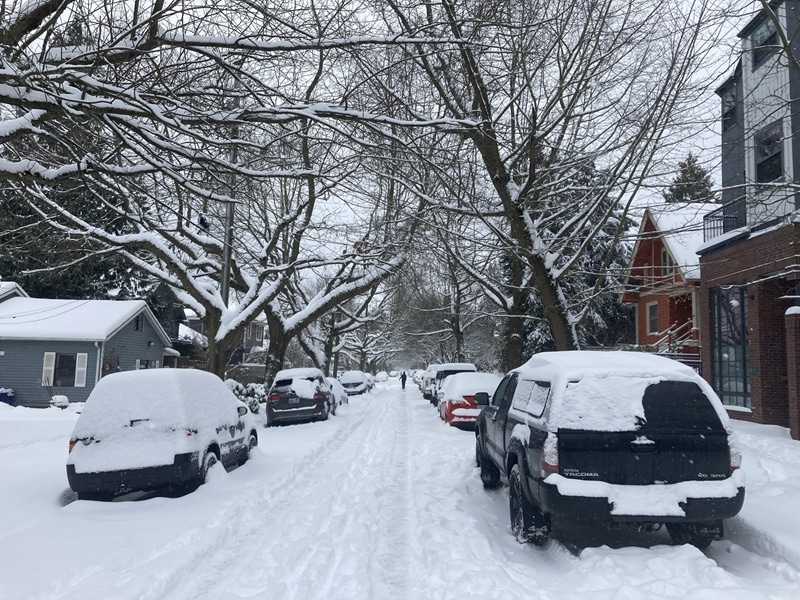
- It’s not as bad as up north in Canada, but driving in snow can sometimes be dangerous, so people sometimes use chains or traction tires. Also, if you’re driving to a ski resort or something similar on mountainous roads, you’ll need some snow tires.
Public Transportation Safety
Public transportation is somewhat safe, but crimes and accidents can also occur. I’ve never had any issues while taking public transportation (mostly the light rail, though), so I don’t have firsthand experience on the matter, besides the fact that the rides can sometimes be a bit dirty and smelly.
Most crimes involving public transportation take place on buses. Here are a few examples from past headlines:
- Back in December 2024, a bus driver named Shawn Yim was stabbed to death by a homeless man on a random morning in the U-District.
- More recently, a person was stabbed on a Route 21 bus in September 2025, and another person in October 2025. Both happened in the Downtown and Capitol Hill areas.
- A man was shot dead on a bus in West Seattle in October 2023.
I’m pretty sure there are more crimes that don’t make headlines. While the attacks seem random, a common factor is that many of these criminals are:
- Homeless.
- Drug addicts.
- They normally stay in SODAs and the surrounding areas.
- They tend to attack when there are fewer people around.
These are their patterns that you should keep in mind so you can avoid being near them if you spot someone acting suspiciously.
Honestly, the only thing that you can do with these attacks is to remain calm, call 911, and try not to provoke the criminal. Really, that’s all you can do in these situations, unless you’re trained in self-defense or are armed. The good news is, in recent years, the city has increased the number of security personnel, and people have since felt “more at ease.”
Most accidents are bus crashes or train crashes. The light rail, however, is generally safe. Just make sure to take basic safety precautions, and you should be fine.
Homelessness
Homelessness is another prominent issue that the city government hasn’t been able to solve completely, and I doubt they ever will.
You can see homeless people lying around on sidewalks, under highway bridges, in parks, or any other area with space for them to occupy.
Some homeless people are aggressive and use drugs (and are actually criminals themselves), so in general, you should avoid walking near them when possible. Yes, there are also homeless people who are genuinely sincere, and I’ve given them some drinks or spare change, but when it comes to safety, use your common sense when it comes to interacting with strangers.
There are areas in which homeless people set up encampments and make them their own territories, like the Jungle in Beacon Hill and the area near Seattle Center and I-5 in SLU. The city usually clears these places once in a while, but they tend to reappear again and again.
Protests and Riots
Like many large cities in the US, Seattle is known for being a progressive center, and protests or riots can literally erupt at any moment in response to any political event whatsoever.
The areas that are most prone to protests and riots are Downtown and Capitol Hill. The 1999 WTO protests and the 2017 Women’s March are examples. Personally, I experienced a kind of protest-turned-riot firsthand when I was in Capitol Hill during those BLM and George Floyd protests back in mid-2020.
They turned Cal Anderson Park into their own little community, piling up weapons, and even having their own “security guards.” I lived across the street, so I could watch the entire event unfold from my windows, seeing them breaking into stores and restaurants, from the day they set up the autonomous zone to the day the police cleared it up.
My advice when things like this happen is to stay in your room and lock all doors (barricading is also a good idea if you don’t live in a high-rise), monitor the situation through local news, avoid provoking protestors or police, and wait for the authorities to clear the area. If you have to go out, avoid protest areas, and don’t draw attention to yourself.
The Weather and Natural Disasters
Seattle’s weather is generally mild with dry summers and wet winters. It rains a lot, even more so than in London. So, you might get sick easily after moving here. Overall, I’d say that on most days of the year you can expect a slightly cool, rainy climate.
According to Choose Washington, summer temperatures rarely rise above 79°F (26°C).
However, in June 2021 there was a record high of 108°F (42°C) because of the heatwave in that year, which I experienced myself. It was one of the driest summers I’ve ever been through (the other was in Kelowna, BC). Many people died since they didn’t expect the heat to be that bad, and most households didn’t have air conditioning. That’s why staying hydrated, especially in summer, is a must.
During winter, temperatures rarely drop below 45°F (8°C), but they can also fall into the 20s to 30s°F (-6°C to -1°C) at night. It also snows lightly in winter from December to January, which averages around 8 inches annually.
Natural disasters are primarily caused by:
- Earthquakes: can possibly happen once in a lifetime.
- Landslides: because of the hilly terrain and heavy rainfall, mostly from December to March.
- Flooding: by heavy rain.
- Windstorms: like cyclones.
Emergency Contacts
Here’s a list of emergency contacts in Seattle:
- Police, fire, medical for life-threatening emergencies: 911
- Non-emergency police: 206-625-5011
- Washington Poison Center: 800-222-1222
- Power, sewer, water, drainage: 206-684-3000
- Fallen trees and roadway obstructions: 206-386-1218
- Landslides: 206-684-8950
- Temporary shelter: 800-621-4636
You can also sign up for alerts at this website.
My Overall Thought on Seattle’s Safety
My honest take on Seattle’s safety is “yeah, it’s generally unsafe, especially at night,” but it’s not like an anarchic war zone or anything. It’s more like your typical American city with drug and homeless issues.
When I was living in Seattle, the only crimes that caught my attention were package theft, homeless people using drugs on the sidewalks, and the CHAZ protest in Capitol Hill, which trashed the stores and restaurants in the area. So, I’d say the main concerns are property crime, drug activity and homeless people, and protests.
Also, get health insurance. The cost of healthcare here can be expensive.
Frequently Asked Questions about Safety in Seattle
Is Seattle safe to visit as a tourist?
Seattle can be visited safely as long as you stay aware of your surroundings, especially in tourist areas like Pike Place Market and Seattle Center. Most of the crimes you’re likely to encounter are property crimes, such as theft, pickpocketing, and car prowls, so keep an eye on your belongings and avoid leaving valuables in your car.
Is Downtown Seattle safe at night?
Downtown Seattle is one of the areas where you should be extra cautious at night. It’s better not to walk alone, avoid rundown alleyways and barely lit sidewalks, and stick to busy, well-lit streets if you have to be out.
Which Seattle neighborhoods should I be careful in after dark?
Based on my experience, you should be more careful at night in Downtown, Capitol Hill (especially around E Pine St), South Lake Union, Ballard, the Chinatown-International District (CID), and the U-District. Avoid walking alone and try to move in groups in these areas.
How bad is package theft in Seattle?
Package theft is an issue in Seattle. Couriers usually leave packages in front of houses or apartment buildings, which makes them easy targets. Using lockers, package rooms, video doorbells, and being careful about who you buzz into your building can greatly reduce the risk.
Is public transportation in Seattle safe?
Public transportation is somewhat safe, and I’ve personally never had issues on the light rail. However, some violent incidents have happened on buses, often involving homeless people or drug addicts, usually when there are fewer people around. Stay alert, avoid provoking anyone acting suspiciously, and call 911 if something happens.
Are the homeless people in Seattle dangerous?
Not all homeless people are dangerous. Some are genuinely sincere, and I’ve even given some drinks or spare change. That said, some homeless people are aggressive and use drugs, and some are involved in crime. For safety, it’s best to avoid walking too close to people who are acting up and use common sense when interacting with strangers.
What should I do if there are protests or riots near where I live?
If protests or riots break out near you, like in Downtown or Capitol Hill, the safest thing to do is stay inside, lock your doors (and barricade them if you don’t live in a high-rise), monitor local news, avoid provoking anyone, and wait for authorities to clear the area. If you have to go out, avoid protest areas and don’t draw attention to yourself.





 Español:
 ไทย:
ไทย: