This article will take approximately 20 minutes to read. Don't have the time right now? No worries. Email the ad-free version of the article to yourself and read it later!
If you’re moving to Greece, here’s what you actually need to know about getting a Greek driving license based on real experience, plus what to expect with costs, timelines, and the test itself.
If you’re moving to Greece, getting a driving license is something you’ll likely need to deal with sooner or later. And from what I’ve seen, there’s a lot of confusing or outdated information online about how the process actually works.
In this guide, I’ll walk you through everything you need to know based on real experience. I’ve gone through the process myself, including retesting and sitting the driving exam in Greece even though I already had a valid New Zealand license.
Disclaimer: This article may include links to products or services offered by ExpatDen's partners, which give us commissions when you click on them. Although this may influence how they appear in the text, we only recommend solutions that we would use in your situation. Read more in our Advertising Disclosure.
Contents
- Key Takeaways
- Do You Really Need a Driving License in Greece?
- Requirements to Get a Driving License in Greece
- 3 Ways to Get a Driving License in Greece
- How to Get a Driving License in Greece for the First Time
- How to Exchange a Foreign Driving License in Greece
- Who Should Exchange a Driving License in Greece?
- Who Can Exchange a Driving License?
- Can You Drive in Greece Without Exchanging Your License?
- Cost of Exchanging a Driving License
- Good to Know About Changing a Driving License
- Translation Requirements for License Conversion
- Where to Exchange Your Driving License
- Do You Need an Appointment at KEP?
- How to Retest to Get a Driving License
- Can I Apply for a Car and Motorcycle License at the Same Time?
- How Long Does It Take to Get a Driving License in Greece?
- When You Should Not Exchange Your Driving License in Greece
- What’s the Best Option for You?
- Frequently Asked Questions
Key Takeaways
- If you’re staying long-term, getting a Greek driving license will make life much easier, especially outside Athens.
- There are three main routes: getting a license from scratch, exchanging an eligible foreign license, or retesting.
- Most people apply through a driving school, which usually handles the paperwork and fees (paravola) for you.
- Even if you already drive, retesting still requires the compulsory lessons and both theory and practical exams.
- Total costs vary widely, but a full first-time license often lands around €700–€1,200+ depending on where you are and how many lessons you need.
- Exchanging your license can be the easiest option (if you’re eligible), but you may need translations and you’ll usually have to surrender your original license.
Do You Really Need a Driving License in Greece?
If you’re planning to stay in Greece long term, getting a driver’s license is pretty much a necessary step. Outside of Athens, having a car makes your life in Greece much easier, and it’s useful in more situations than you might expect.
Here are a few reasons why:
- Renting a car becomes easier: Even if you don’t plan to own a car, having a Greek license simplifies rentals. The alternative is an International Driving Permit (IDP), but that’s only valid for a limited time and not a long-term solution.
- Getting insurance: When you buy a car, having a Greek license makes the insurance process smoother. You avoid extra paperwork and get approved faster.
- Identification: While Greeks don’t commonly use a driver’s license as ID, it can still be useful as a secondary form of identification for certain bureaucratic processes.
- Driving across the EU: One of the biggest advantages is that you can drive in all EU and EEA countries without needing an IDP or additional documentation.
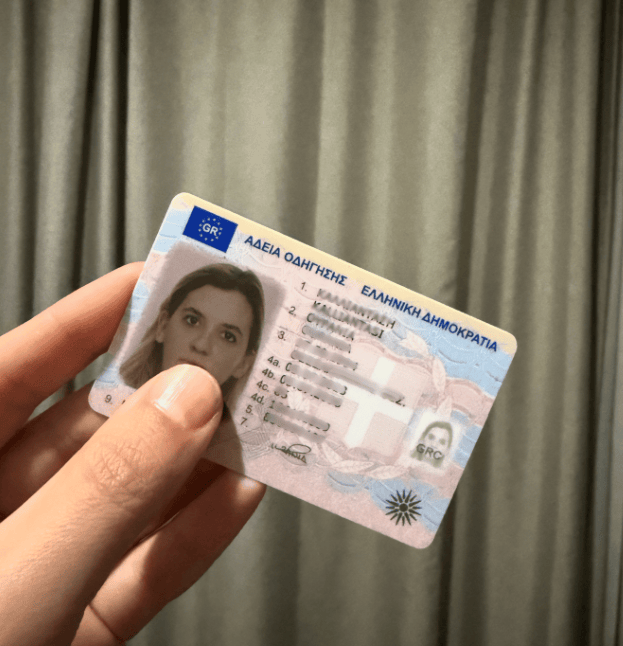
Requirements to Get a Driving License in Greece
Like most countries, the basic requirements are fairly simple:
- You must be at least 18 years old for a standard car or motorcycle license.
- For trucks, buses, or heavy vehicles, the minimum age is 21 or 24 depending on the category.
- You shouldn’t have a serious criminal record related to driving offenses.
While the requirements are straightforward, the process itself depends on your situation.
3 Ways to Get a Driving License in Greece
Not everyone follows the same path. In general, there are three main options:
- Getting a license from scratch (first-time drivers)
- Exchanging an existing license
- Retesting (similar to starting from scratch, even if you already know how to drive)
How to Get a Driving License in Greece for the First Time
If you’ve never had a driver’s license before, you’ll need to go through the full process. Depending on the driving school and how quickly you complete your lessons, this can take around 1 to 2 months.
One advantage in Greece is that there are no restricted or probation periods. Once you pass, you’re a fully licensed driver.
Who Should Get a Driving License from Scratch?
- You’ve never had a driver’s license before.
- Your current license can’t be exchanged in Greece.
- You prefer to learn everything step by step in a structured way.
Application Process
Here’s what the process looks like:
- Start your application.
- Register with a driving school (mandatory).
- Complete the required paperwork and pay the fees.
- Pass the theory exam.
- Complete the mandatory driving lessons (plus any extra if needed).
- Pass the practical driving test.
Step 1: Application
The process can start online through the gov.gr portal, but you can also go through a driving school and skip the online part entirely.
If you apply online, you’ll need Taxisnet credentials, which you usually set up when moving to Greece. You’ll choose your license type, upload a photo and signature, and pay the required government fees (paravola).
In reality, most people don’t do this themselves. Instead, they go through a driving school, which handles the entire application for you, including uploading documents and issuing the paravola.
Step 2: Medical Requirements
To move your application forward, you’ll need to complete two medical exams:
- a general doctor check-up
- an eye exam
If you apply through gov.gr, the results are usually uploaded automatically. If you receive paper certificates from the doctors, you’ll need to submit them to your driving school.
The easiest way to book these appointments is to call doctors directly. You can also search online using terms like “παθολόγος near me” or use platforms like doctoranytime.gr.
The cost typically ranges from €20 to €40 per doctor. When booking, make sure to mention that you need a certificate for a driving license.
Step 3: Theory Test and Study Requirements
Unlike many other countries, you can’t practice driving with friends or family in Greece. Only certified driving instructors are allowed to teach you.
Once your application is approved, your driving school will schedule your theory test.
You’ll get a manual to study from, but I found online mock exams really helpful. Most are in Greek, but there are a few sites that offer English versions like this one.

The theory test is:
- computer-based
- multiple choice
- usually available in English (request this in advance)
Step 4: Practical Driving Lessons
For a standard car license, you need to complete at least 10 practical lessons with an instructor.
If your level isn’t quite there yet, you may need additional lessons before taking the test.
One important thing to know is that Greece is mostly a manual-car country. This means:
- if you take the test in a manual car, you can drive both manual and automatic
- if you take it in an automatic, your license will only allow automatic cars
Also, finding a school that offers automatic lessons can be a bit harder.
Step 5: Practical Driving Test
Once your instructor feels you’re ready, you’ll take the practical exam.
During the test:
- the examiner sits in the back seat
- your instructor sits next to you
- you follow a set route and demonstrate basic driving skills
In my experience, the test takes less than 20 minutes.
The instructor isn’t supposed to help you or use the dual pedals. If you pass, they often don’t say much. If you fail, you’ll be asked to pull over and park immediately.
After passing, you’ll receive a temporary license right away, and the official one will be sent to you within a few weeks.
Practical Exam Expectations
A lot of people wonder what the driving test actually involves. From my experience getting a license in two different countries, the process can vary quite a bit.
In Greece, driving schools train you specifically to pass the exam. The focus is mainly on:
- parallel parking
- road positioning
- speed control
Parallel Parking Test
Driving in Greece means being able to parallel park under different conditions. The standard practical examination will require you to do a parallel park.
Most examiners will choose a spot where there’s a car in front but a lot of space behind. In my case, I remember there being a car both in front and behind, but I still had plenty of space—about enough for one and a half cars.
If you’re worried about it, ask your instructor to build in more parallel-parking practice.
Most driving instructors teach a set “flow” and expect you to stick to it. That way you clearly show the examiner what they’re looking for: blind-spot checks, correct positioning, and parking in fewer than four moves.
Hill Starts
Hill starts aren’t an official exercise, but they often come up in the exam because of the roads and common test routes.
You’ll be expected to:
- stop properly on a slope (often near a stop sign)
- check for traffic
- give priority as needed, hold the car and demonstrate control of the clutch, then move off smoothly without rolling back
Stalling or rolling back a lot can be reasons to fail the test.
Driving Test Routes
The good news about the test routes is that instructors know them well.
This is where your lessons really help, because you’ll practice driving in the exact area where you’ll be tested.
Cost of Getting a Driving License in Greece
While gov.gr lists the official fees (paravola), your total cost will also include:
- medical exams
- driving school package
- lessons (including extra lessons if needed)
- exam fees
In practice, the total cost usually ranges from €700 to €1,200+, depending on the school, the city, and how many lessons you need.
How to Exchange a Foreign Driving License in Greece
Another option, if you already have a valid driver’s license, is to exchange it for a Greek one. This process has pros and cons, so we’ll briefly go through them.
Overall, it’s by far the easiest and most cost-effective option, but it depends on your country of origin.
Who Should Exchange a Driving License in Greece?
Exchanging your license is the easiest and fastest option, but it’s not available to everyone.
You should consider this route if:
- you hold a license from an EU or EEA country
- your country has a reciprocal agreement with Greece
Who Can Exchange a Driving License?
In general, you can exchange a license if you:
- hold a license from an EU or EEA country
- hold a license from a country that has a reciprocal agreement with Greece
For the latter, I wouldn’t trust everything you see online. I was told a few times that exchanging my New Zealand license would be fine; however, driving schools confirmed that wasn’t the case.
Some of the countries that, according to official guidelines, have reciprocal agreements (sometimes only for certain states/territories) include:
- Switzerland
- Serbia
- Albania
- USA
- Australia
- Canada
- Japan
- South Africa
- South Korea
- Some countries in the former Soviet Union
If your license is from Asia, Africa, Latin America, or another region, check with a driving school in advance. They usually have the most up-to-date information.
What you find online isn’t always accurate.
Can You Drive in Greece Without Exchanging Your License?
At this point, you might be wondering if you can just use your overseas license instead of exchanging it or going through the hassle.
You can, but it opens another question. If you’re from the EU:
- You can drive with an EU driving license.
- But as a long-term resident, you’re expected to eventually change it.
If you’re outside the EU:
- You may be able to drive temporarily using your original license.
- You’ll need an IDP (which you apply for and get before departure).
- It isn’t a long-term solution.
Cost of Exchanging a Driving License
For updated information on fees, head to the National Registry of Administrative Public Services website, where there are pages for each country.
- EU member states are typically €30, and it takes about 45 days.
- UK driver’s licenses are €108 to €198.15, and it takes about 45 days.
- USA and other countries (Japan, Australia, etc.) are typically €130–€200.
Good to Know About Changing a Driving License
You’ll notice there are a lot of requirements depending on the country. You’ll definitely need to apply before your license expires, and you also need to qualify for things like:
- Not having any other Greek or EU member-state driving licenses. In practice, this means if you’ve converted a license before, you won’t be able to do it again.
- Proof of residence in Greece
- For the UK, having received your UK license before 02.02.2021
- Official translations of all documents
- Official certificates from the issuing country (not just the physical card)
Translation Requirements for License Conversion
To have your documents accepted, you’ll also need official translations. The process can be tedious, and the exact requirements depend on the latest guidelines, so it’s important to follow the official instructions carefully.
The country-specific links mentioned earlier usually include the steps and what’s required, including which types of translations are accepted.
In general, the process involves:
- applying through a government authority (such as the Ministry of Foreign Affairs or Justice Department)
- submitting the original document
- paying a fee
- receiving a certified translation or an apostille
An apostille is an official certificate that confirms your document is genuine and valid for use in another country.
You can also find a list of certified translators on the gov.gr website if you’d rather contact one directly.
Where to Exchange Your Driving License
If you’re exchanging your foreign license for a Greek one, you’ll need to submit your documents either in person or by post. I recommend doing it in person to avoid unnecessary delays.

You can apply at:
- the regional transport authority
- a KEP office (Citizen Support Centre)
In most cases, KEP is the better option. They’re set up to help with paperwork and can guide you through the process at no cost.
There are also two private KEP offices in Athens:
- Private KEP Marousi
- Private KEP Piraeus
These charge a fee, but the main advantage is faster support.
Wherever you apply, you’ll need to submit all required documents, including translations and medical certificates. Even then, delays are common. It’s not unusual to be asked for extra documents or go back and forth a few times before everything is approved.
Officially, the process takes around 45 days. In reality, it can take longer, especially if your documents aren’t perfectly in order.
Do You Need an Appointment at KEP?
In most cases, you don’t need an appointment to visit a KEP. You can usually walk in, take a number, and wait for someone to help you.
You can also book an appointment for a video call online through this website.
KEP can help with paperwork and guidance on the steps, but keep in mind you’ll still need to handle the rest of the process yourself.
How to Retest to Get a Driving License
This option is very similar to getting a license from scratch. The main difference is speed—since you already know how to drive, you can usually move through the process faster.
Some driving schools may also offer slightly better rates if they know you’re retesting. However, you’re still required to complete all compulsory lessons.
A quick note on lesson structure:
- lessons are officially counted as 25 sessions of 45 minutes
- in practice, most schools combine them into 90-minute sessions
- this usually works out to around 12 to 13 lessons
Even if retesting sounds straightforward, don’t underestimate it. You may need to adjust your driving habits and revisit rules you haven’t thought about in years.
My recommendations based on experience:
- Don’t underestimate the theory test: The theory exam can still be challenging, especially if you’re not familiar with Greek road rules. You’re only allowed 2 mistakes and need 28/30 questions correct to pass.
- You can fail for small things: Mirror checks, lane changes, seatbelts, signaling—it doesn’t matter that you already know how to drive. You’re being tested on how well you follow the expected procedure.
- Find an instructor who speaks English: This makes a big difference, especially when it comes to explaining theory concepts and test expectations. You’ll have more options in larger cities.
- Consider testing in a smaller city: If you prefer a less chaotic environment, you can take your test outside major cities like Athens.
My Experience Retesting for a Driving License
I’m using my own experience here as a case study from when I took my driving test in Greece in 2023. While that was a few years ago, the steps are still similar as of March 2026.
I opted for a combined Category A + B license (motorcycle + car), which meant sitting the theory exam for both.
The list of documents I was given by the driving school included:
- 3 passport-type photos
- 2 ID-type photos
- 2 completed applications and Υπεύθυνες Δηλώσεις (certified), provided by the driving school
- 1 additional application form
- Medical certificates from a pathologist and an ophthalmologist
In terms of cost:
- The total for the theory exams (motorcycle + car), plus the lessons and fees for getting my car license, came to around €620.
Additional costs to keep in mind:
- Failing an exam: approximately €100 per attempt
- Extra driving lessons: around €30 per lesson
Who Should Retest to Get a Driving License in Greece?
This is the best option if:
- your license can’t be exchanged
- you already have driving experience
- you want a faster alternative to starting from scratch
Can I Apply for a Car and Motorcycle License at the Same Time?
Yes, you can. This is exactly what I did when I retook my driving test to get a Greek license.
Applying for both at the same time has a couple of advantages:
- you may get slightly better pricing from the driving school
- you can sit the theory exam on the same day, which saves time
How Long Does It Take to Get a Driving License in Greece?
I thought it would be useful to quickly recap the timeline for all three options so you can pick the fastest one.
In most cases, both exchanging and retesting take around the same amount of time, usually just over a month or about 6 to 8 weeks.
For exchanging, the biggest delays usually come from document verification and translations.
For retesting, it depends on the driving school. In a best-case scenario, you can sit the theory exam within a few weeks, complete your lessons over the next couple of weeks, and be ready for the practical test within a month.
This is often the fastest route in practice, and it’s what I’d recommend for most people.
When You Should Not Exchange Your Driving License in Greece
While exchanging your license can seem like the easiest option, there are a few situations where I’d suggest thinking twice. Here are the main reasons.
You have to give up your original license: What you might not realize at first is that when you exchange your license, you’re effectively surrendering your original one. That means you no longer hold a valid license from your home country.
This can become an issue if you plan to:
- move back to your home country in the future
- want to keep your original license for travel
- deal with a home country that has strict rules for reissuing licenses
You might give up certain categories: Not all license categories transfer. So if you drive cars, motorcycles, and trucks or vans, for example, you may end up only being able to drive standard car vehicles after the exchange.
What’s the Best Option for You?
By now, you’ve probably realized there isn’t a one-size-fits-all answer. The best option really depends on your situation.
- If your country is eligible, exchanging your license is the easiest and fastest route.
- If not, retesting is usually the most practical option if you already know how to drive.
- If you’re starting from zero, going through the full process is your only path.
In my experience, most expats in Greece end up retesting. It’s not as complicated as it sounds, and it gives you a solid understanding of how driving works in Greece.
Frequently Asked Questions
Can I get a Greek driving license if I already have one from another country?
Yes. If your country is eligible, you may be able to exchange your license. If not, you’ll usually need to retest, which still includes compulsory lessons plus the theory and practical exams.
How long does it take to get a driving license in Greece?
Exchanging and retesting often take a similar amount of time, usually just over a month, or around 6 to 8 weeks. Getting a license from scratch typically takes around 1 to 2 months, depending on how quickly you complete lessons and get test dates.
How much does a driving license cost in Greece?
For a first-time license, the total cost is commonly around €700 to €1,200+ once you include medical exams, driving school packages, lessons, and exam fees. Retesting and exchanging have their own costs depending on your situation and country.
Do I need to go through a driving school in Greece?
Yes. Driving schools are mandatory for lessons, and most people also use them to handle the application process and paperwork.
Will I lose my original license if I exchange it for a Greek one?
Yes. When you exchange your license, you effectively surrender your original one, which can be a problem if you plan to move back home later or want to keep it for travel.