This article will take approximately 17 minutes to read. Don't have the time right now? No worries. Email the ad-free version of the article to yourself and read it later!
Panama drives on the right, uses USD at the pump, and has roads that range from excellent inter-city highways to sections that become impassable in rain. Here’s what you need to know about the license requirements, the rules that catch foreigners, and what to do if something goes wrong.
Driving in Panama City is an education in patience. The traffic is dense, the lane markings are treated as suggestions, and a ten-block trip can take twenty minutes at the wrong hour. Outside the capital, the Pan-American Highway runs well and the scenery is excellent. In the highlands during rainy season, roads can close with no notice. Panama rewards drivers who go in with accurate expectations.
The country is easily navigable with a foreign license for the first 90 days after entry. If you gain residency, conversion to a Panamanian license becomes a legal requirement. Either way, knowing the rules that specifically catch foreign drivers (and knowing what to do at the scene of an accident) is worth the reading time before you get behind the wheel.
Disclaimer: This article may include links to products or services offered by ExpatDen's partners, which give us commissions when you click on them. Although this may influence how they appear in the text, we only recommend solutions that we would use in your situation. Read more in our Advertising Disclosure.
Contents
Key Takeaways
- Tourists can drive on a valid foreign license for 90 days from their latest entry stamp. Residents must convert to a Panamanian license.
- Panama drives on the right. Speed limits: 40 km/h urban, 60 km/h rural, 100 km/h motorway.
- The legal BAC limit is 0.05%, roughly equivalent to one standard drink for most people. Enforce your own zero-tolerance policy behind the wheel.
- Phone use while driving is illegal even at red lights. The fine exceeds that for speeding.
- After an accident, do not move the car until police arrive and say you can. Moving it forfeits your right to pursue the other driver’s insurer.
- Third-party liability insurance (SOAT) is mandatory. Fuel runs about US$1.19 per liter for regular petrol, US$1.27 for diesel.
Can You Drive Here?
For tourists, yes, without any additional paperwork for 90 days from your most recent entry stamp. Your valid foreign license is recognized by Panamanian law for the duration of a standard tourist stay.
For residents, the picture changes. Once any Panamanian residency is granted, including temporary residency, you are legally required to convert to a Panamanian license. Driving on a foreign license after residency approval is not a gray area; it is illegal. The conversion process (called homologation) skips the written and practical tests if your country has reciprocity with Panama, which most do.
Processing takes about two weeks and costs around US$40 plus authentication fees.
Read more: Getting a Panama Driver’s License: A Step-by-Step Guide for Expats
Documents to Carry When Driving
Every time you drive in Panama, carry these originals. Photocopies are not accepted:
- Valid driver’s license (your foreign license for tourists; your Panama license once you have one)
- IDP (International Driving Permit): not legally required but strongly recommended; issued alongside your foreign license, it provides a Spanish-language translation that reduces friction during police stops
- Vehicle registration (circulación): must be current
- SOAT or insurance certificate: proof of mandatory third-party liability coverage
- Passport or cédula: carry your passport as a tourist; your cédula as a resident
Police checkpoints on main routes are common. Officers will request these documents, and anything missing creates a delay and a possible fine. Keep originals in the car in a document holder, not loose in a bag.
Tip: Make certified copies of your license and documents and keep them at home. If you are stopped and your original license is retained as part of a fine process (this occasionally happens), having a certified copy helps with the follow-up. The originals stay in the car; the copies stay at home.
Is It Easy to Drive in Panama?
In Panama City: no, not initially.
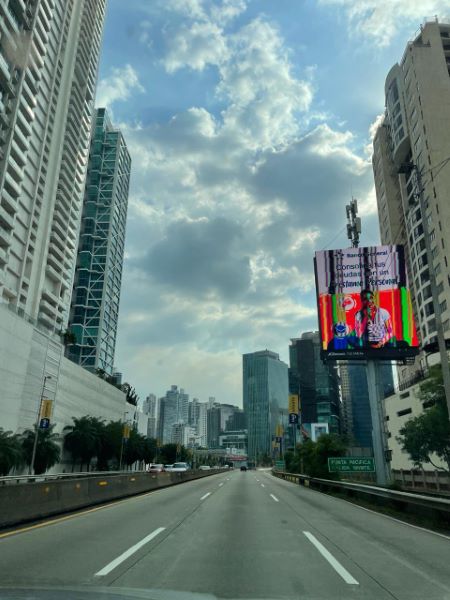
Traffic congestion in the capital is serious, particularly during the morning rush (7am to 9am) and evening rush (5pm to 7pm). The road network is denser than the city’s infrastructure can comfortably handle, and drivers are assertive. Motorcycles weave, lane discipline is loose, and traffic lights are sometimes treated as strong suggestions rather than legal obligations.
Panama City is finite, though. Once you learn the main arteries (the Cinta Costera, Vía España, Calle 50) the city becomes manageable. A GPS application is essential. Waze is the most popular navigation app in Panama and is well-maintained by local contributors who mark accidents, checkpoints, and road closures in real time.
Outside the capital, driving is considerably more relaxed.
The Pan-American Highway (Interamericana) to David and the western provinces is well-maintained, well-marked, and pleasant to drive. Secondary roads to beach communities (Pacific side) are paved and in reasonable condition. Highland roads around Boquete and Volcán are passable year-round, though they narrow considerably and some sections are steep.
The Atlantic coast and Bocas del Toro are a different story. Reaching Bocas requires a ferry crossing; the road network there is limited. In rainy season across the highlands and Atlantic-facing slopes, road quality can deteriorate quickly.
Road Conditions by Region
The general road conditions in Panama is quite good, this make it quite easy to drive here unless it’s inside the city during the rush hour as mention earlier. Anyway, here’s road conditions by region to give you a clearer picture.
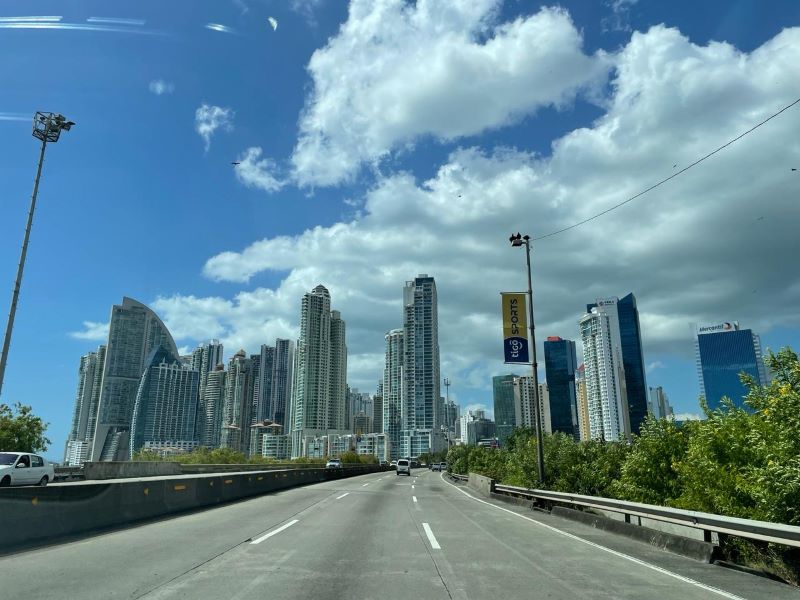
Panama City and metro area: Roads are paved throughout the capital. Potholes exist but are typically patched. The main challenge is volume, not surface quality. Flooding on low-lying streets during heavy rainy-season downpours can temporarily close certain routes; the Cinta Costera and underpasses are the most common flood points.
Pan-American Highway (Interamericana): Well-maintained divided highway from Panama City to Santiago, then a good two-lane road continuing to David and the Costa Rican border. Shoulders are present, signage is clear, and the route is safe for night driving with reasonable caution. This is Panama’s best road.
Pacific coastal access roads (Coronado, Santa Clara, Pedasí): Paved main approaches in generally good condition. Beach access roads within communities vary; some are paved, some are packed dirt that becomes difficult in heavy rain. Check with property owners or community groups before the rainy season (May through December) if driving to an unfamiliar beach area.
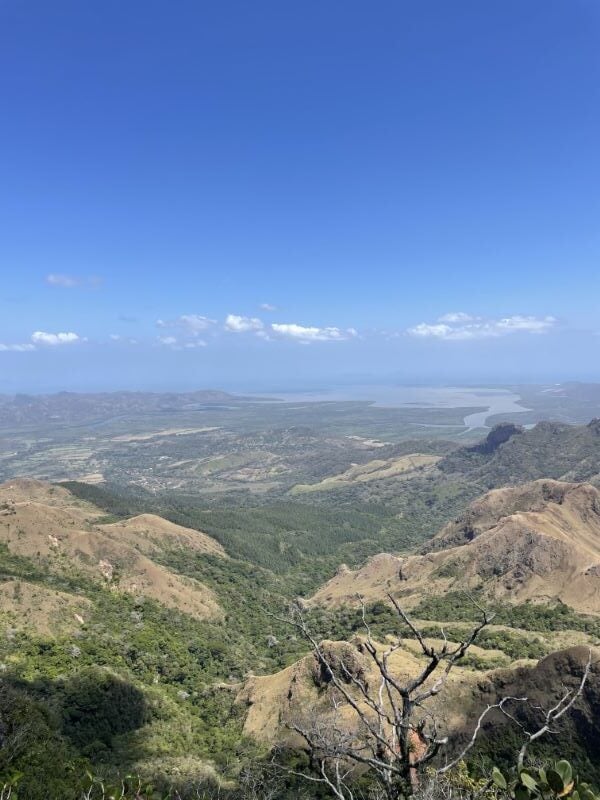
Chiriquí highlands (Boquete, Volcán): Paved but narrow roads with significant elevation change. Guardrails exist on many stretches but not all. Excellent visibility in dry season; fog and wet road surfaces are common in rainy season and particularly early mornings. 4WD or AWD is advisable for properties off the main road.

Bocas del Toro: Limited road network. Almirante is the mainland connection point; from there you take a water taxi or ferry to the archipelago. On the islands themselves, taxis and water taxis are the primary transport. Driving in Bocas is a limited activity.
Darién and eastern Panama: The Pan-American Highway ends at Yaviza; there is no road through the Darién Gap. Do not attempt overland travel into the Darién without expert local guidance.
The Rules That Catch Foreigners Off Guard
There are certain rules that catch foreigners in Panama off guard and costs in penalties.
Phone use at any point while driving, including at red lights, is illegal and carries a higher fine than speeding. This surprises drivers from countries where the red-light exemption exists. In Panama, the engine running counts as driving. Put the phone away before you start the car and do not pick it up until you are parked with the engine off. If you need navigation audio from your phone, set it before you drive.
The BAC limit is 0.05%, not 0.08%. At 0.05%, you are legally impaired in Panama before most North American drivers would feel any effect. For a 150-pound (68 kg) person, one standard drink (one beer, one glass of wine, one shot of spirits) can bring BAC close to or over 0.05% depending on body weight, metabolism, and timing. For a smaller person, one drink is potentially enough. For a heavier person, two drinks may still exceed 0.05%. The only safe policy behind the wheel in Panama is zero alcohol. The fine is secondary to the criminal exposure: impaired driving resulting in an accident carries serious legal consequences.
Speed bumps (policías muertos) are often unmarked. On residential streets and in smaller towns, speed bumps can appear with no warning sign or road marking. Hitting one at speed is damaging to your vehicle and not reimbursable by anyone. Slow down in any residential area, particularly when entering small towns and communities on secondary roads.
The circulación (vehicle registration) must be current. Driving with an expired registration is a fineable offense at any checkpoint. If you are renting, confirm the paperwork is valid before driving off the lot. If you own a vehicle in Panama, set a calendar reminder for registration renewal.
Seatbelts are mandatory for all occupants. The driver is legally responsible for ensuring all passengers are belted. Children require appropriate car seats; Panama follows international child safety seat standards.
Reflective triangles and a fire extinguisher are legally required in the vehicle. If you are stopped after an accident or a breakdown without these, you face an additional fine on top of whatever else is happening.
Driving Culture and Safety Tips
Panamanian driving has a reputation that is accurate in parts and overstated in others. Drivers in Panama City are aggressive by European standards but not notably more so than in Mexico City, Bogotá, or São Paulo. The specific things worth knowing:
Horn use is communication, not hostility. Short honks signal awareness, warn at blind corners on mountain roads, and indicate turn intentions in tight spaces. A honk is not necessarily aggression; calibrate your interpretation accordingly.
Left-lane courtesy rules apply inconsistently. On the Interamericana, trucks and slow vehicles in the left lane are common. Overtaking happens where gaps appear rather than following predictable rules. Drive defensively and do not assume the left lane is clear.
Night driving outside cities carries elevated risk. Unmarked pedestrians on rural roads, livestock crossing, unlit vehicles, and the combination of potholes and rain make night driving on secondary roads riskier than it appears. Plan highland and rural driving during daylight hours where possible.
Fuel is available and affordable. Petrol (regular unleaded) runs approximately US$1.19 per liter; diesel approximately US$1.27 per liter as of June 2026. Gas stations are plentiful on all major routes. In remote areas, carry extra fuel for any stretch over 200 km between towns. Panama has no fuel deserts on main tourist routes, but going off-route changes the calculation. Prices are government-regulated and updated weekly by the National Energy Secretariat (SNE).
Electronic tolls on Corredor Sur and Corredor Norte require PanaPass. Both corridors operate with 100% electronic tolling; there are no cash lanes. A PanaPass tag costs US$15 plus an initial balance. Purchase locations are near Albrook Mall and at Atlapa Convention Center in Panama City. Without a PanaPass you will need to use city surface streets, adding significant time to cross-town trips. Typical corridor tolls run US$3 to US$8 depending on route and plazas used.
Parking in Panama City requires strategy. Street parking is available but contested. Parking buildings (parqueos) are the reliable option for extended stays in commercial districts. Budget US$1 to US$3 per hour at covered parqueos. Know where you plan to park before you drive in; circling while looking is how traffic accidents happen.
How to Fill Up Gas in Panama
One thing that surprised me on my first fill-up: in Panama you don’t pump your own gas. Stations are full-service, so an attendant fills the tank while you stay in the car. You just pull up and tell them what you want.
A few things worth knowing before your first stop:
- Fuel is sold by the gallon, not the liter, which throws off anyone arriving from Europe or most of Latin America.
- You will see three options: 91 octane (regular), 95 octane (premium), and diesel. Most cars run fine on 91.
- Specify the amount and the octane. Tell the attendant “lleno” for a full tank, or a figure like “quince” (US$15), plus the grade: “noventa y uno” (91) or “noventa y cinco” (95).
- Prices are set by the government and change every Friday at 6am, so last week’s price is not always today’s. As of mid-2026, 91 octane runs around US$4.51 a gallon and 95 around US$4.81 in Panama City, with the interior often a few cents higher; you can check the latest pump prices before you go.
- Cards are widely accepted in the city, but carry cash for smaller stations in the interior, where the card machine is “broken” more often than you would like.
You will see a handful of chains. The biggest and most common is Delta, a Panamanian company with more than 225 stations nationwide, so it is the one you will pass most often, especially outside the city. Terpel is the next largest with close to 200 stations, and Puma rounds out the main three.
Fuel quality is consistent across them since prices and standards are regulated, so most expats just use the nearest Delta or Terpel.
Tip: it is customary, though not required, to tip the attendant a few coins (around 25 to 50 cents), especially if they clean your windshield or check your tires.
Dealing with Accidents
What you do in the first minutes after an accident determines your legal and insurance position in everything that follows. The standard procedure:
- Call 911 for police and, if anyone is injured, an ambulance. Panama’s emergency number is 911. Report the accident immediately.
- Call your insurance company. Most policies require notification within 72 hours of an accident; calling immediately is better. They will tell you what to do and when their inspector can arrive.
- Do not move the car. This is the rule expats most commonly break by instinct. In Panama, moving your vehicle before police arrive forfeits your right to pursue the other party’s insurer for damages. Even if your car is blocking traffic, do not move it without explicit instruction from the police officer on scene. Turn on your hazard lights and wait.
- Photograph everything. Both vehicles from multiple angles, the road surface, skid marks, street signs, and any damage. Video the scene. Photograph the other driver’s license, registration, and insurance documentation.
- Write your account of what happened. Writing it in English is legally acceptable. Include time, direction of travel, what each vehicle was doing, and what you observed. Sign and date it.
- Get the police report reference number. The officer will give you a slip with a court appearance date (typically about one month out) and a case reference. Keep this document; you need it for insurance claims.
- Attend the court date. Ignoring the court notice is not an option. The court appearance is generally administrative rather than adversarial for minor accidents, but non-attendance can result in a warrant.
Your insurance company will assign an inspector to assess the vehicle and process the claim. For significant damage or injuries, legal representation is worth considering. Expat attorneys in Panama City who handle traffic cases are straightforward to find through expat networks.
Good to Know: Panama’s mandatory third-party liability insurance (SOAT) covers injury to the other party, not damage to your own vehicle. For vehicle damage coverage (whether your vehicle hits something or gets hit), you need comprehensive insurance (seguro todo riesgo) on top of the mandatory SOAT. If you are financing a vehicle, comprehensive coverage is typically required by the lender. If you own outright, the decision is yours, but given repair costs in Panama, comprehensive is generally the sensible choice.
Frequently Asked Questions
Can I use my US or UK license to drive in Panama?
Yes, for 90 days from your most recent entry stamp as a tourist. If you gain residency, you must convert to a Panamanian license. The conversion (homologation) is straightforward for most nationalities and does not require retaking a driving test. The Autoridad de Tránsito y Transporte Terrestre (ATTT) oversees licensing and registration.
What side of the road does Panama drive on?
The right, same as the US, Canada, and most of Latin America.
Is an International Driving Permit (IDP) required?
Not legally required for tourists. Strongly recommended as a supplement to your foreign license; it is a standardized document in multiple languages that reduces friction at police stops and border crossings. Obtain it in your home country before you travel.
How bad is traffic in Panama City?
Significant, particularly during morning and evening rush hours. Outside those windows, the city moves reasonably well. On weekends and holidays, traffic drops considerably. Use Waze for real-time routing around accidents and checkpoints.
Can I drive from Panama to Costa Rica?
Yes. The Pan-American Highway crosses the border at Paso Canoas (Pacific side) and Sixaola (Atlantic side). You will need vehicle permits, proof of insurance valid in Costa Rica, and border documentation for the vehicle. If the vehicle is financed or rented, a cross-border permit from the lender or rental company is required. Verify requirements with your insurer and rental company before the trip.
What fuel does Panama use?
Petrol (gasolina regular and super) and diesel. All are sold in liters at stations nationwide. Prices are government-regulated and change weekly; current rates as of June 2026 are approximately US$1.19/liter for regular petrol and US$1.27/liter for diesel.
Is it safe to drive at night?
In Panama City and on well-lit main roads, yes. On secondary rural roads and mountain routes, significantly less so due to unmarked hazards, wildlife, livestock on the road, and limited emergency response. Plan rural and highland drives during daylight hours where possible.






'/%3E%3Cpath%20fill='%23b2b2b2'%20d='M241%20382q0%2016%2017%2026%2017%2011%2042%2011t42-11q16-11%2017-26V269H241'/%3E%3Cpath%20fill='%239f7e00'%20d='M241%20379q0%2014%208%2023%209%209%2021%209%2014%200%2021-9%209-9%209-23V269h-59'/%3E%3Cpath%20d='M241%20339v-70h59v110q0%2014-9%2023l-6%205v-68h-15v72q-8%200-14-4v-68zm59%2040c0%2022%2015%2032%2029%2032%2021%200%2030-18%2030-32v-40h-59'/%3E%3Cpath%20fill='%239f7e00'%20d='M266%20277v5h2v12h-3v-5h2v-5h-9v5h2v5h-4v9h3v18h-5v10h34v-10h-5v-18h3v-9h-4v-5h2v-5h-9v5h2v5h-3v-12h2v-5zm42%20101q0%2010%206%2017%206%206%2015%207%2010-1%2016-7%206-7%206-17v-29h-43'/%3E%3Ccircle%20fill='%230044ad'%20cx='329.5'%20cy='372'%20r='6'/%3E%3Cellipse%20fill='%230044ad'%20cx='300'%20cy='340'%20rx='16'%20ry='21'/%3E%3C/svg%3E) Español:
Español: Deutsch:
 Français: