
This article will take approximately 17 minutes to read. Don't have the time right now? No worries. Email the ad-free version of the article to yourself and read it later!
Georgia lets you stay a full year with no visa and no minimum income, it doesn’t tax your foreign pension, and Tbilisi is still one of the cheapest capitals in the region. From 1 January 2026, though, you can’t clear the border without health and accident insurance. Here’s what retirement in Georgia actually costs and requires in 2026.
I’ll be honest about the thing that makes Georgia unusual for a retiree. It is one of the easiest countries on earth to move to, and it is quietly getting stricter about who stays. Most nationalities walk in and get a 365-day stamp at the airport, no application, no bank statement, no lawyer. Your pension arrives untaxed. A furnished one-bedroom in a good Tbilisi neighborhood runs less than a studio in most of Western Europe.
Then the fine print arrives. As of 1 January 2026, every visitor needs insurance to enter. Local health cover often won’t take you past 65. Border runs that used to be routine now sit next to overstay fines that reach GEL 3,000. None of this makes Georgia a bad place to retire. It makes it a place you should understand before you buy the plane ticket.
Disclaimer: This article may include links to products or services offered by ExpatDen's partners, which give us commissions when you click on them. Although this may influence how they appear in the text, we only recommend solutions that we would use in your situation. Read more in our Advertising Disclosure.
Key Takeaways
- Most nationalities get a 365-day visa-free stay in Georgia with no minimum income and no application.
- From 1 January 2026, every visitor needs health and accident insurance, minimum GEL 30,000 (about US$11,000), to enter the country.
- Foreign pensions are not taxed in Georgia. The territorial system exempts foreign-source income.
- A single retiree lives comfortably in Tbilisi on around US$1,600 to US$1,800 a month, or frugally on closer to US$1,000.
- Cheap Georgian tourist policies clear the border but usually exclude pre-existing conditions, and local insurers often stop taking new applicants at 65 to 70.
- Winter heating and health insurance are the two costs that break naive budgets.
- The property-based residence permit now needs US$150,000, up from US$100,000 since 1 March 2026.
Why Retirees Are Looking at Georgia
There are many reasons why retirees choose Georgia.
- Visa: citizens of roughly 95 countries, including the US, UK, Canada, Australia, and the whole EU, can enter Georgia and stay for up to 365 days per entry, visa-free, with no minimum income and no application. You get the stamp at passport control and you’re done. No other country offering this quality of life hands out a year that casually.
- Tax: Georgia runs a territorial tax system, which for a retiree means your foreign pension, such as a US Social Security check, a UK private pension, or a portfolio drawdown from abroad, is not taxed here at all. I’ll talk more about it later in the article.
- Cost of living: A single retiree lives comfortably in Tbilisi on around US$1,600 to US$1,800 a month, and frugally on closer to US$1,000. Rent for expat-grade apartments is usually quoted in dollars, so a dollar or euro pension carries no currency risk on your biggest expense.
Food here is also good and affordable, and the wine culture is among the oldest in the world.
The New Entry Insurance Requirement (2026)
This is one of the most important things to know before you retire in Georgia. Since 1 January 2026, every foreign visitor entering Georgia must hold valid health and accident insurance, with the following requirements.
- Minimum coverage: no less than GEL 30,000, roughly US$11,000 at current rates.
- Type: health and accident, not one or the other.
- Duration: the policy must cover your full stay, arrival and departure dates included.
- Documentation: physical or electronic, written in Georgian or English.
- Who can issue it: a Georgian insurer or a foreign one. Any international policy that meets the threshold qualifies.
That last point matters more than any other for retirees. You do not need to buy a Georgian policy. If you already hold an international health plan or travel insurance, chances are it already passes the requirements. The bar here is quite low.
Good to know: This new insurance requirement applies only to foreign visitors and tourists. If you have a Georgian residence permit, this rule doesn’t apply to you.
Which Insurance Actually Works for Retirees
There are two types of insurance you can buy: local and international.
Local Insurance
Georgian insurers sell tourist and visitor policies built for the new rule at around GEL 2 to 3 per day. Providers like IRAO, GPI Holding, TBC Insurance, and Ardi issue them online in minutes, and they satisfy the GEL 30,000 requirement cleanly. For a healthy traveler, they’re fine.
The problem is what they cover. These are emergency-and-accident products, such as:
- urgent hospitalization
- emergency dental
- medical evacuation.
So it’s a good plan for travelers. But for retirees, the coverage might not be enough. The GEL 30,000 limit isn’t sufficient for a week-long hospital stay, for example. These policies are also built for emergencies, such as getting sick while traveling. They may not cover a retiree’s chronic conditions, such as cancer. It’s travel insurance, after all.
While local Georgian insurers also provide health insurance, they commonly stop accepting new applicants at 65 to 70 with no guaranteed lifetime renewal.
International Insurance
For retirees, an international health plan (sometimes called IPMI in Europe) is better. It comes with higher coverage and covers you not just in Georgia but in other countries as well. However, it’s also more expensive. Expect to pay at least US$200 a month, and the older you are, the more it costs.
A common approach, and the one I’d point most retirees toward, is to split the problem. Out-of-pocket care in Georgia is cheap, so you only need a plan for hospitalization. You can also add a deductible to bring the premium down further.
You can read our dedicated guide to health insurance in Georgia to find out more.
Visa for Retirees
There are two main visa options for a retiree in Georgia: a visa-exemption and a residence permit by property purchase.
Visa Exemption
For a lot of retirees, the 365-day stamp is the entire immigration plan. You arrive, you get a year, and near the end of it you leave and come back to reset the clock. The classic reset is a day trip to the Armenian border at Sadakhlo: a few hours by marshrutka, step across, turn around, and re-enter with a fresh 365 days.
Georgians at the border are used to it.
But this isn’t always a reliable strategy. In 2026, border runs still work, but the community consensus is to treat them as a fragile convenience rather than a permanent strategy, and to do your run or apply for residence well before you hit day 365, not on the deadline.
Residence Permit
If you want to stop border-hopping and put down roots, residence permits are the answer. The route most retirees use is the short-term residence permit by property ownership.
As of 1 March 2026, the minimum property value for this permit rose to US$150,000, up from US$100,000. If you completed your property registration before that date, the old US$100,000 figure may still apply to you under a transition rule. The permit runs for one year, renews annually while you hold qualifying property, and after six years of continuous legal residence you can apply for permanent residence.
A residence permit is not required to retire in Georgia, and it’s not required to become a tax resident either. It’s for people who want stability, an exit from the border-run cycle, or a firmer legal footing for the long haul.

Tax
Will Georgia tax my pension? For foreign pensions, the answer is no.
Georgia taxes individuals on a territorial basis. Under Article 82 of the Tax Code, resident individuals are exempt from income tax on non-Georgian-source income. Your pension, whether it’s US Social Security, a UK state or private pension, or drawdown from an investment portfolio abroad, is foreign-source passive income. It falls squarely inside that exemption. Georgia also has no wealth tax, no inheritance tax, and no gift tax.
The picture changes only if you earn active income from work physically performed inside Georgia. That income is treated as Georgian-source and taxed at the flat 20% rate, regardless of where your client sits.
If your pension is your only income and it comes from abroad, Georgia is close to a zero-tax retirement.
Tip: If you do plan to keep freelancing on the side, Georgia’s Individual Entrepreneur regime with Small Business Status taxes turnover at just 1% up to GEL 500,000 a year, which is why it draws so many location-independent workers. A pure retiree living on a pension needs none of it. If it’s relevant to you, our guide on how to open a company remotely in Georgia covers the setup.
One more money detail worth knowing before you bank here. Since 1 September 2026, the National Bank of Georgia has required banks and other payment providers to apply extra scrutiny to electronic transactions made by customers aged 60 and over.
The trigger is a transaction above GEL 500 that is linked to a high-risk category: online forex trading, investment schemes, gambling, or virtual assets. Unusual spending patterns can flag a payment too. Your provider has to pause the transaction and contact you before it goes through, and you then have 48 hours to confirm it or let it drop. The rule applies to card payments first.
Worth knowing: this targets scam payments, so ordinary pension transfers, rent, and grocery spending go through as normal. If you trade or buy crypto from a Georgian account after 60, expect a phone call and a wait.
Cost of Retiring in Tbilisi, Georgia
Forget the pre-2022 blog posts promising US$600 months. The Russian and Ukrainian influx after 2022 pushed Tbilisi rents up sharply, and while prices settled somewhat through 2025, they never returned to old levels. Adjust any pre-2022 figure up by 30% to 50% and you’ll be closer to reality.
Here’s a realistic monthly budget for a single retiree living comfortably but not lavishly, at mid-2026 prices. The exchange rate sits around 1 US$ to 2.65 GEL.
| Category | Lean (US$) | Comfortable (US$) |
|---|---|---|
| Rent, furnished 1-bedroom | 450 (Saburtalo) | 750 (central Vera or Vake) |
| Utilities, internet, mobile | 90 | 130 |
| Food, groceries and dining | 250 | 400 |
| Transport | 30 | 60 |
| Healthcare and insurance | 100 | 200 |
| Miscellaneous | 100 | 220 |
| Total | about US$1,020 | about US$1,760 |
Two lines on that table deserve attention because they’re where naive budgets break.
- The first is winter heating. Tbilisi apartments run on gas, insulation is generally poor, and a summer utility bill of US$30 can hit US$120 or more between December and February. Budget for the annual average, not the July number, or the first winter will sting.
- The second is healthcare, which for a retiree scales in a way it doesn’t for a young digital nomad. A 30-year-old is cheap to insure. A 65-year-old with a pre-existing condition is not, and that single line is the main reason a retiree’s budget sits above a nomad’s. Most other costs, rent, transport, food, are the same for both.
Rent is the biggest variable. Numbeo’s mid-2026 city-center one-bedroom average is around GEL 1,768 (US$667), while renovated, expat-grade apartments in prime Vake or Vera run US$800 and up. Value neighborhoods like Saburtalo bring that down considerably. If you’re deciding where to base yourself, our breakdown of the best neighborhoods in Tbilisi for expats is worth a read, and for the full picture see our cost of living in Tbilisi guide.
A couple doesn’t pay double. Shared costs stay flat and only food, healthcare, transport, and personal spending scale, so a couple living comfortably budgets around US$2,400 to US$2,600 a month, roughly 1.4 to 1.5 times a single person.
Healthcare
Routine healthcare is one of Georgia’s quiet strengths, and it’s cheap. A private GP visit runs about US$45 to US$55, a specialist US$55 to US$75, and you can see someone quickly. Central Tbilisi has private clinics with English-speaking staff, and the names that come up repeatedly among expats are Evex Medical, MediClub Georgia, and Aversi Clinic, along with the larger hospitals for anything serious.
The honest ceiling is complex and specialized care. Georgia handles everyday medicine and common procedures well, but for major surgery, rare conditions, or advanced treatment, many expats fly to Turkey or Western Europe. Istanbul is a short, cheap flight away and is a genuine medical hub. If your retirement plan involves managing a serious chronic illness, factor in that Georgia is a comfortable base for routine care rather than a place to handle the hardest cases locally.
This is exactly why the insurance question earlier isn’t academic. Cheap out-of-pocket care handles the small stuff. Real international cover handles the expensive stuff, including the flight-to-Istanbul scenarios. The two together, not either alone, is what a well-planned retirement here looks like.
Retiree Lifestyle in Georgia
Numbers tell you whether you can afford Georgia. They don’t tell you whether you’ll be happy there, and that’s a fairer question for a retiree than for a 28-year-old passing through for three months.
Pros
The good side is real.
- The pace is unhurried
- The food is excellent and cheap.
- The wine culture is thousands of years old and taken seriously. A long lunch of khinkali and khachapuri with a carafe of local wine costs a few dollars.
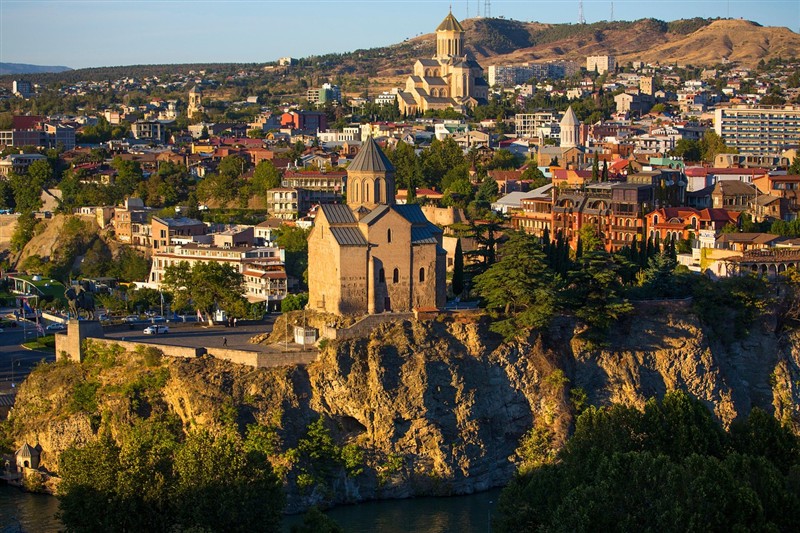
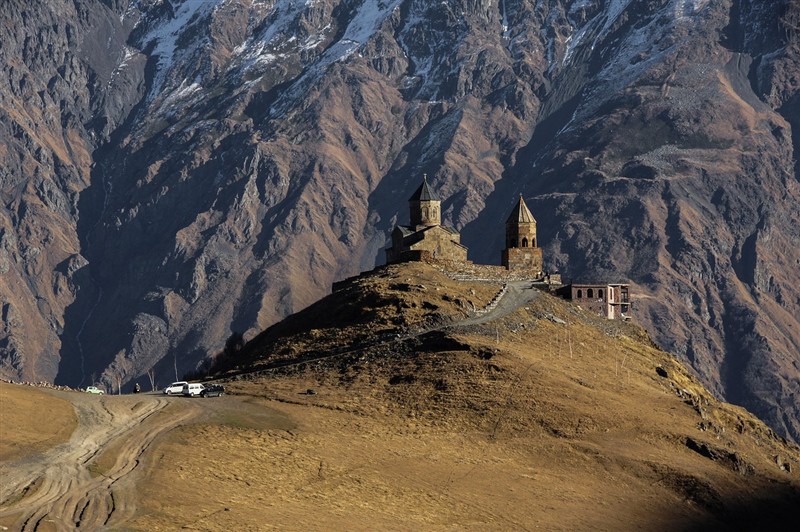
- There are also many great places to go. Tbilisi’s Old Town is beautiful, the sulfur baths are a local institution, and the mountains of Kazbegi and the wine country of Kakheti are day trips, not expeditions.

Cons
The frustrations are just as real, and the expat community is candid about them.
- Winter is the recurring complaint, on two fronts. Heating is expensive and often inadequate, and a cheap apartment with bad heating makes for a miserable January.
- Tbilisi’s winter air quality also suffers from traffic and heating emissions, which is one reason retirees often prefer higher-elevation neighborhoods like Vake and Saburtalo over the valley floor.
- Language is the other hurdle. Georgian is one of the harder languages to learn, with its own alphabet, and while English is common among younger people in central Tbilisi, it thins out fast beyond that. If you don’t pick up at least some Georgian or Russian, you may find daily life, and social life, harder than expected.
- The expat community is smaller than in Portugal or Thailand, so building a social circle takes more deliberate effort. That suits some people and isolates others. It’s worth being honest with yourself about which you are.
None of this is a dealbreaker. It’s the texture of the place. Georgia rewards retirees who want a low-cost, low-tax, slow-paced life and are willing to handle a few rough edges, and it frustrates those expecting a polished, English-speaking, all-season resort. Knowing which you’re signing up for is most of the decision.
If you’re still weighing the move itself, our guide on moving to Georgia covers the practical logistics of getting set up. This article focuses on what changes when you’re retiring rather than just relocating.
Frequently Asked Questions
Does my regular travel insurance meet the entry requirement?
It can, if it provides at least GEL 30,000 (about US$11,000) of health and accident coverage, covers your entire stay including arrival and departure dates, and can be shown in Georgian or English. Any international insurer qualifies, so you don’t need a Georgian policy. Check the coverage amount and the wording before you rely on it, and carry the documentation on your phone.
Is my pension taxed in Georgia?
No. Georgia’s territorial tax system exempts foreign-source income, and a foreign pension is foreign-source passive income under Article 82 of the Tax Code. Whether you’re a tax resident or not, your overseas pension is not taxed in Georgia. There’s also no wealth, inheritance, or gift tax.
Can I really stay a full year without a visa?
Yes. Citizens of around 95 countries, including the US, UK, Canada, Australia, and the EU, get up to 365 days per entry with no application and no minimum income. Many long-stayers reset the clock with a border run near the end of the year, but note that overstay penalties rose sharply in late 2025, so don’t cut the deadline close.
Do I need a residence permit to retire in Georgia?
Not necessarily. Plenty of retirees live in Georgia entirely on the renewable 365-day visa-free stamp. A residence permit, most commonly obtained through property ownership (minimum US$150,000 as of 1 March 2026), gives you stability and ends the border-run cycle, and after six years of continuous legal residence you can apply for permanent residence.
What if I’m over 70 and local insurers won’t cover me?
This is a real constraint. Georgian insurers commonly stop accepting new applicants at 65 to 70. The workaround is an international health plan that underwrites older applicants and pre-existing conditions, which costs more but actually covers you. Many older retirees combine cheap out-of-pocket routine care with catastrophic international cover. Read our Georgia health insurance guide for the specifics.