
This article will take approximately 22 minutes to read. Don't have the time right now? No worries. Email the ad-free version of the article to yourself and read it later!
How to apply an OIB number in Croatia for expats, covering the necessary steps, required documents, including applying for a Biometric Residence Card, and important information you need to know to make the application process simple and hassle-free.
If I had to compare the ‘OIB’ (Croatian tax identification number) to something familiar, I’d say it’s like a ‘house key‘ that you must always have with you. Without an OIB in Croatia, living becomes quite difficult, from opening a bank account, receiving salaries, buying a home, to even small matters like subscribing to a monthly internet plan.
So if you are planning to live in Croatia, whether for studying, working, investing in business, or even as a digital nomad, getting an OIB should be at the top of your to-do list from the very start. You can apply for it alongside the Biometric Residence Card.
In this article, we’ll discuss everything you need to know about the OIB, including its importance, the application process, required documents, and what to do if you lose your OIB.
Key Takeaways
- OIB is a tax identification number necessary for all transactions, such as opening a bank account, paying utility bills, buying a house, or subscribing to internet services.
- Necessary for long-term expats, investors, financial transaction handlers, business operators, and digital nomads staying longer than 12 months
- Documents to prepare include a passport, visa or residence permit (if applicable), proof of address in Croatia, OIB form, and a power of attorney if submitted through a representative
- Application process: Third-country nationals must apply at the tax office and police station, complete biometrics, pay the fee, and EU/EEA/Swiss citizens can apply online via e-Citizens and will receive an OIB within 8-14 days
- For digital nomads planning a long stay, having an OIB is useful for easily managing daily expenses, but using a digital card like Wise, Revolut, or N26 might be more convenient
What Is an OIB? Why Is It Important for Living in Croatia
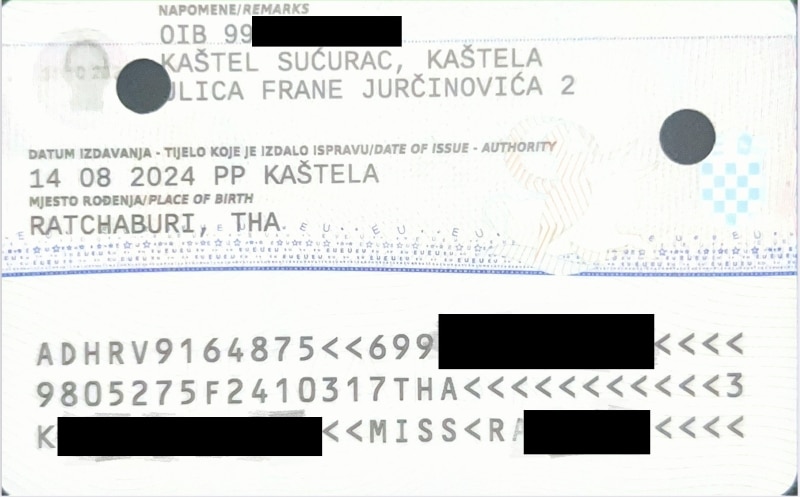
In Croatia, an OIB (Osobni identifikacijski broj) is an 11-digit taxpayer identification number issued by the Croatian tax office. It serves as a permanent identity number for both individuals and legal entities domiciled in the country, and is used for identity verification in tax, financial, legal, and important transactions. The OIB number remains unchanged even if names or addresses are altered.
Who Needs to Apply for an OIB in Croatia?
When I first moved to Croatia, I quickly realized how important the OIB is. No matter how small the task, it was requested everywhere. From activating a mobile SIM, opening a bank account, to buying a long-term bus pass, without an OIB, it was simply not possible.
I had to put all my plans on hold temporarily to quickly sort out getting an OIB. This made it instantly clear that whether you’re in Croatia to study, work, do business, or just live as a digital nomad, having an OIB is essential. It’s the key to smoothly managing your daily life.
Generally, an OIB is necessary for
- Expats residing long-term in Croatia
- Those needing to perform financial transactions, like opening a bank account, receiving a salary, or paying bills
- Those buying property or investing in Croatia
- Those running a business or registering a company
Simply put, if you plan to live in Croatia for more than a few months, you should apply for an OIB. A common question in expat forums is whether you need your residency permit in hand first. The answer is no. You can apply for an OIB as soon as you have a Croatian address, even before your residence application is finalized.
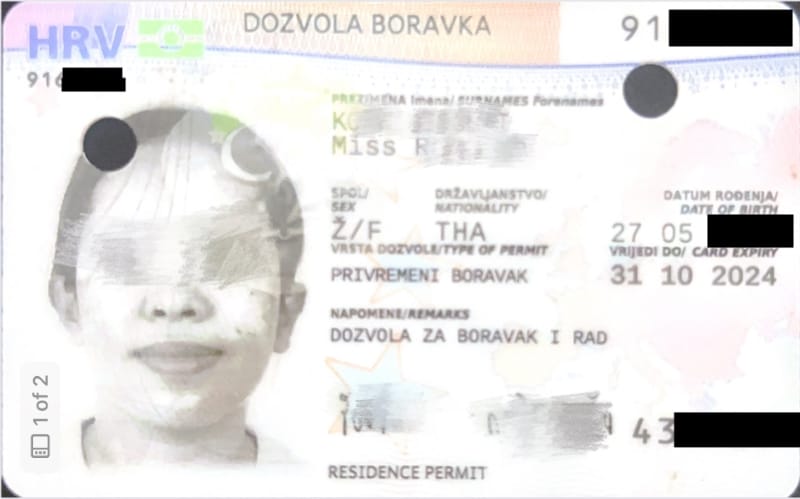
Tips: If you’re planning to stay long-term in Croatia, I recommend getting the “Biometric Residence Card” or also known as the “Permit Card” along with applying for the OIB. This card acts like an “ID card” for identity verification, helping you not to memorize the OIB number or carry bulky documents, and it also saves you from having to carry your passport frequently when doing various transactions.
What Can You Use the OIB for in Croatia?
At first, I thought the OIB might only be necessary for taxes and that you could use your passport number for other transactions. But once in Croatia, I realized that this 11-digit number is asked for much more frequently than expected and virtually becomes the key to every transaction, whether it’s finance, work, or even small everyday services.
Examples of when you need an OIB:
- Financial transactions from opening a bank account, transferring money, and other financial transactions
- Interacting with government agencies, from registering your address, contacting the tax office, and submitting documents to public offices
- Paying utility bills like water, electricity, internet, receiving salary, or working with local companies
- Purchasing a house, condo, or real estate
- Registering a company/business
- Signing up for a phone, internet, or monthly service contract
- Buying a car and registering a vehicle
- Purchasing a monthly public transport pass
What documents are needed to apply for an OIB?
Before applying for an OIB, many people might worry about the complexity or the amount of paperwork needed. However, the process is quite straightforward. The key is to prepare all the necessary documents from the start. Otherwise, you might need to make multiple trips, which is a hassle I’ve experienced myself. If you’re missing just one document, you can’t submit the application first and send additional documents later. You have to go back only once you have all the complete documents.
- A valid passport
- Visa or residence permit (if applicable)
- Proof of address in Croatia, such as a rental agreement or a registration of address at a police station (MUP)
- OIB Application Form (can be obtained at the Porezna Uprava office or downloaded OIB Application Form)
- If applying through a representative, a power of attorney in Croatian, signed and notarized, is required
What Documents Are Needed to Apply for a Biometric Residence Card?
If you want to apply for a Biometric Residence Card, additional documents need to be prepared as follows:
- (Residence Permit) Application Form (Form 1a)
- The original passport
- Proof of OIB (or it can be submitted along with the OIB application)
- Proof of health insurance
- Proof of sufficient income or assets for residence
- Photo size 30×35 mm
- Proof of purpose for residency (e.g., employment contract, education certificate)
- Certificate of good conduct from home country (if applicable)
- Receipt of fee payment, which can be pre-paid. Bank account details for payment can be found at MUP Biometric Residence Permit
How to Apply for an OIB and Residence Card (Biometric Residence Card)
Now that you know how important an OIB is for living in Croatia, next is how to apply for it. The application process isn’t complicated, but it varies depending on your status as a third-country national like Thai, Chinese, Japanese, etc., or an EU/EEA and Swiss citizen. Here’s how the process differs:
Steps to Apply for an OIB for Third-Country Nationals
For Thais, Chinese, or anyone who isn’t an EU/EEA and Swiss citizen, you need to handle matters at the Tax Office (Porezna Uprava) and the local police station
After arriving in Croatia, I sorted out registering my address, requesting an OIB, and getting a Biometric Residence Card all at once within 2 weeks. This is because the system in Croatia can be a bit slow and paper-intensive. Doing everything at once is convenient, saves time, and is easier for both us and the officials.
At that time, I chose to submit at the police station near my home because it was the most convenient. It must be the station that matches your address, otherwise, the staff will tell you it’s out of their jurisdiction, causing delays and frustration.
When submitting documents, the officer will ask to check your passport along with proof of address and payment evidence. Then, you’ll do the biometric by scanning your fingerprints. You’ll receive a small white paper to carry as temporary proof and be scheduled to pick up the real card. The timeline depends on what the officers inform you. If it’s just an OIB request, it takes about 8 – 14 days. For a Biometric Residence Card, expect around 2 – 4 weeks. Many expats report that when everything is in order, the OIB number itself is written on that temporary slip the same day; the 8-14 days refers to receiving the official confirmation document, not the number.
But if someone hasn’t paid the fee in advance, the officer will give a Revenue Stamp or Potvrda o uplati (Payment Receipt), which is red and green. You’ll need to pay at a bank or post office before you can pick up the real card.
When I used this method, I have to say it was really complicated because we had to fill out the payment form ourselves, which included entering the address, ID number, and full name. Plus, the entry fields were quite confusing with many steps, making it very time-consuming. In the end, I managed to do it, but if you want the process to go smoothly, I recommend paying the fees in advance through a bank account. You can find the account number at the Ministry of the Interior of the Republic of Croatia website. This is backed up by other expats’ experiences too: those who pre-paid via bank transfer consistently report a smoother submission, while those who paid at the counter spent extra time wrestling with the confusing Revenue Stamp payment form.
Steps to Request an OIB for EU/EEA or Swiss Citizens
For EU/EEA or Swiss citizens, it’s much easier. Applying for an OIB can be conveniently done online through the e-Citizens system, which allows you to submit your request without having to go to the office in person. If you have a working e-Citizens account, you can visit the website e-Citizens Platform for EU/EEA Citizens and select Electronic PIN (OIB) assignment. Then, follow the steps in the system, fill out the personal information and required documentation. That’s it, you’ll receive the OIB within 8 – 14 days.
It’s important to note that applying for an OIB through the e-Citizens system will not get you a Biometric Residence Card. You’ll only receive an 11-digit OIB number, which is okay for EU/EEA or Swiss citizens since you already have an EU citizen ID card and can live normally. But if you want a Biometric Residence Card, you can apply following the same procedure as third-country nationals.
2026 Update: Croatian Language Test for Renewals
Croatia’s amended Law on Foreigners came into force on June 4, 2026, and it changes the renewal rules for third-country nationals on a work and residence permit. After your first year in Croatia, you now have to pass a basic A1.1 Croatian language and Latin-script exam to renew the permit.
The exam is standardized and your employer pays for it. Seasonal workers are exempt.
In addition to that, a decision on a residence and work permit from the authorities can now take up to 90 days, so file your renewal well ahead of expiry rather than at the last minute.
Fees
Last updated in 2026, the application for an OIB is free. However, if you need a Biometric Residence Card, the standard fee is €31.85, while the urgent fee is €59.73 and the card issuance fee is €9.29. Having this card makes life much easier as you won’t need to remember your OIB number or carry bulky documents. Plus, you won’t have to frequently use your passport. It’s definitely more convenient.
OIB Application Tips
From my own experience, these are a few small tips to make the process of applying for an OIB and Biometric Residence Card much smoother. Start by going early, as the Porezna Uprava office or the police station often has long queues. Arriving late might mean waiting a long time and wasting a lot of time.
I personally have waited from 09:00 until just 5 minutes past the employee’s break time at 11:15, and they wouldn’t continue helping. It’s that European work-life balance style. I was quite frustrated because I had to queue and wait. It’s not the modern queue system we’re used to in Thailand, and I ended up having to return a week later. Let’s just say the system isn’t very stable or up-to-date.
Another thing is to prepare copies of documents because officials often ask to keep copies, such as your passport, proof of address, or payment receipts. Having these copies ready in advance will speed up the process and save you from having to make copies there, as time is quite limited and there are long queues. If you’re missing something, you’ll just have to start the queue all over again.

Finally, when I went to request documents, my main purpose was for work. The police will either call in our employer or have the employer submit the application on your behalf. However, the employer doesn’t need to bring any documents; they just need to show up in person so the officer can verify their identity and ensure that the process is legally correct.
Additionally, when applying for any documents at the police station, it’s advisable to have an interpreter who speaks Croatian with you. Even though some stations might have officers who speak English, in typical European working style, officers often focus strictly on their own duties and will not assist with translation or provide additional guidance. Having an interpreter can reduce confusion and make the process much smoother.
A little tip: When you go to the tax office or MUP, don’t forget to smile and try to say ‘Hvala’ (thank you) to the staff every time. From personal experience, the staff can be much nicer than you think
Precautions When Applying for an OIB for Expats
Even though applying for an OIB isn’t too complicated, we expats should pay attention to small details that might delay or unnecessarily reject the application. A common issue is mismatched address information between the house lease agreement, the address registration from the police station, and the documents filled out in the OIB form. Any discrepancies, even a single wrong digit in the address or a misspelled street name, might get your application denied straight away, because the OIB is a permanent number used to link with government data. So, before submitting documents, make sure everything matches 100% including the name, address number, and postal code.
I personally had a close experience where a friend filled in the OIB number wrong when paying with a Revenue Stamp, resulting in unusable documents that had to be purchased again, and importantly, they couldn’t get a refund. When it came time to submit, the official found the numbers didn’t match, so the whole process had to be done again, wasting both time and money.
For anyone who already has an OIB but later finds the address information incorrect or has moved, you can directly notify the tax office to make corrections. There’s no need to apply again as the OIB is a permanent code and cannot be changed or duplicated.
Because of this, many people including myself choose to use an agent or broker service to help prepare documents to ensure completeness and accuracy. I once had a law office handle the documents, and all we had to do was submit them and sign the necessary paperwork. But if I couldn’t submit it myself, I’d need a letter of power of attorney made in Croatian and properly notarized. It’s important to always keep copies of documents and the power of attorney to prevent problems that may arise later.
What to Do if You Lose Your OIB or Biometric Residence Card?
Both of these documents are essential and should be carried at all times. But if your Biometric Residence Card goes missing, the first thing to do is to report it to the nearest police station (MUP) immediately, as once reported, the old card will be invalidated and cannot be used again. Then, you need to apply for a new card, preparing the documents and following the same steps as when you first applied.
In case your OIB document is lost, if you remember the 11-digit number, it’s not a big issue, but you should report it to prevent potential issues. You can request a new OIB confirmation document at the police station or tax office, and the OIB number will always remain the same and cannot be changed. It is often printed on your Biometric Residence Card or health insurance card, so if you still have those, they can be used in daily life as a substitute.
Do Digital Nomads in Croatia Need an OIB?
For anyone planning to come to Croatia as a digital nomad, a common question that arises is, “Do I need to get an OIB?” This is because many people do not work directly with local companies, and all their income comes from abroad.
From my experience, if you’re not staying long, you might not necessarily need it because you can still use credit/debit cards from your home country to pay for daily expenses. You’ll just have to pay high foreign transaction fees. But if you’re planning to stay for a long time, especially over 12 months and pursuing permanent residence, having an OIB is almost essential. It’s used for everything from paying utility bills, rent, and internet, to purchasing monthly public transport passes. In Croatia, you’ll be asked for an OIB at almost every step.
However, nowadays there’s a very convenient option for modern nomads: using digital cards like Wise, Revolut or N26. These help reduce fees and make international money management much easier. You can pay for goods and services or even transfer money to an account in Croatia without relying on local banks all the time.
Frequently Asked Questions
Can I apply for my Croatian OIB before I arrive in the country?
Yes. You can email a completed OIB application form with a scanned copy of your passport to [email protected], or apply through a Croatian embassy or consulate abroad. This gets your tax number sorted before you land, though you’ll still need to show up in person once you’re in Croatia to register your address and complete the Biometric Residence Card process. If you’re still finalizing your move, our guide to moving to Croatia covers what else to line up before departure.
Do children and minors need their own OIB?
Yes. Any minor involved in an official process in Croatia, such as being added to a health insurance policy, enrolled in school, or named as an heir to property, needs an OIB of their own. A parent or legal guardian applies on the child’s behalf with the child’s passport and a notarized power of attorney or proof of guardianship, following the same representative rules as an adult applicant.
What’s the actual difference between the OIB and the Biometric Residence Card?
The OIB is an 11-digit tax number. The Biometric Residence Card is a physical ID card that displays that number along with your photo and fingerprint data. You can have an OIB without a residence card, EU/EEA/Swiss citizens usually do, since they already carry an EU ID, but you can’t get a residence card without first having, or applying for, an OIB.
Does the OIB expire or need to be renewed?
No. The OIB is permanent and never changes, even if you move house, change your name, or switch visa categories. Only the Biometric Residence Card itself expires and needs renewing, on the schedule tied to your specific residence or work permit.
Do retirees moving to Croatia need an OIB the same way as workers do?
Yes. Retirees need an OIB to register a foreign pension deposit with a Croatian bank, enroll in the health insurance system, pay property tax if they buy a home, and handle the same daily transactions everyone else does. Our guide to retiring in Croatia covers the residence permit route retirees typically use alongside the OIB application.
Can I use my foreign bank card or withdraw cash in Croatia before I have an OIB?
Yes. Croatian ATMs accept foreign-issued debit and credit cards without requiring an OIB, so you can cover cash needs while your paperwork is in progress. You’ll only run into a wall once you try to open a local account, since Croatian banks require an OIB before they’ll issue one. See our guide to using ATMs in Croatia for fee and withdrawal-limit details.
If I qualify for Croatian citizenship by descent, do I still need to apply for an OIB separately?
Yes, at least initially. Citizenship by descent is a separate legal process from the OIB system, and you’ll typically still need an OIB during the application period for identity verification and any transactions you make while your citizenship case is pending. Once citizenship is granted, you keep the OIB you already had. Read more in our guide to Croatian citizenship by descent.
Can I register a car or sign a phone contract before my physical residence card arrives?
In most cases, yes. Once you have the OIB number, whether on the temporary slip issued the day you apply or on the confirmation document that follows, you can use it for most transactions, including phone and utility contracts. Vehicle registration and a few bank processes sometimes ask to see the physical Biometric Residence Card as photo ID, so check with the specific office before you rely on the slip alone.
Sources Cited
- Ministry of the Interior of the Republic of Croatia (MUP) – Biometric Residence Permit: Official primary source confirming the current Biometric Residence Card fees (31.85 EUR standard, 59.73 EUR urgent, 9.29 EUR card issuance) that the article states in its Fees section.
- Porezna uprava (Croatian Tax Administration) – Allocating and assigning of OIB to foreigners: Official primary source confirming that OIB applications for foreigners are free and can be submitted by email ([email protected]) before arriving in Croatia, used to verify the Fees section and write a new FAQ answer.
- Narodne novine (Official Gazette) – Zakon o strancima (Law on Foreigners) amendment, NN 55/2026: Primary legal text confirming the A1.1 Croatian language test requirement (Article 92.a) for permit renewal after one year, employer-paid, and the extended 90-day permit decision window cited in the article’s 2026 Update section.





 Deutsch:
 Français:
 Español: